Even when ancient Greek city-states spent centuries locked in perpetual conflict, certain principles governed their lives. One of them was Xenia – derived from xenos, meaning stranger – the sacred rule of hospitality. A host owed protection to a guest. To mistreat a visitor was not merely rude; it risked inviting the wrath of a god disguised as a stranger.
Often associated with Zeus himself, Xenia was not simply a moral virtue but a political obligation. Its violation was seen as evidence not only of cruelty but of defective virtue.
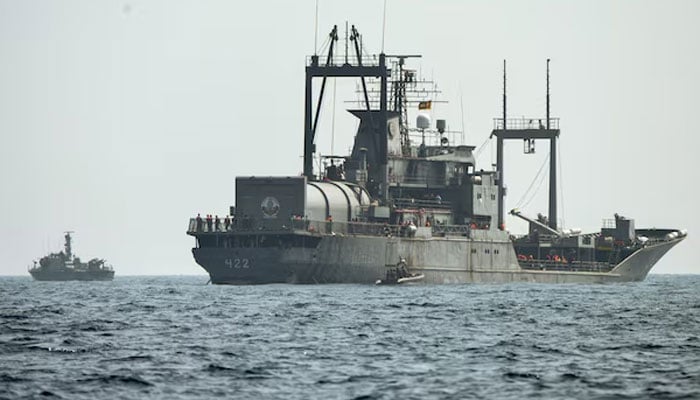
On February 17, the Eastern Naval Command of the Indian Navy took to X to welcome IRIS Dena to Visakhapatnam, where India was hosting a naval drill. Roughly two weeks after departing the Bay of Bengal, the same vessel was sunk by torpedoes in international waters. With the vessel also sank Modi’s narrative of the Indian Navy being a guardian of the Indian Ocean. A lesson for the Indian Navy perhaps: for a guardian to exist, the ward must too. More so, a lesson for those studying narrative politics: state your narrative and have your ministers walk it back after an accident. To put it in Jaishankar’s words after Dena’s sinking, the Indian Ocean is not limited to Indian jurisdiction.
Even though Dena sank near Sri Lankan waters and Sri Lanka acted as the first responder, India’s obligation did not simply evaporate at the shoreline. Hospitality does not end at the harbour gate, nor at the outer limits of an economic zone. Once a guest has been welcomed, the responsibility travels with them – at least until they are safely on their way home. India’s over twenty-four-hour silence post the sinking, therefore, raises a troubling question: whether it has failed not merely on diplomatic fronts but in upholding one of the oldest codes of conduct known to civilisation.
History is full of hosts who betrayed their guests. Rarely has it ended well for them.
In Homer’s Odyssey, the Cyclops Polyphemus receives Odysseus and his men in his cave, only to trap them inside and devour some of them raw. In 1440, the Sixth Earl of Douglas and his brother were invited to dine with King James II of Scotland, only to be beheaded after supper in what history remembers as the ‘Black Dinner’. In 1811, Muhammad Ali of Egypt invited the Mamelukes to a grand procession in Cairo, served them coffee and sweetmeats, and had them massacred in a narrow gateway.
The violation of Xenia promised wrath, and for all those who betrayed their hosts, the sinister consequences arrived in one way or another. Much like winter came for House Frey after the Red Wedding, Polyphemus was blinded by Odysseus and his men. The massacre of the Mamelukes secured Muhammad Ali’s power but left a legacy stained by treachery – his dynasty would later fracture and fade as Abbas was murdered by his own slaves. King James – II of Scotland, died 19 years after the Black dinner with an explosion of his own cannon.
What awaits India remains to be seen. But history has never been kind to those who forget that hospitality is a covenant, not a photo opportunity.
Beyond mythology and history, however, lies something far more concrete: international humanitarian law. India’s response, or lack thereof, to the sinking of the Dena also raises serious questions under the Second Geneva Convention, the treaty governing the treatment of wounded, sick and shipwrecked members of armed forces at sea. The convention places a clear responsibility on contracting states to search for and rescue shipwrecked persons, regardless of whether they are parties to the conflict. Those found must be protected, treated humanely and given medical assistance.
Article 18 obliges parties to a conflict to take ‘all possible measures’ to search for and collect the shipwrecked after an engagement, while additional provisions extend similar obligations to neutral powers. In simple terms, the law of the sea, like the ancient code of hospitality, demands that human life take precedence over politics – regardless of participation in conflict.
When even neutral states begin treating these obligations as optional, the entire system of humanitarian law frays.
If a naval vessel can be sunk and those nearby respond with silence rather than rescue, the precedent is dangerous. The argument that India did respond to distress signals but only hours after Sri Lanka had and therefore is not complicit in Dena’s drowning suffers not only from logical fallacy, as distress signals were sent to surrounding nations at the same time, but also from a fundamental attribution error – the silence was undoubtedly external.
International law survives because states – especially powerful ones – choose to uphold it even when they have little to gain, not because it is convenient. This piece does not attempt to litigate the US’s role in the sinking of the Dena. Its violations of international law are neither novel nor likely to be the last. The more instructive question is what follows when rising powers like India begin adopting the same indifference: treating international law as a suggestion rather than a rule, whatever the motives or excuses.
Sri Lanka may well deserve praise for tending to those wrecked from the Dena – after all, it was simply upholding the basic obligations of the law of war at sea. At the same time, India’s refusal to comment begs the question of whether it’s just silence in mourning for civilian loss of life or silent complicity in Dena’s drowning in the first place to advance strategic interests. Alternatively, the formal Indian naval chief’s comment, “If it is a surprise, then that’s a great concern since we have a so-called strategic partnership with the USA”, may shed light on India’s future hosting capacity.
Betrayal for personal gain is an age-old tale. In the Bible, Judas Iscariot betrayed Jesus by disclosing his whereabouts for thirty pieces of silver – a personal gain that set in motion one of history’s most infamous acts of deceit.
Why must the Horn Effect cast over India’s intentions or complicity in the Dena tragedy? Simply because it would also not be the first time that India has betrayed Iran for personal gain. In 2005, India voted against Iran at the International Atomic Energy Agency – a decision widely seen as a prerequisite for India in securing the Indo-US nuclear agreement. At the time, Iranian official Ali Larijani remarked with evident disappointment: “India was our friend.”
Two decades later, Larijani has lived long enough to serve as the current secretary of the Supreme National Security Council of Iran and witness what many may view as a second Indian betrayal. Whether his opinion of India-Iran friendship had changed following Chabahar or diplomatic support in international forums is uncertain. The only certainty we have is history, which suggests that when hospitality is broken – whether in myth, law or diplomacy – the consequences rarely remain confined to the moment.
And the wrath that follows has a habit of becoming history.
The writer is a lawyer.













![Epistemology Of The Quran [Part - II]](https://www.thenews.pk/assets/uploads/akhbar/2026-03-13/s_1404153_020045_updates.jpg)


![Epistemology Of The Quran [Part - I]](https://www.thenews.pk/assets/uploads/akhbar/2026-03-12/s_1403968_020112_updates.jpg)