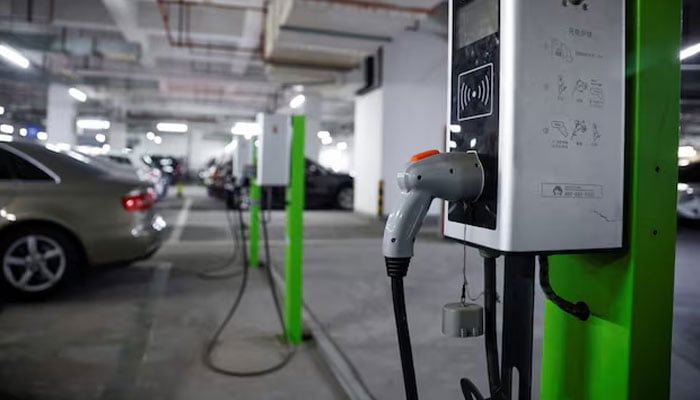
KARACHI: The Oil Companies Advisory Council (OCAC) has raised concerns over mandatory electric vehicle (EV) charging requirements at petroleum retail outlets, proposing the withdrawal of the compulsory linkage between K-Form issuance and the provincial condition of 10 per cent EV charger availability. It also called for a review of directives that make the installation of EV chargers a precondition for the approval of new retail outlet layouts.
Highlighting commercial and operational challenges faced by oil marketing companies (OMCs) under the government’s New Energy Vehicles (NEV) policy, the OCAC reiterated its support for the government’s long-term vision for cleaner energy, environmental sustainability and the transition towards NEVs. However, it noted that OMCs, which are expected to implement EV charging infrastructure at retail outlets, were not involved during the policy formulation stage.
In a letter to Minister for Petroleum Ali Pervez Malik, the council said the NEV policy was initiated primarily by the Ministry of Climate Change, with implementation envisaged at multiple locations, including petroleum retail outlets.
While a special electricity tariff of Rs38.9 per unit has been approved for EV charging stations, clarity regarding customs duties and other fiscal incentives for NEV vehicles remains under consideration and is expected to be finalised in the fiscal year 2026.
OCAC noted that the policy target of achieving 10 per cent NEV charging availability at retail outlets by 2030 does not correspond with current market realities. As of November 2025, around 2,700 to 3,000 electric vehicles were operating nationwide, compared with the projected target of 125,000 vehicles.
The council said installing a single Level-3 charging station requires an estimated capital investment of Rs15 million to Rs20 million, excluding the cost of transformers and cabling, largely due to the need for high-capacity grid connectivity and backup power arrangements.
Currently, about 15 charging stations have been established by OMCs across the country. However, only a few have achieved breakeven, while most continue to operate at a loss due to low utilisation levels.
The OCAC also highlighted implementation challenges, including delays in the issuance of no-objection certificates (NOCs) by some deputy commissioners, the linkage of K-Form issuance with Level-3 charger requirements, and directions in certain jurisdictions to withhold approval of new fuel station layouts unless EV chargers are included.
The council observed that global trends show EV charging is largely carried out at residential premises, commercial complexes, hospitals, parks and shopping malls, where vehicles remain parked for longer periods. In contrast, petroleum retail outlets are designed for quick service turnover, limiting the commercial viability of high-capacity charging infrastructure at the current stage of EV market development.
The OCAC called for the formulation of a phased, demand-driven and commercially sustainable implementation framework in consultation with all stakeholders, including the Ministry of Climate Change, the Ministry of Energy (Petroleum Division), Ogra, the National Energy Efficiency and Conservation Authority and oil marketing companies.
The council said that once a viable EV population and an enabling fiscal framework are in place, OMCs will expand charging infrastructure on sound commercial principles, similar to their experience with alternative fuels such as compressed natural gas.