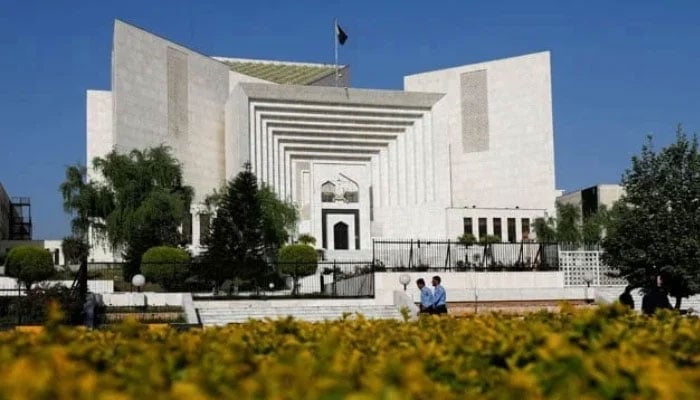
ISLAMABAD: The Supreme Court has acquitted a father accused of poisoning his son, ruling that it is ‘unnatural’ to presume that a father would administer poison to his son.
A three-member bench of the apex court, headed by Justice Muhammad Hashim Khan Kakar and comprising Justice Salahuddin Panhwar and Justice Ishtiaq Ibrahim, issued the judgment in an appeal filed against Sindh High Court judgment in Sultan alias Babo Jatoi versus the State.
After accepting Babo Jatoi’s appeal, the court acquitted him, set aside his conviction and death sentence, and ordered his release if not required in any other case. The case arose from the August 2019 death of four-year-old Mudassir alias Meethu in Sukkur from alleged poisoning, for which his father, Sultan alias Babu Jatoi, was accused by the child’s maternal uncle, who registered a case at Sangi Police Station. The Additional Sessions Judge-III, Sukkur, convicted him under Section 302(b) PPC and sentenced him to death as Tazir, a decision later upheld by the Sindh High Court’s Sukkur Bench, which answered the murder reference in the affirmative.
“The bond between a parent and child is founded upon affection, protection and sacrifice,” says the six-page judgment authored by SC Justice Ishtiaq Ibrahim. The court held that, in the absence of compelling evidence of strained relations, denial of paternity, or some other grave motive, it is wholly unnatural to presume that a father would administer poison to his minor son, ‘particularly in the presence of relatives’. “It is an admitted position that the petitioner was the biological father of the minor deceased and had been living with him since birth,” says the judgment, adding that in our societal and moral framework a father is regarded as the natural protector, guardian and well-wisher of his children.
The court also held that the prosecution brought no material on record suggesting any enmity between the spouses, any suspicion regarding the child’s paternity, or any other circumstance that could provide a motive for such an extreme act. “Upon independent appraisal, we find that the prosecution evidence is fraught with material contradictions, improvements, unexplained delay in lodging the FIR, absence of motive, and a medical opinion consistent with accidental ingestion,” the court held. “These circumstances cumulatively create reasonable doubt in the prosecution case,” says the judgment, adding that it is a cardinal principle of criminal law that if a single circumstance creates reasonable doubt in the mind of a prudent person regarding the guilt of the accused, he is entitled to its benefit, not as a matter of grace or concession but as a matter of right,” the court ruled. The court held that the courts appear to have overlooked these material infirmities and did not appreciate the evidence in its true perspective.
The Supreme Court noted that in the house pesticides were kept stored for the cotton crop and the child could have drunk it himself. Referring to the medical report, the judgment said “a four-year-old child cannot distinguish between poisonous and drinkable substances.” The court noted that Dr Tanveer Hussain (PW-5), in clear terms, conceded during cross-examination that it was possible for a child of four years to consume poison on his own, mistaking it for a drink, and that a child of such tender age lacks the capacity to differentiate between a harmful substance and potable liquid. In such circumstances, the possibility of accidental ingestion cannot be excluded, the judgment read.
The court noted a serious contradiction between the doctor’s and witnesses’ statements regarding the colour of the child’s clothes, adding that the witnesses’ failure to search the room or check the container makes their presence doubtful. It also observed that the eyewitness accounts contain contradictions and appear unnatural, with no convincing explanation for their presence at the scene. The court held that the testimony of such witnesses requires cautious scrutiny, noting that in the absence of a plausible explanation. The court held that “under criminal law, even a single doubt entitles the accused to acquittal.”
Meanwhile, the Supreme Court (SC) on Monday dismissed as withdrawn, a petition seeking cancellation of the bail of accused Bangal Khan in a case related to the kidnapping of a government employee for not paying extortion, and ordered the trial court to decide the case within two months.
A two-member SC bench, headed by Justice Muhammad Hashim Khan Kakar and comprising Justice Ishtiaq Ibrahim, heard the case. During the hearing, Justice Ishtiaq Ibrahim addressed the accused Bangal Khan and said: “What do you think of this country? You have started kidnapping government employees.”
The lawyer for the complainant, Samiullah, informed the court that Bangal Khan is accused of kidnapping a government employee in Qila Saifullah, and that 18 other kidnapping cases are also registered against him. He submitted that at the time of his arrest, a five-hour long encounter took place between the accused and the police. He told the court that the abducted government employee’s vehicle and a hand-grenade were also recovered from his house. The lawyer added that the accused is a very influential person and has connections with politicians.
Justice Hashim Kakar questioned as to how the accused managed to survive if the firing continued for five hours. Later, the court allowed the complainant to withdraw the petition for cancellation of bail and directed the trial court to decide the case within two months. The court further stated that if the accused misuses the bail, the complainant may approach the court again for cancellation of bail.
Meanwhile, the same bench also heard a case regarding post-arrest bail application filed by accused Ghulam Ghaus alias Shakir in a case involving the fraud of taking millions of rupees from a citizen by promising to send him to Greece.
The court adjourned the case until March 16 after counsel for the accused sought time for preparing the case. Justice Hashim Kakar asked how much money the accused had received from the victim. The complainant’s lawyer replied that the accused had taken Rs1.75 million on the pretext of sending the person abroad.
In response to the court’s question, the affected citizen said he had paid the money to go to Greece. The judge remarked that even if he had gone to Greece, he would have remained wandering and struggling. He advised that since he is a young man, it would be better to stay in his own country and work hard, noting that many people lose their lives while attempting to travel illegally by boats.
The complainant’s lawyer further stated that the accused neither sent the citizen abroad nor returned the money, adding that the cheques given for repayment were also dishonoured, and separate cases have been registered regarding those cheques. The accused’s lawyer argued that this was his first case before the Supreme Court and requested time for preparation. The court then adjourned the hearing of the case until next Monday.