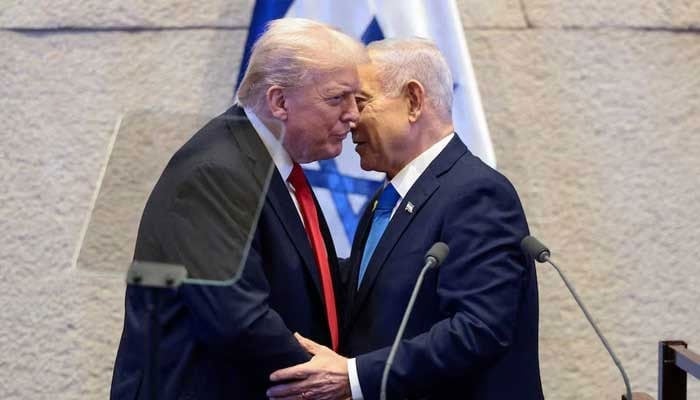
WASHINGTON: Israeli Prime Minister Benjamin Netanyahu delivered a startling revelation to President Trump last Monday — Iran’s supreme leader, Ayatollah Ali Khamenei, and his top advisers were scheduled to meet in Tehran on Saturday morning (Feb 28), a tip reported by Axios.
Netanyahu informed Trump that this presented a rare and invaluable opportunity to strike, suggesting that all of them could be eliminated in a single, devastating airstrike. The call, made from the White House Situation Room and kept under wraps until now, marked a pivotal moment that would set the stage for the onset of the Iran war. The timing was critical, as Khamenei and his inner circle became prime targets neither Trump nor Netanyahu could afford to ignore.
Before receiving this new intelligence, Trump had already been leaning toward striking Iran. However, he had not decided when the attack would take place until Netanyahu called. The February 23 call was part of months of intensive coordination between the two leaders. They met twice and spoke by phone 15 times over the two months leading to the war, according to U.S. and Israeli officials. Although the U.S. and Israel had considered launching the strike a week earlier, the operation had been postponed due to intelligence and operational reasons, including bad weather.
An initial CIA check, conducted at Trump’s direction, confirmed the information about Khamenei, which had been gathered by Israeli military intelligence. With this confirmation, preparations accelerated, but Trump chose to wait until after the president’s State of the Union address the following night before making a final decision. U.S. officials stated that Trump made a deliberate decision not to focus excessively on Iran in his speech to avoid spooking Khamenei and driving him underground before the attack could be carried out. By Thursday, the CIA had fully confirmed that Khamenei and his advisers would all be together, and U.S. officials decided to seize the opportunity.
On the same day, Trump’s envoys Jared Kushner and Steve Witkoff called from Geneva after hours of talks with Iranian officials. They delivered a blunt verdict: the negotiations were going nowhere. A U.S. official with direct knowledge of the call stated that Trump was told, “If you decide you want to do diplomacy, we will push and fight to get a deal. But these guys showed us they weren’t willing to make the deal you will be satisfied with.” At this point, Trump was convinced that the intelligence was solid, and that diplomacy had failed. On Friday (Feb 27) at 3:38 p.m. EST, he gave the final order for the strike. Eleven hours later, bombs fell on Tehran, Khamenei was killed, and the war had begun.
Behind the scenes, Trump had viewed Netanyahu as a close partner and had genuinely been open to his counsel on Iran. However, Trump was equally determined to exhaust all diplomatic avenues before moving forward with military action. U.S. officials explained that while one side of the house was negotiating, the other side was involved in joint military planning with Israel. Trump was assessing both approaches simultaneously.
Secretary of State Marco Rubio, under fire for suggesting the U.S. had been dragged into the conflict by Israel, insisted that the operation had to happen anyway, and that it was simply a question of timing. Rubio stated, “This weekend presented a unique opportunity to take joint action against this threat. We wanted this to have maximum success.” An Israeli official noted that Trump had wanted to strike earlier, in early January, but Netanyahu had asked to delay. The timing was fully coordinated with the understanding that the operation would be carried out jointly.
The original plan had called for a strike in late March or early April, giving the administration time to build public support. However, Netanyahu pushed to move faster, and a U.S. official explained that Netanyahu began “agitating” and warning that Iranian opposition leaders sheltering in safe houses were at risk of being killed by the regime. This accelerated timeline left the administration flat-footed. Instead of spending weeks building the public case for war, the White House found itself justifying the strikes after the bombs had already fallen. One official admitted, “We didn’t make the case in advance as well as we could have because the opportunity came on us so fast.”
Because Trump and Netanyahu disguised their Saturday attack, many U.S. citizens were caught completely unaware when Iran launched retaliatory strikes across the Gulf. Rubio’s State Department scrambled to mount an emergency evacuation effort for more than 1,500 Americans who requested assistance getting out of the region. When asked by reporters why there was no evacuation plan, Trump replied, “Well, because it happened all very quickly.”