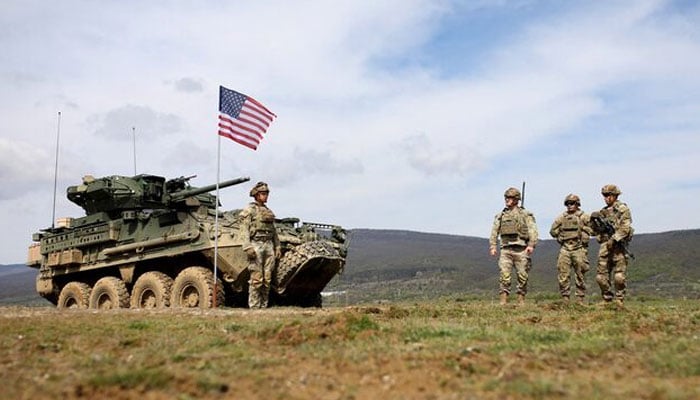
LAHORE: The United States has been at war for approximately 215 of 250 years since its founding in 1776, according to research conducted by Jang Group and Geo Television Network.
This means United States — whose defence budget rose from $534 billion in 2016 to $838.7 billion by 2024 — has been at war for more than 86 percent of its existence. Critics argue the country’s leadership has become heavily reliant on military power, emboldened by repeated successes against weaker nations unable to defend themselves. In other words, United States has experienced only about 35 years of peace in its history.
According to Journal of Conflict Resolution, an American bimonthly academic publication, half of these military operations have taken place since 1950.
The history of American overt and covert foreign interventions dates back to 1811, when it reportedly invaded Chile, shortly after South American country gained independence from Spain. An American federal agent, Joel Roberts, visited Chile to assess revolutionary prospects during the war against the Spanish Empire.
This marked beginning of what would eventually become more than 400 foreign military campaigns by a nation that later emerged as world’s leading superpower.
(References cited include Cambridge University, The Baltimore Sun, and GlobalSecurity.org)
In October 2017, US Congressional Research Service documented 392 American military interventions. By March 2026, this number had reportedly exceeded 400.
This figure has also been cited by The Catholic University of America, founded in 1887 by Pope Leo XIII and American bishops.
Data from The Catholic University of America shows: 39 foreign interventions from 1800–1849; 47 from 1850–1899; 69 from 1900–1949; 111 from 1950–1999; 126 from 2000–2017.
Since 2017, US foreign interventions have included counterterrorism operations in Middle East and Africa, along with increased pressure on Venezuela and Iran. Key actions have included drone strikes, special operations raids, and naval deployments under Trump and Biden administrations.
Between 2017 and 2026, operations continued in Syria and Iraq, along with shifting involvement in Yemen. In Afghanistan, despite a troop surge in 2017, airstrikes continued until US withdrawal.
In Venezuela, pressure increased on President Nicolás Maduro’s government through sanctions and alleged naval and air blockades. Reports in early 2026 indicated a major unauthorised intervention leading to Maduro’s removal.
The administration of Donald Trump (2017–2021) heightened tensions, including 2020 killing of Qasem Soleimani. Reports in 2026 also indicated joint US-Israeli strikes in Iran.
While President Trump’s tenure saw an expanded range of targets, adding Iran and Venezuela to ongoing conflict zones, George W. Bush had earlier initiated operations in Afghanistan, Iraq, Pakistan, Somalia, and Yemen. Under Barack Obama, interventions expanded to include Libya and Syria. Joe Biden maintained military pressure in Afghanistan, Iraq, Somalia, Syria, and Yemen.
On November 23, 2017, Channel 4 News published research conducted by Institute for Politics and Strategy at Carnegie Mellon University in Pittsburgh.
According to that research, there were 117 “partisan electoral interventions” worldwide between 1946 and 2000 — roughly one in every nine competitive elections during that period. Nearly 70 percent of these interventions were attributed to United States.
Notably, 21 such interventions occurred between 1990 and 2000, 18 of them by US, targeting 60 independent countries.
Channel 4 News further reported nearly two-thirds of these interventions were conducted secretly, without voters’ knowledge. Countries where secret US tactics were reportedly used included Guatemala, Brazil, El Salvador, Haiti, Panama, Israel, Lebanon, Iran, Greece, Italy, Malta, Slovakia, Romania, Bulgaria, Albania, Sri Lanka, the Philippines, South Vietnam, and Japan.
For Russia, the list of alleged covert interventions included France, Denmark, Italy, Greece, West Germany, Japan, India, Pakistan, Bangladesh, Congo, Venezuela, Chile, Costa Rica, and even United States.
Meanwhile, The National Interest reported in 2017 United States conducted 46 military interventions between 1948 and 1991. From 1992 to 2017, that figure reportedly quadrupled to 188. The publication questioned why interventions increased even as their success rate appeared to decline, and why they continued to rise after Cold War ended.
According to The Washington Post, by December 2016, the United States had attempted to change foreign governments 72 times during the Cold War.
The newspaper wrote between 1947 and 1989, US undertook 72 regime-change efforts — 66 covert and six overt — often in contexts where Soviet Union was supporting anti-US forces.
The Washington Post also examined declassified CIA documents and historical research, identifying 27 clandestine US operations between 1949 and 2000. Many of these “secret wars” targeted democratic states.
Documents published by US National Security Archive at George Washington University revealed British assistance in the 1953 overthrow of Iran’s democratically elected Prime Minister Mohammad Mosaddegh, along with efforts to suppress information about the coup.
The newspaper further noted in 1954, a CIA-trained and armed anti-Communist force removed Guatemala’s democratically elected President Jacobo Árbenz Guzmán, leading to years of civil war and right-wing rule. In 1981, President Ronald Reagan authorised funding for CIA-led covert operations against Nicaragua’s democratically elected government.
These examples represent only a portion of documented US covert operations abroad.