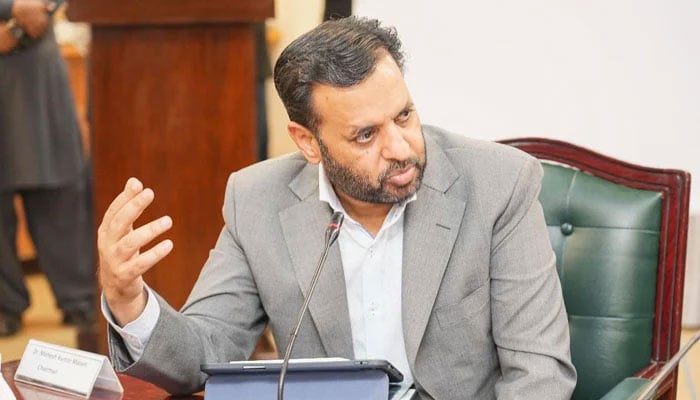
ISLAMABAD: Members of the National Assembly’s Standing Committee on National Health Services reviewed the proposed Pakistan Nursing and Midwifery Council (PNMC) ordinance during an in-camera meeting on Tuesday, with some lawmakers proposing the inclusion of parliamentarians in the council, a move strongly opposed by Federal Health Minister Syed Mustafa Kamal.
The closed door meeting, chaired by Dr Mahesh Kumar Malani at Parliament House, examined various aspects of the ordinance aimed at restructuring the PNMC, the statutory body responsible for regulating nursing education, accreditation of institutions and registration of nurses and midwives in the country.
According to sources present in the meeting, several members of the committee suggested that parliamentarians should be included in the PNMC to ensure stronger oversight and transparency in the functioning of the regulatory body.
However, Health Minister Kamal opposed the proposal and told the committee that the inclusion of parliamentarians in the council would not be appropriate.
Instead, he suggested that parliamentary oversight of the nursing regulator should be exercised through the relevant standing committees of the National Assembly and Senate rather than by placing lawmakers directly in the council responsible for regulating the profession.
Sources said the minister argued that professional regulatory bodies should primarily consist of experts and professionals from the relevant fields, while elected representatives should exercise oversight through parliamentary mechanisms.
The in-camera session began with the confirmation of the minutes of the previous meeting, after which the committee members undertook a detailed review of the PNMC ordinance and its key provisions.
Lawmakers expressed concerns over certain aspects of the proposed law and stressed the need to ensure transparency, professional standards and accountability in the regulation of the nursing profession.
Following the meeting, Kamal told reporters that serious problems had existed within the nursing regulatory system in the past and reforms were necessary to address them.
“There was a complete mafia sitting in the nursing council,” he said, adding that some elements involved in exploitation had operated within the system for years.
He said the government was determined to eliminate vested interests from the regulatory framework and introduce reforms aimed at strengthening the nursing sector.
“We do not want people with vested interests to have an upper hand in the system,” the minister said.
Kamal also highlighted the acute shortage of nursing professionals in Pakistan, saying the country requires around 900,000 nurses to meet the needs of its healthcare system.
He noted that the shortage of nurses was a global challenge as well, with the world currently facing a deficit of around 2.5 million nurses.
The minister said the government had approached the proposed legislation with great care and caution in order to reform the sector and improve the quality of nursing education and regulation.
“The condition of the entire nursing sector had deteriorated badly over the years,” he said, adding that reforms were necessary to ensure better training and regulation.
“The objective of the new legal framework is to ensure that graduates from nursing colleges, recognised by the council, receive training that meets international standards and are able to compete globally,” he added.
The committee members decided to continue consultations on the ordinance and review its provisions further before moving ahead with the legislative process.
The PNMC serves as the national regulatory authority responsible for setting educational standards, accrediting institutions and registering nurses and midwives across the country. Officials say the proposed reforms are aimed at strengthening governance, improving training standards and addressing the country’s growing shortage of nursing professionals.