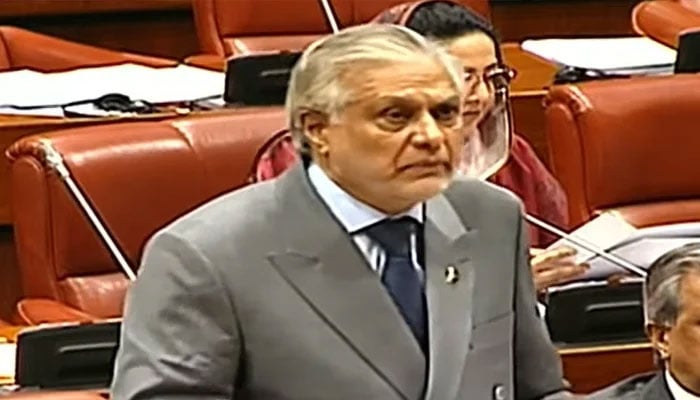
ISLAMABAD: Deputy Prime Minister Ishaq Dar informed the Senate on Tuesday that minimal or no quick reaction of Iran against Saudi Arabia after the assassination of Iranian Supreme Leader Ayatollah Ali Khamenei in a joint US- Israel air strike was a result of Pakistan’s Strategic Mutual Defence Agreement with Saudi Arabia.
He said that Pakistan has Strategic Mutual Defence Agreement with Saudi Arabia, adding that they had contacted Iran after the escalation to tell the neighbouring country to keep it in mind.
The minister said, “They (Iran) asked for some assurances that the Saudi soil would not be used against them and, consequently, they were given assurances on our behalf.
“As a result, there is no quick or minimal reaction of Iran against Saudi Arabia and Oman. I am grateful they were able to understand my point.”
Dar said that Pakistan will continue its efforts for de-escalation between the US and Iran, as there are clear chances of further conflict.
He shared details of his diplomatic engagements with counterparts from various countries over the previous three days, emphasizing that these were aimed at convincing both sides to come to the table of dialogue and diplomacy to settle their issues.
Pakistan, he underlined, was ready to facilitate talks between the United States and Iran in Islamabad, as this conflict was not in anyone’s interest and a negotiated solution was necessary.
Dar, who is also the foreign minister, expressed surprise over the sudden attack on Iran, calling it a repeat of an incident from June of the previous year.
He said the Omani foreign minister had informed him that progress had been made in Iran-US negotiations and that talks had been moving in a positive direction before the strikes occurred.
Prime Minister Shehbaz Sharif, he explained, had presided over a meeting which decided that diplomatic efforts to ease tensions would continue. It was, he underlined, Islamabad’s responsibility to pursue sustained diplomatic engagement to prevent further escalation in a region already gripped by a conflict-like environment.
Regarding Pakistan’s fraternal relations with Iran, Dar said Islamabad had immediately condemned the attack on the neighbouring country. He also stated that Pakistan recognises Iran’s right to the peaceful use of nuclear energy.
He informed the Senate that parliamentary leaders from both sides of the aisle would be given a detailed briefing. He noted that both the prime minister and Chief of Army Staff and Chief of Defence Forces Field Marshal Asim Munir had played a “very active and positive role” in diplomatic and defence-level engagements aimed at defusing tensions.
“It is not appropriate to misrepresent Pakistan’s sincere diplomatic efforts on the Iran issue within the country”, he said adding that the Iranian leadership was fully aware of Pakistan’s efforts.
He also pointed out that Iran had previously agreed not to build nuclear weapons, but said the United States was now pressing for the complete dismantling of Tehran’s nuclear programme. Dar said he had shared Tehran’s position during a meeting with US Secretary of State Marco Rubio.
He reiterated Pakistan’s support for Iran’s right to the peaceful use of nuclear energy and said Islamabad had worked to ensure this position was recognised internationally, including during its presidency of the UN Security Council.
Dar maintained that Pakistan stood by Iran but emphasised it would not allow itself to be dragged into a broader regional conflict. Regarding Pakistanis stranded in Iran, he explained that around 35,000 countrymen were currently in Iran. So far, 792 nationals had been evacuated through the Taftan-Zahedan border crossing, which remained operational. Though airspace had been closed, roads were open and repatriation was continuing by land.
Earlier, taking the floor, PPP parliamentary leader Senator Sherry Rehman underlined that the first objective of an effective foreign policy should be to protect its citizens; the second is to maintain the sovereignty of the state; the third is to advance the country’s interests in an impartial manner and to condemn attacks from all sides.
Regarding the martyrdom of Iran’s supreme leader, she noted, “We regretted and condemned the martyrdom of Iranian Supreme Leader Ayatollah Khamenei. Pakistan is the only country that condemned the top leader’s martyrdom. We have condemned the Zionist state from the beginning and in the current situation it is the duty of every Pakistani to defend our country.”
She said that Pakistan is also maintaining deep relations with the Gulf countries. She stressed that Pakistan has always shown a spirit of brotherhood by “opening our hearts” to Afghanistan, having old friendly relations with Kabul. She made it clear that those who attack Pakistan would have to pay a price.
Rehman underlined that wars are merciless and not the solution to any problem, as the solution lies in negotiations. “We pray that the Iranian people, Pakistani citizens and the people of Gulf countries remain safe while some quarters are describing the current situation as equivalent to World War-III.
“We made it clear that the land of Pakistan is only for Pakistani citizens and not for anyone else and not to be used against others. The opponents want the seeds of unity and solidarity to be uprooted, but unity should prevail over all,” she insisted. She noted that Pakistan has always tried to negotiate, but when defence was needed, it was necessary to respond.
Pakistan Tehreek-e-Insaf parliamentary leader in the House, Barrister Syed Ali Zafar, termed the attack on Iran as illegal, deserving the highest level of condemnation. He warned that the US and Israel were treading on extremely dangerous ground and have set a horrific precedent with the assassination of Iranian leaders that could have far-reaching consequences.
He cautioned that if such actions are normalised, it would open the door for states to justify the assassination of presidents, ministers and officials merely because they are politically opposed or disliked. Under the Charter of the United Nations and established principles of international law, he emphasized a country is authorised to use force against another state only in two circumstances: when authorised by the United Nations Security Council in the interest of international peace and security, or in self-defence against an armed attack.
“Any use of force outside these two situations is illegal. And in this case (attack on Iran), there was no evidence of self-defence and it has been acknowledged before the US Congress that there was no evidence that Iran was about to launch an imminent attack on either the United States or Israel,” he maintained.
The PTI legislator said negotiations between the US and Iran were progressing towards a potential resolution before being abruptly abandoned in favour of military action, suggesting the plan was to change the regime in Tehran. “It is not a legal war. America has played the role of a rogue state, as a go-ahead from the US Congress is mandatory for the start of a war. Israel has entangled the US by attacking Iran,” he contended.
He warned that this war would have repercussions for the future of the entire region and stressed the need for a regional security framework. The Senate will now meet again Wednesday afternoon.
Meanwhile, in the National Assembly, Minister for Law and Justice Azam Nazeer Tarar said that Prime Minister Shehbaz Sharif has invited parliamentary leaders and party heads to attend an in-camera briefing being arranged today (Wednesday) on the evolving situation in the region.
Amid a discussion on the Middle East situation, the minister said the prime minister had invited all parliamentary leaders for an in-camera meeting at 11:30am. “It shows the government’s seriousness about the latest developments taking place in the region,” the minister said, while urging the parties to set aside political differences and sit together to evolve a common strategy to move forward in view of the prevailing circumstances.
He pointed out that Pakistan has relations with Iran and, on the other side, the Pakistan government also signed a defence agreement with Saudi Arabia. He told the House that Rana Sanaullah had also conveyed the invitation to all the parliamentary leaders.
The law minister said the government would move forward in accordance with the consensus reached during the parliamentary meeting on Pakistan’s strategic and regional affairs. He said that certain issues involve sensitive dimensions that cannot be discussed openly, particularly in view of the regional situation and Pakistan’s relations with brotherly Muslim countries.
Highlighting Pakistan’s ties with Iran, he described it as a neighbouring and brotherly Islamic state with longstanding relations. He said that Pakistan also enjoys deep and historic ties with other countries, especially Saudi Arabia, calling the relationship “unique” given the kingdom’s status as the Custodian of the Two Holy Mosques and the longstanding defence cooperation agreements between the two nations. The minister said that keeping these sensitivities in mind, the prime minister decided that all stakeholders should sit together to deliberate on the matter comprehensively in the interest of national affairs.
Earlier, JUIF chief Maulana Fazlur Rehman, while speaking on the floor of the House, also demanded an in-camera briefing from the government to clarify Pakistan’s position at this critical juncture. He said that he would propose that an in-camera briefing be arranged immediately, as there was an alarming security situation in the region. “What will be Pakistan’s strategic position now? It is the responsibility of both the government and establishment,” he said.
The House earlier held a discussion on the situation in the region and in the Middle East following attacks on Iran and its retaliation, after suspending Private Members’ Day business.
PPP parliamentarian Abdul Qadir Patel, in an emotional speech, paid rich tributes to the martyred supreme leader of Iran who, he said, had given a ‘fatwa’ against the nuclear bomb but was attacked under a conspiracy. “He sacrificed his life but never bowed before the Yazeed of the present time,” he said. He regretted that Pakistani governments also failed to raise an effective voice for the people of Gaza and also followed failed Kashmir policies. Saying that traitors were behind planning the attack on Iran, he feared that Pakistan could be the next target.
PTI parliamentarian Nisar Jatt demanded that the prime minister come to the floor of the National Assembly and apologise for proposing President Trump’s name for the Nobel Prize. “The opposition will continue to play its role, and you will also have to say ‘Absolutely Not’ to America and Israel,” he said. He alleged that there were supporters of Israel, and that was why protestors in Pakistan were fired upon for protesting the assassination of the Iranian leader.
Barrister Gohar Ali Khan of the PTI said that the opposition desires that Iran’s relations with the Gulf countries should not deteriorate further. He said there was no reason for attacking Iran which, according to reports, had agreed that it would neither enrich uranium nor store it to achieve nuclear capability.
Separately, the US Embassy in Islamabad and its consulates across the country have suspended visa services for the current week amid street protests against the deadly US-Israeli airstrikes on Iran.
The US Mission in Pakistan announced in a statement on Tuesday that the embassy in Islamabad and the US Consulate General Lahore and US Consulate General Karachi had cancelled all visa appointments through Friday (March 6) due to the security situation.
Just a day ago, the US Consulate General Peshawar temporarily halted routine operations, while Karachi and Lahore consulates cancelled all consular services for 24 hours. The Islamabad embassy resumed normal operations on Tuesday after a one-day suspension.
The measures follow nationwide demonstrations against US-Israeli airstrikes that killed Iran’s Supreme Leader Ayatollah Ali Khamenei in Tehran.
Protests in Karachi, Lahore, Islamabad and Peshawar have raised security concerns near diplomatic missions.
Meanwhile, the Gilgit-Baltistan government on Tuesday decided to maintain the curfew in Gilgit as previously notified, while any extension in Skardu will be determined based on the evolving ground situation, as authorities work to stabilise the region following days of violent protests.
The unrest erupted after the assassination of Iran’s Supreme Leader Ali Khamenei, which triggered clashes between protesters and law enforcement personnel in parts of Gilgit and Skardu. At least 13 people were killed, and several others were injured during the violence. A three-day curfew was imposed in both districts from March 2, and troops were deployed to assist the civil administration in maintaining order.
In a statement issued on Tuesday, the government announced a series of measures aimed at restoring normalcy and preventing further unrest. The government spokesperson to the chief minister, Shabbir Mir, said the administration was committed to enforcing the writ of the state. “The government will ensure the protection of life and property and the law will take its course against those involved in violence and vandalism,” he said.
Among the key decisions approved in principle is the establishment of a high-level judicial commission to conduct a transparent fact-finding investigation into the overall situation in Gilgit-Baltistan. The administration has also decided to launch a large-scale de-weaponisation drive in Gilgit, directing relevant departments to make immediate arrangements for the recovery of illegal arms.
Authorities confirmed that strict legal action would be taken against individuals involved in damaging state institutions and private property in Gilgit and Skardu, emphasising that no act of lawlessness would be tolerated. An early survey of damaged infrastructure has been ordered, with restoration work to be undertaken on a priority basis.
The government further announced an intensified crackdown on hate speech, dissemination of fake news and cybercrime. Additionally, inter-district transfers of police personnel will be carried out in accordance with the Inspector General of Police’s plan to improve operational efficiency.
Meanwhile, in a post on ‘X’, Defence Minister Khawaja Asif said the war imposed on Iran, despite Tehran’s readiness for an agreement, was part of a wider “Zionist agenda” aimed at extending Israel’s influence up to Pakistan’s borders and surrounding the country with hostile forces.
“It is necessary for all 250 million Pakistanis, regardless of their political or religious affiliations, to understand this conspiracy and the intentions of our eternal enemies,” the minister said.
He called Zionism a threat to humanity, saying that from the establishment of Israel on the land of Palestine to the present day, every catastrophe faced by the Islamic world and every war imposed on it carried the direct or indirect role of Zionist ideology and the Israeli state.
He said Zionism had controlled the world’s economic system for a century and that major global powers were effectively being held hostage by it.
Referring to Pakistan’s strategic strength, Asif said the country was a nuclear power and the might of its armed forces was recognised across the world.
He said the nation was indebted to its “martyrs and ghazis” for safeguarding Pakistan’s sovereignty and prayed for Allah’s blessings on all those who contributed to making the country a nuclear power.
He paid tribute to former prime minister Nawaz Sharif, saying his courage in conducting the nuclear tests had demonstrated to the world that Pakistan was a nuclear-armed state. Asif said that although Iran was prepared for an agreement, war had been imposed on it and that the agenda behind the conflict, orchestrated by the Zionists, included pushing Israel’s influence right up to Pakistan’s border.
He warned that a single, coordinated agenda involving Afghanistan, Iran and India would then be directed against Pakistan, resulting in hostility towards the country, insecure borders, encirclement by enemies on all sides and the risk of Pakistan being reduced to a vassal state.
He prayed for unity in the Islamic world and for the ability to recognise its enemies, called for the freedom of Palestine and said he hoped Pakistan would remain strong and safe until the Day of Judgment.
Meanwhile, Prime Minister Shehbaz Sharif held a telephonic conversation with Turkiye President Recep Tayyip Erdogan, the PM Office media wing said in a statement..
Expressing his deep concern over the escalating crisis in the Middle East, the prime minister condemned the Israeli attack on Iran, and subsequent regrettable attacks on other brotherly Gulf countries.
Shehbaz apprised Erdogan of his recent outreach to the leadership of brotherly Gulf countries, reaffirming Pakistan’s full solidarity with them, and conveying its readiness to play a constructive role in efforts aimed at resolving the crisis. Both the leaders underscored the importance of maximum restraint by all parties to prevent further escalation. The prime minister also took President Erdogan into confidence on the recent developments in the context of Afghanistan. The two leaders agreed to remain in close and frequent contact in this regard while continuing their efforts to bring peace and stability in the region.
Reuters adds: Turkish President Erdogan told Shehbaz Sharif Turkey will continue working to reinstate ceasefire between Pakistan and Afghanistan, Turkish Presidency said. Turkish President Erdogan said Turkey will support Pakistan in fight against terrorism in phone call with Shehbaz Sharif.