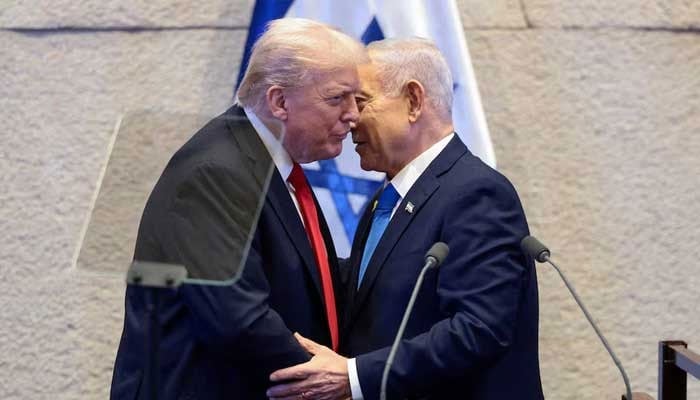
WASHINGTON: Prime Minister Benjamin Netanyahu of Israel walked into the Oval Office on the morning of Feb 11, determined to keep the American president on the path to war, The New York Times reported.
For weeks, the United States and Israel had been secretly discussing a military offensive against Iran. But Trump administration officials had recently begun negotiating with the Iranians over the future of their nuclear programme, and the Israeli leader wanted to make sure that the new diplomatic effort did not undermine the plans.
Over nearly three hours, the two leaders discussed the prospects of war and even possible dates for an attack, as well as the possibility — however unlikely — that Mr Trump might be able to reach a deal with Iran.
Days later, the US president made clear publicly that he was skeptical of the diplomatic route, dismissing the history of negotiating with Iran as merely years of “talking and talking and talking.”
Asked by reporters if he wanted regime change in Iran, Mr Trump said it “seems like that would be the best thing that could happen.” Two weeks later, the president took the United States to war. He authorised a vast military bombardment in conjunction with Israel that swiftly killed the country’s supreme leader, pummeled Iranian civilian buildings and military nuclear sites, thrust the country into chaos and triggered violence across the region, leading to the deaths so far of four US troops and scores of Iranian civilians. Mr Trump has said more American casualties are likely as the United States digs in for an assault that could last weeks.
In public, Mr Trump appeared to take a circuitous path to military action, alternating between saying that he wanted to strike a deal with Iran’s government and that he wanted to topple it. He made little effort to try to convince the American public that a war was necessary now. And the limited case he and his aides made false claims about the imminence of the threat that Iran posed to the United States.
But behind the scenes, his move towards war grew inexorably, fueled by allies like Mr Netanyahu who pushed the president to strike a decisive blow against Iran’s theocratic government; and by Mr Trump’s own confidence after the successful US operation that toppled the Venezuelan leader Nicolás Maduro in January.
This reconstruction of Mr Trump’s decision to launch a sustained attack against Iran is based on the accounts of people with direct knowledge of the deliberations, as well as those on all sides of the debate, including diplomats from the region, Israeli and American administration officials, the president’s advisers, congressional lawmakers and defence and intelligence officials. Almost all spoke on the condition of anonymity to describe sensitive discussions and operational details.
The US decision to strike Iran was a victory for Mr Netanyahu, who had been pushing Mr Trump for months on the need to hit what he argued was a weakened regime. During a meeting at Mr Trump’s Mar-a-Lago estate in December, Mr Netanyahu had asked for the president’s approval for Israel to hit Iran’s missile sites in the coming months.
Two months later, he got something even better: a full partner in a war to topple the Iranian leadership. In a statement Monday, the White House press secretary, Karoline Leavitt, said Mr Trump made a “courageous decision” to take on a threat that no previous president had been willing to confront.
Few in the president’s inner circle voiced opposition to military action. Even Vice President JD Vance, a longtime skeptic of American military interventions in the Middle East, argued in a White House Situation Room meeting that if the United States was going to hit Iran, it should “go big and go fast,” according to people familiar with his remarks.
In the same meeting, Mr Trump’s top military adviser, Joint Chiefs of Staff Chairman Gen Dan Caine, told the president that a war could lead to significant American casualties. Days later, Mr Trump told the public that his military adviser had been far more reassuring. He wrote on Truth Social that General Caine had said that any military action against Iran would be “something easily won.”
Other administration officials were similarly misleading in private sessions with lawmakers. During a Feb 24 meeting with the so-called Gang of Eight — the leaders of the House and Senate and heads of the intelligence committees — Secretary of State Marco Rubio made no mention that the Trump administration was considering regime change, according to people familiar with his comments.
Three days later, while flying on Air Force One to an event in Corpus Christi, Texas, Mr Trump gave the order for a sustained attack that would begin with the killing of the supreme leader. “Operation Epic Fury is approved,” Mr Trump said. “No aborts. Good luck.”
The White House insisted that its diplomatic talks with Iran were not mere theater. But it became clear over the past month that there was never the space for a deal that could satisfy Mr Trump, Mr Netanyahu and Iranian leaders at once — or one that could put off a war more than a few months.
The talks delivered nothing, but for Mr Trump they served a different purpose: time to complete the largest American military buildup in the Middle East in a generation and carry out, in Mr Trump’s words, a war of “overwhelming strength and devastating force.”
In an interview with The New York Times on Sunday, the president said he simply became convinced that Iran would never give him what he wanted. “Towards the end of the negotiation, I realized that these guys weren’t going to get there,” he said. “I said, ‘Let’s just do it.’”
In the middle of January, when Mr Trump first threatened to strike Iran in support of the anti-government protests roiling the country, the Pentagon was in no position to wage a lengthy war in the Middle East.
There were no aircraft carriers in the region. Squadrons of fighter jets were sitting in Europe and in the United States. And the bases scattered across the Middle East that are home to roughly 40,000 American troops were low on air defenses to protect them from an expected Iranian retaliation.
Israel was also not ready for the military campaign that Mr Netanyahu had discussed with Mr Trump during the Mar-a-Lago meeting in December. It needed more time to bolster its supply of missile interceptors and to deploy air defence batteries across Israel.
On Jan 14, Mr Netanyahu called Mr Trump and asked him to delay any military strike until later in the month, when Israel’s defence preparations were complete. Mr Trump agreed to wait.
The two leaders would speak several times in the weeks that followed. Mr Netanyahu also conferred with Mr Vance, Mr Rubio and Steve Witkoff, the lead White House negotiator with Iran. Top Israeli military and intelligence officials flew to Washington, and Lt Gen Eyal Zamir, the chief of staff of the Israel Defence Forces, communicated regularly with Adm Brad Cooper of US Central Command.
By late January, the protests in Iran had been brutally quashed, but the war planning hummed along. The US military presented Mr Trump with an expanded range of options, including sending in American forces to carry out raids on sites inside Iran.
Two aircraft carriers and a dozen supporting ships sailed towards the Middle East, and the Pentagon sent fighter jets, bombers, refueling tankers and air defense batteries. By the middle of February, the Pentagon had put into a place a force that could sustain a military campaign of several weeks.
By then, Mr Witkoff and Jared Kushner, the president’s son-in-law, were having indirect nuclear talks with the Iranians, under orders from Mr Trump. But there were signs that the administration was wary.
“We have to understand that Iran ultimately is governed and its decisions are governed by Shia clerics — radical Shia clerics, OK?” Mr Rubio told reporters in Budapest on Feb 16. “These people make policy decisions on the basis of pure theology. That’s how they make their decisions. So, it’s hard to do a deal with Iran.”
The message was apparent: Even though the talks were about dismantling Iran’s nuclear programme, the goal could be removing Iran’s leadership.
A telling moment came when Mr Witkoff spoke to Fox News in an interview on Feb 21 and described Mr Trump’s reaction to the Iranian reluctance to agree to “zero enrichment” — that is, to dismantle its ability to produce nuclear fuel.
“He’s curious as to why they haven’t — I don’t want to use the word ‘capitulated,’ but why they haven’t capitulated,” Mr Witkoff said. He added: “Why, under this sort of pressure, with the amount of sea power and naval power that we have over there, why haven’t they come to us and said, ‘We profess we don’t want a weapon, so here’s what we’re prepared to do’?”
“And yet it’s sort of hard to get them to that place,” he said. It was clear to the president’s advisers that he was strongly considering some kind of military offensive. The question was the scale of the campaign and exactly what it was trying to achieve.