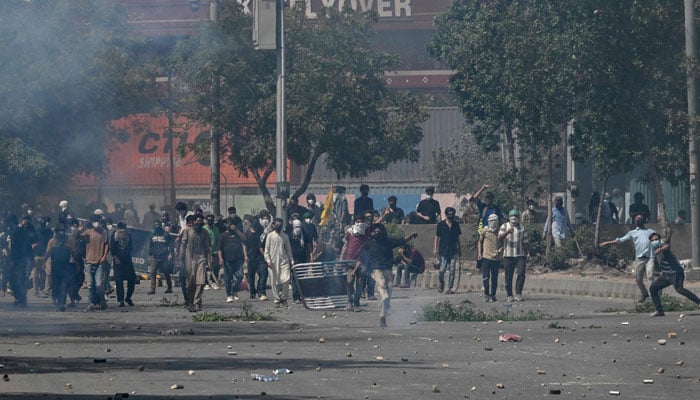
Following the attack on Iran and the reported martyrdom of Iran’s Supreme Leader, Ayatollah Ali Khamenei, violent protests erupted outside the United States Consulate in Karachi on Sunday, turning areas, including Mai Kolachi Road, MT Khan Road and Numaish, into virtual battlegrounds.
Clashes, tear gas shelling and firing continued into the evening, leaving at least 10 people dead and more than 96 injured. In addition to the casualties, a police armoured personnel carrier (APC), a traffic police post and two motorbikes were set on fire during the unrest.
According to reports, most of the victims suffered injuries from batons, sticks and tear gas shells, while injuries from firing were comparatively fewer. However, some of those hit by gunfire are in critical condition, raising concerns that the death toll can rise further.
The Sindh government announced forming a Joint Investigation Team (JIT) to probe the firing incident outside the US Consulate. According to an official statement, the high-level JIT was constituted to conduct an impartial review of all aspects of the incident. The team will determine the circumstances under which the event occurred and identify the underlying causes.
The protest had been announced by various Shia organisations against the alleged US and Israeli attacks on Iran and the killing of Ayatollah Khamenei. According to officials, the Special Branch had already warned senior police authorities of a possible confrontation in its report. Police had set up checkpoints across the city and blocked several routes as a precautionary measure.
A large number of protesters gathered from different parts of the city and reached Numaish, from where they eventually made their way to the consulate on Mai Kolachi Road without facing any major resistance. The unrest, including clashes, firing and confrontations, began around 10am and continued until approximately 4pm.
The situation escalated as a large crowd assembled outside the consulate. Demonstrators reportedly attempted to force their way through the main gate, with some managing to enter the consulate premises and allegedly carrying out acts of vandalism. Videos of the incident later circulated widely on social media.
Heavy contingents of police and Rangers, including personnel from all three city police zones, were deployed to control the situation. During the clashes, eight people were killed on the spot, while several others were injured, including two who later died during treatment. Most of the deceased and injured had suffered wounds to the chest and abdomen from gunshots reportedly fired to disperse the protesters.
No official statement was issued regarding who fired on the protesters, and the authorities are currently investigating. Officials are using footage from the Safe City project cameras, the consulate’s security cameras, social media, and media videos to ascertain the sequence of events.
Following the firing, the protesters became more agitated and resorted to stone-pelting at police and the consulate building. Police claimed that miscreants among the protesters also opened fire, a claim denied by the participants of the protest.
Law enforcers responded with tear gas shelling and pushed protesters back from Mai Kolachi Road towards MT Khan Road. During the unrest, enraged individuals set fire to a traffic police checkpoint established under the Sultanabad Bridge, torched about two motorbikes, one of which belonged to a senior photojournalist, and also set an APC ablaze. Several police mobiles were damaged and multiple officers suffered injuries. The area repeatedly echoed with tear gas shelling and aerial firing throughout the day.
Traffic on both sides of Mai Kolachi Road near the Sultanabad Traffic Section was suspended. Vehicles coming from the Jinnah Bridge were diverted to II Chundrigar Road, traffic from Boat Basin was turned back from Mai Kolachi Phatak, and vehicles from PIDC were redirected via the Park Cut.
The authorities confirmed that emergency was declared at all major hospitals and additional security was deployed across the city. According to Karachi Police Surgeon Dr Summaiya Tariq, eight people were brought in dead, while two more victims died during treatment, bringing the total death toll to 10, with 96 people injured.
At the Shaheed Mohtarma Benazir Bhutto Institute of Trauma, 51 injured were admitted, including 41 from the consulate and 10 from Native Jetty and Numaish. Five of them remain hospitalised, with two in critical condition.
At the Jinnah Postgraduate Medical Centre, seven injured, including five police personnel, were brought in. At the Aga Khan University Hospital, eight injured were admitted, of whom six are receiving treatment and two are in critical condition.
Thirty injured were brought to the Fatimiyah Hospital, with 11 admitted for treatment. The identified deceased included Ali, Kazim, Adeel, Mubarak Sajid, Khawar Abbas, Abbas, Muhammad Ali and Asif.
Despite the violent protests outside the consulate, law enforcement agencies (LEAs) are yet to issue any official statement explaining how the protesters were able to reach the consulate or who was responsible for the resulting casualties.
The News made repeated attempts to reach Sindh police chief IGP Javed Alam Odho, Karachi police chief Addl IGP Azad Khan and several other officials but they remained unavailable for comment.
Following a day of heightened tension around the consulate, Addl IGP Khan and Karachi Commissioner Syed Hasan Naqvi visited the area to review security arrangements. The authorities issued orders to further strengthen security around the consulate, after which containers were placed on all four sides of the building to reinforce barriers.
Also present during the visit were South Zone police chief DIG Asad Raza, District South police chief SSP Mahzur Ali, District Keamari police chief SSP Amjad Sheikh and District City police chief SSP Arif Aziz. During his inspection, Addl IGP Khan toured the roads surrounding the consulate and instructed police to remain alert to prevent any untoward incident.
The traffic police reported that several major roads across the city were temporarily closed for security reasons. On Sharea Faisal, the road from FTC to Metropole was blocked, with traffic diverted via Kala Pul through Lines Area as an alternative route.
Both tracks on II Chundrigar Road from Talpur Chowk to Tower were also closed, with traffic redirected from Talpur Chowk towards Yaqub Mosque, Bolton Market, while vehicles coming from Tower were sent to Saleh Muhammad Street and Mumtaz Hasan Road. The roads surrounding Numaish were also closed for security reasons, particularly due to the funeral prayers being held there.
Alternative routes were provided for commuters: traffic from Gurumandir was diverted via PP Chowrangi, traffic from Society Office was redirected to Kashmir Road, and roads from Teen Hatti to Jahangir Road were blocked with obstacles, with trucks rerouted via alternative routes. By late evening, as the situation normalised at various locations, roads that had been closed for security reasons were gradually reopened to traffic.
Sindh Home Minister Ziaul Hasan Lanjar sought immediate details from Addl IGP Khan regarding the ongoing protests outside the consulate. Speaking on the situation, he said: “No one will be allowed to take the law into their own hands.”
He urged the authorities to further strengthen the security of sensitive installations, and stressed that alternative routes should be arranged to ensure smooth traffic flow during the protests.
LEAs remain on full alert and are closely monitoring developments. Lanjar warned that strict action would be taken against any elements attempting to disturb law and order. The home department extended the enforcement of Section 144 across Karachi and the rest of the province for an additional month. An official notification issued by the department states that the order would remain in effect from March 1.
Under Section 144, all forms of wall chalking, protests, demonstrations, sit-ins, rallies and display of weapons continue to be prohibited across the province. The government clarified that the measure aims to maintain law and order, and prevent a sense of insecurity among the public.
The notification allows registered private security company guards to carry firearms while on duty but prohibits the display or brandishing of weapons. Security personnel were also instructed not to visibly carry firearms during patrols or at public places and to keep their weapons secured inside vehicles.
According to the home department, violators of Section 144 would face action under the relevant provisions of the Pakistan Penal Code, and the SHO of the police station concerned would be authorised to take legal action.
The order was issued with the approval of Additional Chief Secretary (Home) Muhammad Iqbal Memon, and copies were circulated to the relevant LEAs and administrative officials for necessary action.
The funeral prayers for the deceased protesters were held at Numaish on Sunday night. A large number of Shia clerics, community elders and mourners gathered at the site to offer prayers and express solidarity.
The participants condemned the US, Israel and state authorities, shouting slogans against their actions. Chants of “Down with the US and Israel” were also heard, alongside slogans denouncing the alleged brutality by state institutions.
Among those attending the funeral prayers were Jamaat-e-Islami Emir Hafiz Naeemur Rehman, along with his delegation as well as leaders from the Pakistan Tehreek e Insaf. Sunni clerics and community leaders were also present to show solidarity with the victims.
The US Embassy in Pakistan issued a security advisory on its official website, warning American citizens about ongoing demonstrations at the consulate in Lahore and violent protests at the consulate in Karachi.
The advisory also notes calls for additional demonstrations at the embassy in Islamabad and the consulate in Peshawar. US government personnel were instructed to restrict their movements until further notice.
The embassy urged US citizens in Pakistan to monitor local news, exercise heightened personal security, stay aware of their surroundings, avoid large crowds and ensure their Smart Traveller Enrolment Programme registration is up to date.
Due to protests near the consulates in Karachi and Lahore, and the embassy in Islamabad, all appointments for US visas and American Citizen Services scheduled for March 2 were cancelled.
Safety recommendations from the embassy included avoiding areas of large public gatherings, reviewing personal security plans, monitoring local media for updates, checking email and local media for updates regarding appointments at all locations, keeping a low profile, carrying identification and cooperating with local police authorities.