KARACHI: The market may find support next week if cross-border tensions cool and talks with the International Monetary Fund move forward. Sentiment will likely track news from Vienna on Iran and the United States, and updates from the IMF review team in Islamabad.
Analysts say clarity on external financing and a stable rupee could steady nerves. For now, investors remain cautious after another volatile week.
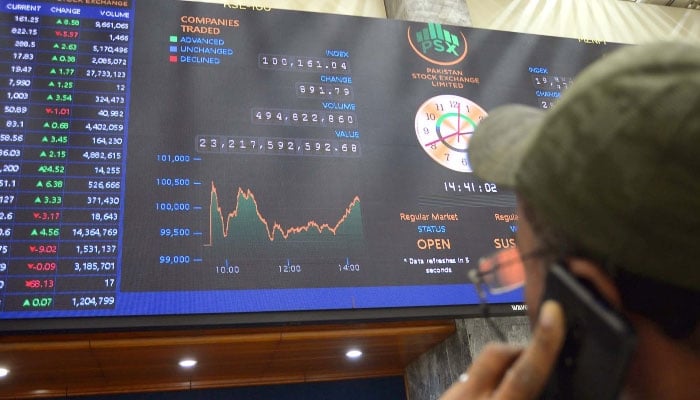
The benchmark KSE 100 Index closed at 168,062 points on Friday, down 5,108 points or 2.9 per cent week-on-week (WoW). The slide came amid rising geopolitical strains between the United States and Iran and renewed friction along the Pakistan-Afghanistan border.
The market staged a partial rebound on Thursday, gaining 4,267 points in a single session. AKD Research expects the market to recover as domestic and geopolitical uncertainties subside. It noted that the index trades at a forward price to earnings ratio of 7.2 times with a dividend yield of 6.6 per cent.
AHL Research said the KSE-100 witnessed a sharp sell-off amid persistent selling pressure and heightened geopolitical concerns. It added that an IMF delegation has arrived to conduct the third review under the $7 billion Extended Fund Facility and the second review under the Resilience and Sustainability Facility.
As of February 26, 69 companies representing 83 per cent of the index market capitalisation announced 2025 results. Their combined profit stood at Rs1.6 trillion, up 5.9 per cent year on year. Investment banking, auto assemblers, miscellaneous sectors and textiles led earnings growth.
On the macro front, the State Bank of Pakistan’s (SBP) liquid foreign exchange reserves rose by 16 million dollars week on week to 16.2 billion dollars as of 20 February, despite repayment of a $700 million loan to the China Development Bank. Over the past 18 months, the central bank’s net foreign exchange intervention reached $11 billion as of November 2025.
The rupee appreciated marginally by around 0.02 per cent to close near 279.5 against the dollar. Profit repatriation rose to $1.67 billion in the first seven months of the fiscal year, while foreign direct investment fell 41 per cent over the same period.
Sector performance remained mixed. Vanspati and allied industries, fertiliser and automobile parts posted modest gains. Tobacco, synthetic and rayon, and property stocks led the declines.
Trading activity improved. Average daily volumes rose to around 1 billion shares compared with 831 million shares last week, according to market data.
Nabeel Haroon, vice president international equity sales at Topline Securities, said foreign corporates were net sellers of about $13 million during the week. He added that local individuals and mutual funds also sold equities, while banks and companies absorbed most of the pressure.
Analyst Wadee Zaman at JS Research said the index has fallen 11.2 per cent from its January 2026 peak of 189,167 points. He noted that progress in Iran-United States negotiations helped the late-week recovery.
He said the IMF review and clarity on the rollover of $2 billion in UAE deposits will remain key triggers. For now, investors will watch politics and policy. Any calm on both fronts could open the door to a rebound.