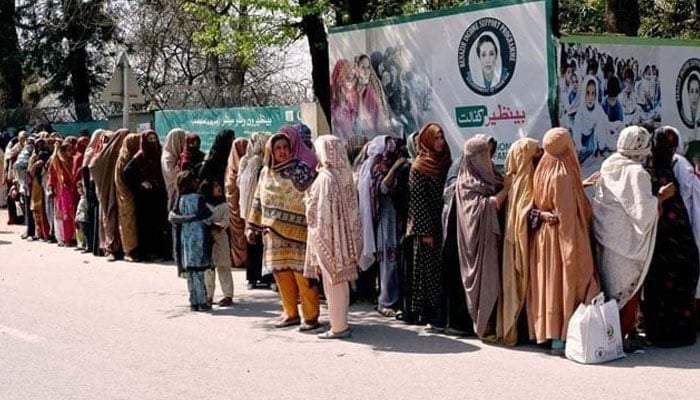
In 2016, while working as a consultant, I was in Buner, observing the shift of the Benazir Income Support Programme (BISP) from debit card payments to biometric payments.
A long queue of women stood outside a small point-of-sale (POS) machine in the main Dagar bazaar. Many had travelled more than an hour from hilltop villages. They had pooled money to hire a vehicle arranged specifically for the women of their village. The round trip cost them more than Rs200, not a small amount for families living on the margins.
I spoke to a few of them about their overall experience with the new system. I remember telling one woman that we would try to bring the POS machine closer to her village next time. She said something that has stayed with me since. “It is better this way. This is the first time I have come to the main bazaar with other women, with just one male chaperone. We are enjoying ourselves”. Let’s pause on that for a bit. A woman spending money she could barely afford, travelling from a hilltop village, standing in a queue for hours and calling it enjoyable.
That moment, that conversation, taught me many things about culture, norms and transformative change. The biometric system, which required each beneficiary’s physical presence, created legitimate reasons for women to leave their homes, gather and occupy public space. It had opened new doors. Many said it couldn’t happen because of our culture and norms. But given the right incentive, their own money in their own names, culture adapted.
Yet too many development programmes consciously avoid this kind of change, choosing the easier path of appeasing entrenched power structures under the guise of respecting culture. And this is not unique to Pakistan. In many developing countries, women face barriers that development programmes politely call ‘cultural constraints. The problem isn’t that development programmes don’t recognise the barriers or issues women face because of such a culture. They do. The problem is how some programmes respond, with interventions that work around culture rather than through it or taking it head-on, indirectly accommodating patriarchal norms rather than challenging them, where they direct resources and knowledge through male household heads and hope some trickles down to women will happen eventually. It’s time to call this approach what it is: a cosmetic exercise that preserves the status quo while pretending to pursue equality.
This raises a bigger question: what is it about culture that makes meaningful change so difficult? Let’s first understand exactly what we’re so afraid to challenge. Edward Tylor, the father of cultural anthropology, defined culture in 1871 as “that complex whole which includes knowledge, belief, art, morals, law, custom, and any other capabilities and habits acquired by man as a member of society”. However, more recently, anthropologists such as Clifford Geertz have emphasised that culture is not static but an ongoing process of interpretation, in which individuals actively construct their social reality through shared symbols and practices. They imply that culture is not written in stone or part of our core DNA; it is, in fact, a living, dynamic set of practices that people constantly negotiate and renegotiate.
So, if the culture is simply the way we live, and its adoptable and changeable, then why do many programmes treat it as if it were sacred scripture? Why do we accept culture as an excuse for compromising on core principles of equity?
There are many examples around us of such development programmes. In fact, a recent systematic review published in BMJ Global Health found that only 8.4 per cent of interventions engaging men and boys in reproductive health actually challenge male norms or unequal power structures. The vast majority merely accommodate existing gender hierarchies. Nothing will change with this.
My colleagues in development, however, will argue, and rightly so, that transformative change takes time. Gender norm change takes years, sometimes generations, and we have limited timeframes where we need to show results. All true. Cultural transformation takes time. Real change is never neat, never immediate, and rarely comfortable, especially when it unsettles power.
So, let’s ask ourselves, what is even the point of five-year projects that avoid the root cause altogether? If change takes years, then programmes that avoid change accomplish nothing except wasting those years. If timeframes are limited, then why spend them on interventions proven ineffective? If we fear backlash from challenging harmful norms, what exactly do we think gender equality looks like? A polite redistribution that threatens no one? If we continue to design interventions that are acceptable to patriarchal gatekeepers rather than empowering women themselves, we should not be surprised when the results are marginal.
Transformative development succeeds not by accommodating patriarchal norms, but by directly disrupting them through institutional design. As seen in BISP, mandating biometric payments directly to women, rather than male household heads, forced a shift in agency, moving millions from economic invisibility to financial inclusion and physical mobility. BISP is not alone; such a transformation is mirrored in Brazil’s Bolsa Família, Colombia’s Familias en Accian, and various Indian state initiatives, where putting cash and decision-making power in women’s hands has consistently outperformed ‘culturally safe’ indirect interventions.
We should learn from these programmes and if we are serious about transformation, we must stop using culture as a convenient excuse for inaction and start treating it as what it truly is, a dynamic system that can and must evolve. The path forward requires a shift from accommodation to disruption, from working around male gatekeepers to deliberately redesigning incentives that force a renegotiation of power within households and communities.
Development programmes must also stop the tokenism that creates the illusion of progress while leaving power untouched. Stop accessing women through men. Every time a project requires male permission, male attendance or male mediation to reach women, it reinforces the idea that women cannot be engaged as independent citizens. Stop creating women’s community-based organisations (CBO) as a parallel formality simply because a male CBO already exists. That is not empowerment; that is checkbox compliance.
Unless women’s organisations control real budgets, exercise real decision-making authority and operate with genuine autonomy, they are stage props in someone else’s governance structure. And stop placing women on panels merely to avoid a ‘manel’. Representation without agenda-setting power or institutional backing changes nothing. These gestures may satisfy reporting templates, but they do not alter who holds resources, who sets priorities or who ultimately decides.
I think of that woman in Buner, smiling in her chaddar, as she explained why she preferred the long journey to the nearby payment centre. She understood something that many development professionals miss: the journey itself was the point. The mobility, the gathering, the legitimate reason to occupy public space, these weren’t obstacles to overcome. They were the transformation.
Development programmes now face a choice. They can continue with cosmetic interventions that make everyone comfortable, donors, governments, community leaders, – everyone except the women whose lives don’t actually change. Or they can embrace genuine transformation, accepting that it will be difficult, contested and uncomfortable.
The writer is a development professional based in Peshawar, who works on governance reforms and institutional development.