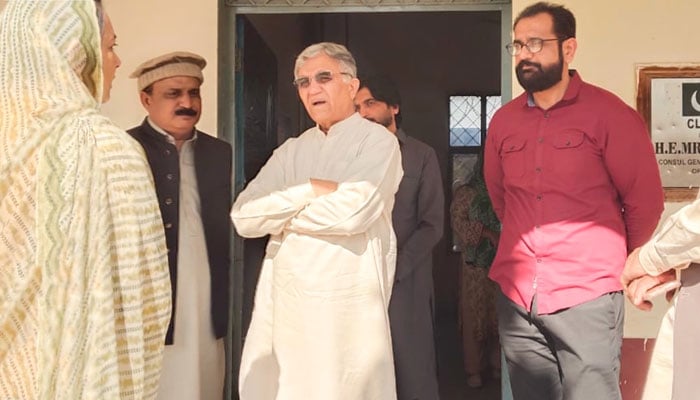
Former chief of the naval staff, Admiral (retd) Muhammad Asif Sandila, has spent more than a decade redefining service to the nation — not on the high seas, but in some of Pakistan’s most underprivileged rural communities.
Deeply involved in philanthropic work in the education sector for over 12 years, he believes that combining formal schooling with marketable vocational skills can dramatically alter the life prospects of young girls in the countryside.
In a conversation with The News, he stressed that while access to quality education remains fundamental, the addition of practical skill training, particularly in tailoring and beauty services, can swiftly place rural girls on the path to financial independence.
Such trades, he observed, have consistently proven sustainable and profitable in low-income communities, enabling women to earn respectably while contributing to their household incomes.
Admiral Sandila has led the non-profit Moawin Foundation since 2014. What began as a modest initiative with just two government schools in his hometown of Sheikhupura has grown into a significant educational network.
Today the foundation manages 338 government-run schools across Punjab, Khyber Pakhtunkhwa, Gilgit-Baltistan and Sindh, serving more than 45,000 students. Nearly 60 per cent of these pupils are girls — a reflection of the organisation’s strong emphasis on female education.
He explained that the idea behind establishing the foundation emerged from his realisation that meaningful socio-economic progress can be achieved by adopting and revitalising struggling government schools.
Rather than constructing new facilities, the foundation focuses on improving existing institutions through structured public-private partnership, upgrading academic standards and introducing vocational streams tailored to local needs. Two core elements underpin the foundation’s model: strengthening classroom teaching and equipping students with employable skills.
Teachers in the adopted schools undergo specialised training, particularly in moral and ethics education, and modern teaching methodologies, to raise the overall quality of education.
At the same time, students are introduced to vocational programmes designed to enhance their future earning potential. In Gilgit-Baltistan, for example, women in need and students are trained in fruit dehydration techniques, enabling them to preserve, package and market local produce as small-scale household enterprises.
In other regions, the foundation offers instruction in motorbike mechanics, stitching and tailoring, electrical work and shoe-making, as well as IT and e-commerce — trades selected for their strong market demand and immediate income-generating potential.
The impact, Admiral Sandila noted, has been measurable and encouraging. Of the 3,300 students who have graduated from schools managed by the foundation, approximately 76 per cent have gone on to become self-employed after acquiring technical skills. Significantly, 85 per cent of these earning graduates are girls, underlining the transformative role vocational training plays in empowering young women.
Drawing on years of field experience, he maintained that tailoring and beautician training in particular have repeatedly demonstrated their value in rural settings.
These professions provide socially acceptable and financially viable avenues for girls to become self-reliant, often within the confines of their own communities. As earning members of their families, they not only improve household finances but also gain confidence and social standing.
The foundation has also collaborated with the Pakistan Navy to enhance standards at selected government educational institutions. Schools at the Pakistan Navy Residential Complex in Islamabad and on Baba Bhit Island in Karachi have been adopted for improvement, alongside the establishment of vocational training centres.
Seeking to broaden its reach further, Admiral Sandila recently met Sindh Education Minister Syed Sardar Ali Shah to discuss expanding the foundation’s footprint in southern Pakistan under the province’s public-private partnership framework.
He also engaged with the leadership of the Green Crescent Trust to explore collaboration with like-minded organisations that have decades of experience in delivering quality education to children from disadvantaged backgrounds.
Reflecting on the journey from two schools in Sheikhupura to hundreds across multiple regions, Admiral Sandila reaffirmed his broader vision: to extend educational and vocational opportunities to deprived rural communities in every corner of Pakistan. For him, empowering the younger generation with both knowledge and practical skills is not merely a charitable endeavour — it is an investment in the nation’s long-term progress.