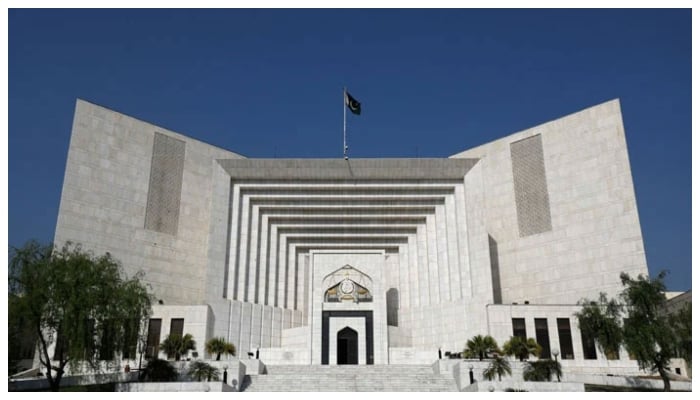
ISLAMABAD: The Supreme Court has ruled that while the State enforces the law against its citizens and expects compliance within prescribed timelines, it must hold itself to the same standard.
A two-member bench of the apex court, comprising Justice Ayesha A Malik and Justice Shakeel Ahmed, issued the judgment in a Federation appeal against a ruling of the Federal Service Tribunal (FST) in Islamabad.
The Federation, through the Ministry of Finance secretary, had challenged the FST judgment dated June 26, 2025, in a case titled ‘Federation versus Farid Ullah and others’.
The court noted that the petition filed by the Federation was barred by a delay of 20 days, for which an application seeking condonation of the delay was submitted.
The court, however, dismissed the Federation’s appeal, ruling that the explanation offered did not constitute a sufficient cause within the meaning of the law. Consequently, the appeal was dismissed as being time-barred.
“We have heard the Additional Attorney General for Pakistan; however, we find that the delay, as explained, does not merit acceptance as sufficient cause for the delay,” states the four-page judgment authored by Justice Ayesha.
The court noted that the explanation offered in the application was essentially that the petition could not be filed on time due to internal procedural requirements and administrative challenges.
“Both explanations are totally unsatisfactory, as internal procedural requirements or administrative inconveniences cannot override the legal obligation to file the petition within the given time,” the judgment read.
It held that the petitioner was fully aware of the prescribed timeframe within which the petition was required to be filed, yet it gave preference to bureaucratic processes without making any effort to expedite the procedure. “Such conduct amounts to a conscious disregard of the requirements of law and also reflects poor enforcement within the system of governance,” it stated.
The court observed that this kind of delay is inexcusable, particularly when no effort has been made to reform or improve the procedure that causes such significant delay. “We are of the opinion that the State is required to organise itself in such a way that it functions in a timely manner and meets legal timelines. It cannot seek indulgence for its own inefficiencies, whether of its own making or otherwise,” the judgment read.
The court ruled that the State enforces the law against citizens and expects compliance within prescribed timelines; it must, therefore, hold itself to the same standard.
“When the State fails to comply with these timelines and seeks indulgence for administrative delay, it transfers the consequences of its disorganisation onto the court and the opposing party, who is often in a weaker position than the State,” the judgment noted.
In this context, the judgment held that the prescribed timeline under the Supreme Court Rules is 60 days, adding that when a statutory timeframe is prescribed, it is intended to ensure that parties act with diligence and that disputes do not remain indefinitely open.
Meanwhile, the Supreme Court Thursday fined a man Rs1 million for criminally assaulting his spouse’s real niece and then falsely claiming marriage. A three-member bench, headed by Chief Justice of Pakistan Yahya Afridi, dismissed the appeal filed by Muhammad Shehzad.
The court observed that the petitioner sexually assaulted his wife’s real niece and attempted to prove it as a lawful marriage. The court noted that the petitioner was already married, and his legal wife was the real paternal aunt of the victim.
The court ruled that marriage with a real niece in the presence of her aunt fell within a legally prohibited degree and could not be lawful. To bypass the legal impediment, the petitioner fabricated a false claim of divorcing his first wife, the court noted, adding that the petitioner concocted a false story to conceal his inhuman act, for which there was no legal evidence.
The court declared the petitioner to be the biological father of the child born to the victim. “Even if the marriage is not proven, a biological father is legally and morally bound to provide maintenance for his child,” the court ruled. The court emphasized that an innocent child could not be deprived of basic rights due to the parents’ illegal relationship or disputes. Similarly, the court observed that the petitioner used the judicial process as a tool to harass and morally pressure the woman. The court noted that under Article 14 of the Constitution, the dignity of every human being was inviolable.