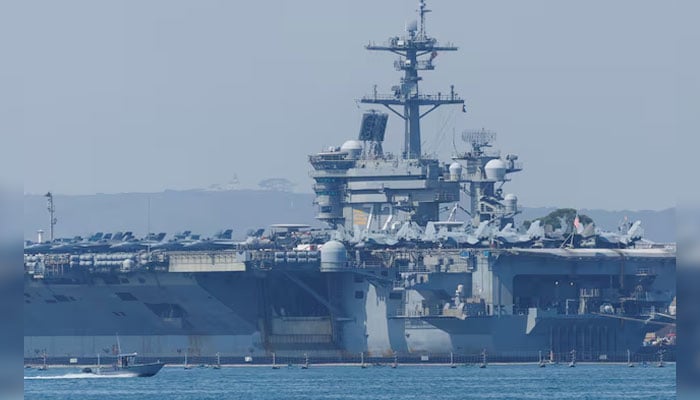
Two floating airbases -- the USS Abraham Lincoln to one flank, the USS Gerald R Ford to another. More than 150 aircraft. More than 10,000 sailors. Six to eight Arleigh Burke-class destroyers. Two Virginia- or Los Angeles-class submarines. Two Ticonderoga-class cruisers. Two USNS Supply (T-AOE-6) Lewis and Clark-class dry cargo ships. Tehran is watching steel and flight decks form a maritime arc.
America’s military architecture is in place. But President Trump’s instinct has often been escalation for bargaining power, not escalation for invasion. Steel first. Diplomacy next.
Iran is not without response options. Tehran’s doctrine rests on asymmetry. One option is a saturated attack -- a military strategy that overwhelms an opponent’s air and missile defence systems by launching large numbers of missiles, drones, and rockets simultaneously from multiple directions.
Iran’s objective is not precision. The objective is volume. Saturation is about exhausting defences, not matching force symmetrically. (In April 2024, Iran launched 300+ drones, cruise missiles, and ballistic missiles on Israel. In October 2024, Iran launched 200+ ballistic missiles in waves to maximise saturation pressure on systems like Arrow, David’s Sling and Iron Dome).
Washington hasn’t been standing still. At 14:47, on February 3, 2026, an Iranian Shahed-139 drone was detected approaching ‘aggressively’ towards USS Abraham Lincoln. Tracking began automatically. Operators classified it as a threat. The weapon system was fired. The beams travelled at the speed of light. There was no visible ‘travel time’ like a missile.
In a second, concentrated energy was held on a single aim point. Surface temperatures of the Iranian drone rose to over 2,000 degrees Fahrenheit. In two seconds, the electro-optical sensors failed. In three seconds, flight stability deteriorated. In four seconds, the propulsion malfunctioned. In five seconds, the drone lost control and fell into the sea -- no detonation, no fragmentation pattern, no secondary explosion. Cost: 70 US cents a shot.
Detection. Classification. Engagement. Kill. There was no launch plume. There was no missile contrail. There was no thunderclap. There was no firing in the traditional sense. Just beams -- invisible, silent, instantaneous. Energy held on target. Heat accumulated. Electronics degraded. Control surfaces weakened. Within moments, the lift collapsed. The drone lost stability and fell.
What was it? It was not a standard missile. It was not a Phalanx burst. It was not an F-35 intercept. There was no smoke. No shockwave. No debris trail. To be certain, what brought the drone down was not kinetic force. It was light. HELIOS -- the High Energy Laser with Integrated Optical-dazzler and Surveillance system. A ship-mounted directed-energy weapon. Integrated with Aegis and powered by the destroyer’s own generators.
The age of thousand-dollar drones and million-dollar interceptors is behind us. Missiles chase. Lasers hold. And when held long enough, steel yields. The contest in the Gulf is no longer just saturated drone attacks versus million-dollar interceptor missiles. In a saturation fight, it is now explosives versus electricity – physics applied with precision. It is cost curve versus cost curve. And electricity is cheaper than explosives.
Based on open-source reporting, HELIOS is currently assessed to operate in roughly the 60–150 kW class, effective primarily against drones, small boats, and optical sensors -- and likely not effective in countering high-speed ballistic missiles.
Under Project METEOR, high-power microwave (HPM) systems have been sent to the US Central Command (Centcom). Unlike a laser, an HPM system does not focus a visible beam on a single aim point. It emits a broad, directional cone of high-power electromagnetic energy designed to couple with electronic circuits.
Within microseconds of HPM exposure, induced currents disrupt flight controllers, communications links and onboard processors. Sensors freeze. Navigation systems lose coherence. Motors desynchronise. The entire swarm of drones suffer permanent electronic damage. The effect is electronic defeat rather than kinetic destruction -- no explosion, no debris field, just multiple drones simultaneously losing control and dropping from the sky.
Iran can launch in waves. It can saturate skies with drones. It can gamble on volume. America seems to be working hard on changing the arithmetic.