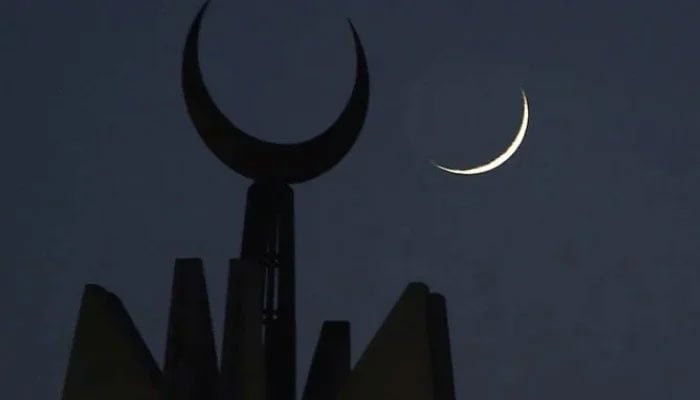
LAHORE: Although the month of Ramadan commenced on Wednesday in counties like Saudi Arabia, Bahrain, Kuwait, Qatar, the United Arab Emirates, Yemen, Afghanistan, and Palestine etc, nations including Pakistan, Egypt, Brunei, Malaysia, Turkey, Indonesia, Tunisia, Libya, Azerbaijan, Kazakhstan, Kyrgyzstan, Uzbekistan, Jordan, Syria and Oman would begin fasting with effect from Thursday (today), reflecting the diversity of practice and interpretation involving the moon-sighting timeline within the Muslim community worldwide.
Research shows that historically, no single country has had a decisive influence in shaping the religious calendar in the region.
Tensions between tradition and astronomy on moonlighting issue have persisted for many decades now as scientific experts have often contested the moon sighting’s validity, sparking heated debates at times between traditionalists who insist on direct visual confirmation and astronomers who advocate for calculated predictions.
This divergence is thus not a new phenomenon.
At least 41 countries are traditionally and historically aligned with Saudi Arabia’s moon-sighting schedule on most occasions.
According to website “moonsighting.com,” countries that follow Saudi Arabian Ramadan and Eid schedules include Afghanistan, Uzbekistan, Albania, UAE, Algeria, Armenia, Austria, Azerbaijan, Bahrain, Belgium, Bolivia, Bulgaria, Burkina Faso, Chechnya, Denmark, Finland, Georgia, Hungary, Iceland, Iraq (Sunni areas), Italy, Japan, Kazakhstan, Kuwait, Kyrgyzstan, Lebanon, Mauritania, Palestine, Philippines, Qatar, Romania, Russia, Singapore, Sudan, Sweden, Switzerland, Syria, Taiwan, Tajikistan, Togo, Turkmenistan etc.
Countries that largely follow Turkey in this context include United States, Canada, Slovenia, Angola, Bosnia and Herzegovina, Tunisia, Croatia, France, Germany, Ireland, Kosovo, Luxembourg, Macedonia, Serbia and Montenegro etc.
Countries that follow their own criteria and calculations are China, Norway, India, Libya, Nigeria, Indonesia, Malaysia, New Zealand, United Kingdom, Poland, Spain and Thailand etc.
Methods for determining the start of Ramadan (moon-sighting) involve a blend of traditional observation and, increasingly, modern scientific calculations.
Several countries, particularly in the Middle East and Southeast Asia, have integrated scientific methods, such as astronomical calculations, telescopes and computerized data to determine the start of Islamic months.
Even outside the Muslim-majority world, countries like the Philippines, Japan, Singapore, France and Australia etc have scheduled Ramadan’s start for Thursday, reflecting the diversity of practice and interpretation within the global Muslim community, as detailed by “AFP” and the “Middle East Eye,” a United Kingdom–based media website and channel that primarily focuses on news related to the Middle East, North Africa and Muslim world.
According to “Khaleej Times,” drones and Artificial Intelligence had helped authorities in the UAE to sight Shawwal’s crescent moon, in a world’s first, in 2025, while Singapore has adopted the astronomical calculation method since 1974 to determine the beginning of Hijri months.
The newspaper writes: “From moon sighting to astronomical dates, there is no singular system that is applied all over the Muslim world to spot the crescent in the evening sky.”





![[Comment] Hour Of Diplomacy — Pakistan’s Historic Hand In Turning War Into Ceasefire](https://www.thenews.pk/assets/uploads/akhbar/2026-04-10/s_1409241_045310_updates.jpg)