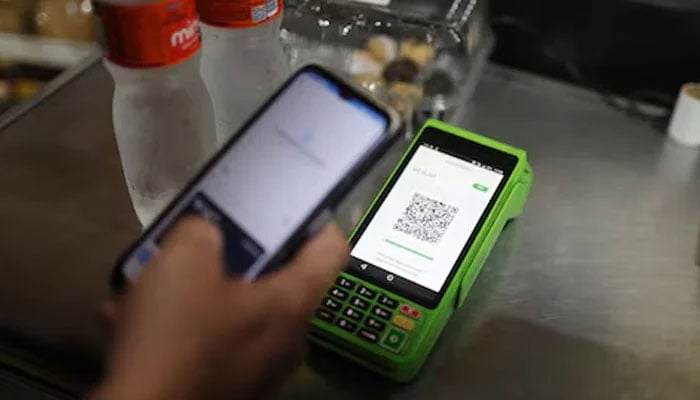
LAHORE: The digital payments revolution is transforming economies across Asia, strengthening state capacity, expanding financial inclusion and shrinking shadow economies. India and China have built global-scale digital payment ecosystems, and Bangladesh has made remarkable progress in mobile financial services.
Pakistan, despite launching its own instant payment system, remains far behind in translating digital finance into economic documentation and inclusive growth. The digital race is not about convenience. It is about the future of Pakistan’s economy, governance and sovereignty.
India’s Unified Payments Interface (UPI) has become one of the largest real-time payment systems, processing about 172 billion transactions in 2024 and moving trillions of dollars across its economy. Digital payments account for nearly all retail payment volumes in India, and UPI alone represents roughly half of global fast-payment transactions. China’s Alipay and WeChat Pay have created an even larger ecosystem, with mobile payments exceeding $80 trillion annually, effectively eliminating cash from daily urban commerce.
Bangladesh, with far fewer resources than Pakistan, has also embraced digital finance. Platforms such as bKash and Nagad serve tens of millions of users, enabling digital wage payments, government transfers and remittances, particularly in rural areas and among women.
Pakistan, in contrast, remains a cash-heavy economy despite recent progress. The State Bank of Pakistan (SBP) launched Raast, a real-time digital payment system, in 2022. Since then, Raast has processed more than 1.9 billion transactions worth over Rs44 trillion, while annual Raast person-to-person transactions reached 1.28 billion worth Rs29.6 trillion in FY2025. Overall, Pakistan recorded 9.1 billion retail payment transactions worth Rs612 trillion in FY2025, with 88 percent conducted through electronic channels, indicating a structural shift toward digital payments.
Yet these impressive growth rates mask a fundamental gap. Pakistan’s digital volumes remain tiny compared with India’s UPI or China’s platforms, and digital payments are still peripheral in informal markets, wholesale trade, agriculture and real estate — the core sectors of the undocumented economy.
The digital gap is also reflected in financial inclusion. Pakistan has made progress in expanding account ownership, reaching around 215 million financial accounts, but many belong to the same individuals and do not translate into active usage or merchant acceptance. Merchant digitisation remains limited, and cash dominates retail and wholesale trade.
The economic consequences are severe. Pakistan’s tax-to-GDP ratio is the lowest in the region. The large undocumented economy rivals the formal economy that limits revenue mobilisation, forces reliance on debt and foreign assistance, and perpetuates inequality.
Digital payments can fundamentally alter this trajectory. When transactions occur digitally, they leave an audit trail. This reduces underreporting, broadens the tax base and curbs corruption. India’s expansion of digital payments alongside GST significantly increased compliance and tax revenues. China’s cashless ecosystem has given authorities unprecedented visibility into economic activity.
For Pakistan, digitalisation could be the most effective tool to document traders, transporters, professionals and real estate dealers — sectors that currently evade taxation almost entirely. Mandatory digital invoicing, QR-based merchant payments and integration of banking data with tax systems could bring millions of businesses into the tax net.
Pakistan’s social protection programmes such as BISP and Ehsaas already use digital channels, but coverage is fragmented. A universal digital public infrastructure—integrating NADRA identity, bank accounts and mobile payments — could transform governance and empower marginalised populations.
India is exporting UPI to Singapore, and many countries. China’s fintech giants and digital yuan are extending Beijing’s financial influence abroad. Pakistan, by contrast, remains a passive adopter of foreign technology rather than a digital standard-setter.
Powerful trading lobbies resist documentation. Banks lack incentives to onboard low-income customers. Regulators hesitate to mandate digital payments due to political backlash. Tax authorities lack the political backing to enforce digital reporting.
Pakistan needs a bold digital strategy: universal basic bank accounts, mandatory digital payments for large merchants, tax incentives for digital transactions, integration of NADRA with financial services, reduced mobile data costs, and interoperability across fintech platforms. Digital literacy campaigns must target small traders and rural populations.Pakistan still has the technology and population scale to do so — but only if political will matches technological capabilities