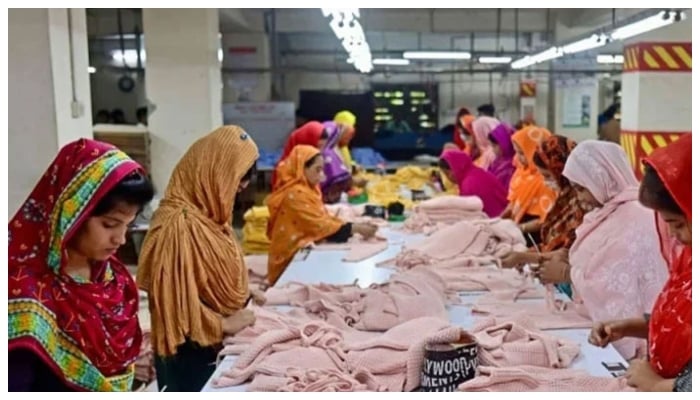
ISLAMABAD: Pakistan’s textile exports climbed to $1.738 billion in January 2026, up 3.1 per cent from exports of the same month last year and surging 28.7 per cent from December, official data showed Tuesday.
Exports stood at $1.35 billion in December. Data released by the Pakistan Bureau of Statistics showed that most major textile categories recorded year-on-year gains, including bedwear, towels, cotton cloth and cotton yarn.
Knitwear was the only segment to show decline of 8.55pc to $428.3 million. Whereas, bedwear exports were up 6.88pc to $308.5 million, towels rose 14.1pc to $116.3 million and readymade garments’ sales abroad increased by 9.6pc to $435.1 million over the same month last year. Likewise, cotton yarn exports were up 12.88pc to $73.5 million, while cotton cloth was almost stagnant at $165 million.
Food sector exports shrank 4.46pc to $624.4 million. Rice, one of the country’s top foreign exchange earners, increased 14.7pc to $365.9 million, with basmati jumping by 156pc to $199.4 million. However, other rice verities’ sales abroad shrank by 31pc to $166.4 million.
Vegetables exports declined by 30pc to $23.8 million, and fruits were also down 4.66pc to $39.5 million. In contrast, oilseed, nuts and kernels exports were up by 20.4pc to $20.3 million, meat exports up by 12.78pc to $51.5 million, and tobacco exports increased by 21.75pc to $13.5 million over the same month of last year. Fish and fish preparation exports also increased by 16.8pc to $35.35 million.
Sports goods exports rose 32.8pc to $41.6 million, led by a 40.4pc spike in football shipments that stood at $24.4 million. Surgical instruments exports increased by 4.6pc to $41.8 million and cement exports were up by 62.75pc to $33.56 million.
On the import side, petroleum group imports declined by 22.3pc to $1.06 billion in January 2026 over the same month of a year ago. Of this, petroleum products imports declined by 40.7pc to $305.86 million, LNG by 14.27pc to $267 million and LPG imports were down by 8.46pc to $96.3 million. Similarly, crude oil imports were also down 9.6pc to $391 million.
The machinery group imports year-on-year were almost stagnant at $954.1 million in January 2026. Of this, the imports of construction and mining machinery increased by 156 percent to $35.97 million, textile machinery up by 6.04pc to $57.95 million, power generation machinery up by 14.6pc to $82.4 million. Telecom machinery imports also increased by 26.7pc to $246 million, with mobile phone imports up 33.6pc to $179.8 million.
However, agricultural machinery imports declined 28.4pc to $11.1million and electrical machinery and apparatus imports dipped by 31.7pc to $213.86 million.
Food sector imports increased 7.74pc to $871.5 million. Of this, palm oil imports increased 6.4pc to $367 million, spices by 5.46pc to $23.2 million, tea by 18.4 pc to $60.4 million in January 2026. Pules imports however declined by 2.76pc to $97.7 million.
Transport sector imports, however, jumped 46.3pc to $310.3 million. Under the build units and complete knockdown/semi-knockdown (CKD/SKD) motor vehicle category, imports increased by 45.7pc to $293 million. The import of complete built units of cars increased by 29pc to $34.9 million, while the CKD/SKD cars imports was 104pc high to $162.3 million.