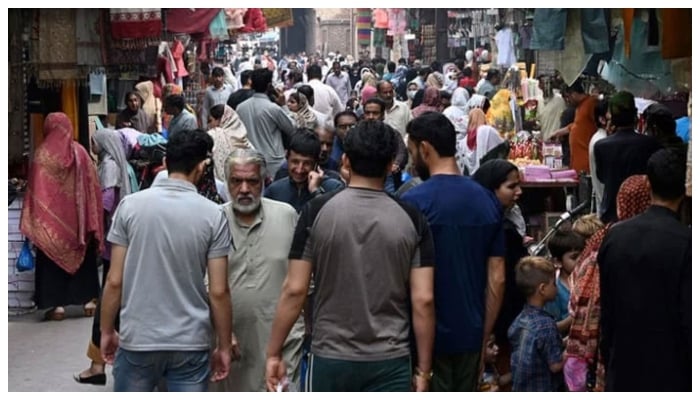
If nothing else sinks us, the population explosion certainly will. Pakistan is adding a country the size of Norway every year to its population due to the prevailing population increase rate of 2.55 per cent, which is well above the universally accepted replacement level fertility rate of 2.1 per cent.
A large population that was supposed to be a demographic dividend has in fact become a demographic liability. The Islamabad Policy Research Institute’s latest report shows the adverse impact of population growth on human security dimensions like food, health, education and economic security. Pakistan faces the Malthusian spectre of food shortages for a burgeoning population.
Thomas Malthus predicted in 1798 that the world’s population would outpace agricultural production, leading to a doomsday scenario. A small technological invention, the tractor, staved off this outcome due to a phenomenal increase in agricultural productivity. Will a similar deus ex machina come to rescue Pakistan? The answer might lie in our religiously sanctioned cultural attitudes, national economic priorities, governance quality, incentive structures to control population, education profile and women empowerment.
Pakistan once had a Ministry of Population Planning and Welfare, which has now been reduced to an attached division of the Ministry of Health. The provinces have different arrangements, such as Punjab’s Population Welfare Department and Sindh’s Population Welfare Department, which works under the Ministry of Health and Population Welfare. In the case of Khyber Pakhtunkhwa and Balochistan as well, population welfare departments exist as independent entities. The devolution of population welfare functions to the provinces should have yielded better outcomes but instead population planning governance has become fragmented and effete.
The weak population planning performance, despite several programs and plans, reflects the lack of seriousness accorded to this issue. Pakistan’s ‘Total Fertility Rate’ (TFR), which indicates the number of children likely to be borne by a woman of childbearing age, was 6.1 in 1994 and has been brought down to 3.6 as per World Bank data for 2023–24. This ratio needs to be scaled down to 2.0 in order to attain zero population growth and stabilise overall numbers.
The Demographic Transition Theory put forward by Warren Thompson and later expanded by Frank Notestein explains five stages of demographic transition. The first stage features a pre-industrial society with low population growth. The second is the industrial stage, where life expectancy increases due to modern healthcare, leading to a population surge. The third stage features a stabilising population due to a narrowing gap between birth and death rates. The fourth stage is usually experienced by advanced industrialised countries, where the fertility rate reaches around 2.0, leading to zero growth. The fifth stage occurs when the fertility rate falls below 2.0, resulting in population decline.
Pakistan is in stage three of the demographic transition but with a high fertility rate (TFR) of 3.6, well above the universally accepted figure of 2, along with a large young population cohort, with 60 per cent below 30 years, producing 1.8 million job seekers annually. The ideal demographic transition occurs when declining fertility rates combine with high economic growth, yielding a lower number of economic dependents for the working generation. This lower dependency ratio creates the conditions for a ‘demographic dividend’. If the dependency ratio remains high and the economy stagnant, population growth becomes a demographic liability.
Although Pakistan’s national security policy regards the young population cohort as an asset, the reality is that due to poor planning and lack of job opportunities, this asset has become a liability. According to a PIDES study, with an economic growth rate of 2.38 per cent and 1.8 million job seekers each year, Pakistan requires an annual growth rate of 7 per cent to absorb new entrants into the job market. The employment-to-population ratio will decline sharply in the absence of structural economic reforms. The impact on food security is equally severe, with rich cropland being encroached upon by rapid urbanization. Combined with reduced soil fertility, agricultural productivity is declining, leading to food shortages.
Health security is also being seriously impacted by runaway population growth, with Pakistan ranked 130th out of 190 countries on the Global Health Security Index (2021), a situation that has not materially improved due to continued population increase. Pakistan’s maternal mortality rate of 186 deaths per 100,000 live births and neonatal mortality rate of 38–41 per 1,000 births are among the highest in the world.
According to the Pakistan Economic Survey 2024–2025, the country has 1,696 hospitals, which need to be increased to 2,182 over the next ten years to accommodate a population growing at 2.55 per cent annually. With health spending at only 1.2 per cent of GDP compared to the WHO-recommended 5 per cent, Pakistan would be hard-pressed to add 482 hospitals within a decade.
Pakistan has 20 million out-of-school children, representing 28 per cent of the total child population, according to the Household Integrated Economic Survey (HIES) 2024–2025. The number of schools in Pakistan, as per the Pakistan Economic Survey 2024–25, is 276,500. This figure needs to increase to 324,000 over the next ten years to accommodate the projected number of school-going children based on the current population growth rate of 2.55 per cent.
To escape the Malthusian trap laid by uncontrolled population growth, Pakistan must take urgent action. These steps include a coherent population planning effort through dedicated population welfare ministries and a unified population welfare regime instead of the current fragmented governance structures. Granting women agency over their lives through education and improved access to contraceptive healthcare must become a national priority, with active support from religious scholars.
Greater investment in health and education, both qualitatively and quantitatively in GDP terms, must accompany structural economic reforms to achieve a sustained growth rate of 7.0 per cent over the next decade without incurring debilitating debt. Policy incentives and national development strategies must actively discourage unchecked population growth through state and societal participation. The population time bomb is ticking and the choice to defuse it is a necessity, not a desire.
The writer is a security and defence analyst. He can be reached at: