One of the many advantages of working with the editor of these pages is that you get introduced to the little worlds she is a part of in Karachi. One such world is an education institution where first-year medical students explore oft-neglected topics. Through my conversations with her (which by the way have great potential to be a viral podcast), I got to know that these students were tasked to talk about things that give them joy.
This got me thinking: what does joy mean to me? The question became even more interesting as I followed Twitter wars (or X wars?) on whether people in Lahore should be celebrating Basant.
This article, however, is not on the kite-flying festival; it is a sincere attempt at finding the lost joy.
To be honest, as a 90s kid, who grew up in a violence-ridden Karachi where bombs and target killings were the norm, I often dream of abandoning everything and flying to a place where nobody knows me. I see myself working a monotonous, extremely basic job (like stamping the seal on the mails or stocking grocery items on shelves or anything that allows the brain to snooze) and not caring about who is winning the elections or losing the throne. This, according to me, is one of the side-effects of living in a place that has been consistently ranked among the worst cities to live in for the past few years. Where survival mode is a necessity, not an option. Where every other day is a challenge.
The idea of joy, then, seems a cruel joke. How can you feel happy when the roads that you take to work give you chronic back pain? How can you feel happy when the street you live on reminds you of the fatal mugging attempt that took the life of your neighbour? How do you feel happy when your house itself reminds you of the most vulnerable time of your life where you were held at gunpoint with a razor-sharp knife inches away from your neck as masked men demand your parents tell them where the non-existent, jewels-laden, stuffed-with-cash safe was?
For some readers, this may sound like a scene out of a crime novel, but for people in Karachi, these experiences are neither new nor shocking. These are the rites of passage. When the horizon is murky, one naturally stops looking ahead. But there is one, near-eccentric quality of humans. It’s their ability to break free from the past and, if not forget completely, move away from discussing the same old things over and over.
On the ‘day-after’ the robbery incident none of the then eight people in our house stayed at home out of fear. We followed our schedule to the T – to our workplaces and schools and colleges. The psychological wounds from the incident were acknowledged but not deliberately scratched so as not to give them a new lease on life. Is that perseverance the joy we should be looking for? Maybe.
Many moons later, the Covid-19 pandemic hit. We lost people close to us, mentors I looked up to. But the legacy that they left remained intact. Is the strength that comes from braving the strongest storm the joy we should be appreciating? Maybe.
A short while later, the world turned upside down. Countries decided to wage a war, sending inflation to double digits. Small mercies like vacations turned into a big-budget extravaganza. The break that such escapes would provide from the chaos of Karachi was also gone. But it was perhaps this loss that has now made it easier to understand what joy really is.
I used to think, and I feel I can forgive myself for such an immature take, that joy blossoms in isolation; that for the feeling to be enjoyed and felt, it has to be separated from all the violent and chaotic elements in an environment. I have written about this feeling too – of being at ease in foreign lands, of tasting the sense of belonging in countries I don’t belong to.
But this phase of being-stuck-in-a-place-you-can-run-away-from both due to finances and because of the current topsy-turvy world order has introduced me to the innate human desire for happiness and joy. It is almost impossible to not yearn for the spark that gives life some meaning, some rationality, some sanity.
Last year’s Independence Day brought a deluge of reels on Instagram. Among them were those that documented the eccentric side of the country – Pakistanis, mostly men, living – not the overly glamorised, sophisticated lifestyle our high-on-Western-content brains conjure up. But a life that is both normal and understandable. I saw the videos of middle aged men on the swing and laughing away; a masked man in a superhero costume doing the bhagra; men on bicycles performing stunts and failing; and so on. In those moments, they were happy, joyful and relaxed. They did not care if the celebrations ticked any or all boxes of acceptability. They were living in the moment. Those videos took me back to 2019, I think, when a political party marched to Islamabad. Along the way, some participants, who were in the capital for the first time, found swings in a park. Unbothered by what others would say, they seized the moment and took turns on the swings, laughing away, letting us see the joy of novelty.
It was this novelty that was missing all these years for me. And this novelty came last May when we did get the assurance, perhaps in decades, that we were capable of defending ourselves; that even if we died we would die fighting, not helplessly waiting for the scythe to fall on us. The extreme joy of a novel discovery! It also came in parts through the Instagram videos I earlier talked about. The novelty of looking at people’s behaviour without any blinders, of looking at our people, of acknowledging that we share the same land, the one that we need to protect. The joy of a shared identity where both our losses and wins are personal.
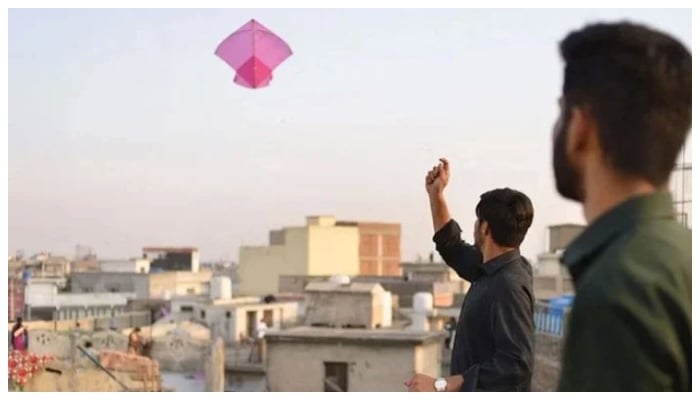
And this brings me to Basant. For a Karachiite, kite-flying is as alien a concept as smooth, pothole-free roads. I don’t have any memories of what Basant looked like 20 years back. For me, kite-flying was limited to Fariha Pervaiz’s music video. For the longest time, I didn’t even know if it was ‘Bo-Kata’ or ‘Wo-Kata’ (like here it goes). Even then, the videos coming out of Lahore evoked a memory I didn’t even have. I strangely got nostalgic for the time I never even witnessed. And I realised, it was not kite-flying but the human connection that made the festival almost divine. It was the laughter that millennial and Gen X parents had when they relived their childhood and young-adult days. It was the awe on the faces of Gen Z who saw their parents as the GOAT. When kite-flying became the adult equivalent of Roblox. These realisations are far bigger than the economic benefits, or lack thereof, of an event.
For me, it also marked the beginning of a fairly, less challenging era.
The famous ‘Let’s go fly a kite’ song has an interesting context. It comes in the movie (Mary Poppins) at a time when the family regains its strength and, in a way, reunites. It allows the protagonist to finally set off, a signal that what needed fixing had been fixed or at least moving towards improvement. In one of the later movies, it is shown that the author of the novel ‘Mary Poppins’ was not happy with how Disney integrated animation in certain scenes. She was uptight and would dismiss most creative ideas. But when the team played this particular song to her, she let her inhibitions slide.
Could our kite-flying moment be similar to that? For me, the joy is to hold on to the idea that things can get better. And that joy doesn’t come when roads are fixed or law and order is improved. It comes amidst everything. For me, joy is not something to be found in isolation, in sequestered islands, but in chaotic and unruly surroundings. It’s a game of Where’s Waldo? where the man in red pajamas is hidden in the middle of chaos. All we have to do is to keep looking.
The writer heads the Business Desk at The News. She tweets/posts @manie_sid and can be reached at: [email protected]