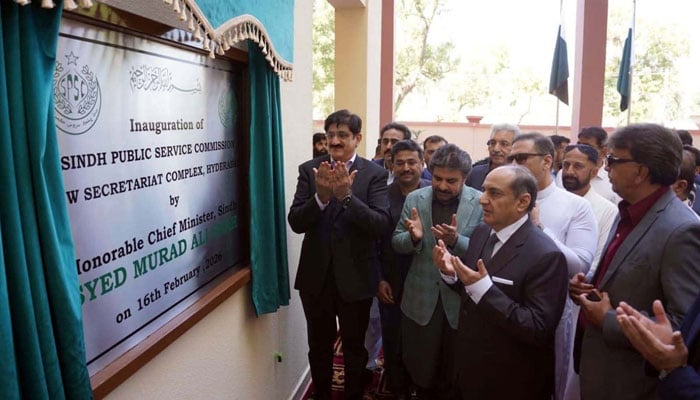
Sindh Chief Minister Murad Ali Shah on Monday inaugurated the newly built, state-of-the-art Secretariat Complex of the Sindh Public Service Commission (SPSC) in Hyderabad, calling it a landmark step towards merit-based recruitment, digital transformation and better governance in the province.
During his address, Shah said the SPSC has been instrumental in maintaining merit across Sindh. He said that a transparent, digital examination system remains a top government priority, describing computer-based testing (CBT) as a significant step toward greater transparency.
“Competent and capable youth are the bright future of Sindh,” he remarked, adding that the Pakistan Peoples Party government would persist in leading initiatives for public welfare. SPSC Chairman Muhammad Waseem said that the modern complex, built for Rs2.493 billion on an acre of land, includes a digital library, a CBT laboratory, an auditorium, a cafeteria, a gymnasium and a mosque. The new facility would lessen reliance on external venues, and further strengthen the commission’s operational independence.
Shah inspected all the facilities at the SPSC Complex, taking particular interest in the world-class digital library capable of accommodating over 300 candidates. He was informed that from July 2022 to December 2025, the SPSC recommended 21,504 appointments across 36 departments, including 8,666 in education; 7,357 in health and social welfare; 1,696 in local government and works; 1,965 in law, order and governance; 1,137 in agriculture, livestock and environment; and 149 in finance and economic affairs.
Moreover, 72 recommendations were made in youth, culture and information; and 462 in competitive and special cadres, strengthening service delivery in key public sectors. Shah was also told that over 2,000 candidates have already appeared for exams using the new CBT lab. The introduction of the 1-Link online challan system, e-library and digital candidate facilitation has greatly enhanced accessibility and efficiency. The implementation of the Recruitment Management Regulations, 2023, has further institutionalised transparency, merit protection and governance reforms.
Disciplinary action was also taken against 16 officers of BS-18 and BS-20 under the relevant laws, including dismissal, compulsory retirement, removal from service, and censure with promotion withheld. These measures have improved institutional credibility and public trust.
With Shah’s approval, the SPSC’s allowance was restored from 20 per cent to 100 per cent. Health insurance cards were introduced, over 100 employees were promoted, and staff from BPS-1 to BPS-4 received time-scale upgrades. Renovation of offices in Hyderabad and Karachi, including the chairman’s annex and members’ residences, were carried out to boost operational efficiency.
The Combined Competitive Examinations (CCE) of 2020, 2021 and 2023 were successfully conducted, with the final results of CCE 2023 announced this month. Notably, Alizer Shawaiz, the first DSP from the scheduled caste Christian community in Pakistan, aged 24, was allocated to the Sindh police, marking a significant milestone for marginalised communities.
The top scorer of CCE 2023, Fatima Shakeel, a graduate in English language and literature, has been allocated to the Provincial Management Service (PMS). She has qualified for CSS, and is currently undergoing training at the Civil Services Academy. Mairaj Yousif Mirani secured the seventh position and has been appointed as a PMS assistant commissioner.
These results highlight the diversity and merit-based selection of CCE 2023, reaffirming the SPSC’s commitment to fairness, inclusion and good governance in the province.
The written exam for CCE 2024 was held in December 2025, with the screening test for CCE 2025 scheduled for March 28, 2026. The SPSC recommended 101 candidates in 2020, 73 in 2021 and 152 in 2023. The exam schedule has also been aligned following the directives of the superior judiciary.
Praising the SPSC’s achievements, the CM said merit, transparency and digital transformation bolster governance. “This complex is not just a building but a centre of progress and prosperity,” he stressed. He later visited the digital library and recorded his impressions in the visitors’ book.