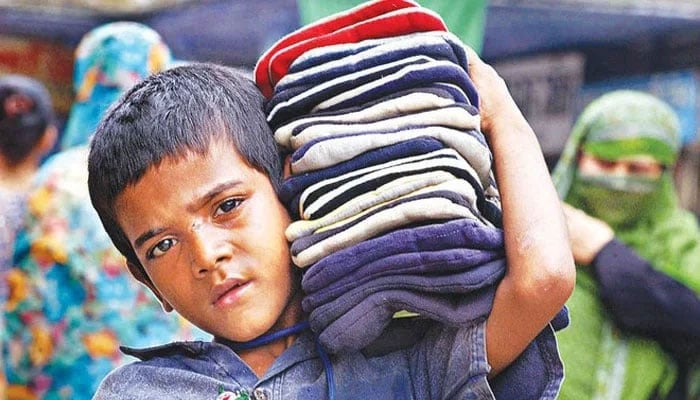
LAHORE: Child labour remains one of Pakistan’s most enduring and shameful socio-economic failures. Despite constitutional guarantees, and decades of policy declarations, millions of Pakistani children continue to work in fields, workshops, brick kilns, homes and streets instead of attending school.
This is not merely a social tragedy; it is an economic blunder that condemns Pakistan to perpetual low productivity and poverty. Pakistan is a signatory to International Labor Organisation (ILO) conventions that prohibit child labour and hazardous work for minors. Article 11 of Pakistan’s Constitution also bans the employment of children in hazardous occupations. Yet, enforcement remains weak and symbolic. Child labour is pervasive, particularly in the informal economy, which accounts for more than 70 per cent of employment.
Recent provincial surveys provide a sobering picture. In Sindh, over 1.6 million children aged 5-17 are engaged in child labour, with more than half working in hazardous conditions. Punjab has districts where child labour prevalence exceeds 30 per cent among children. Khyber Pakhtunkhwa’s first provincial child labour survey found that over 21 per cent of adolescents aged 14-17 are economically active, with agriculture dominating child employment. Balochistan, though poorly documented, is widAely believed to have similarly high prevalence due to poverty and school exclusion.
Agriculture remains the largest employer of children, absorbing around half of all child labourers. Children work in cotton picking, livestock herding, harvesting and family farms — often unpaid and invisible in official statistics. The informal services sector — domestic work, street vending, water collection and small retail — also employs large numbers of children. Informal manufacturing, including brick kilns, carpet weaving, surgical instruments, sports goods, leather tanning and garments, continues to rely on child labour, particularly in subcontracted and home-based units.
The persistence of child labour in Pakistan is not primarily a legal failure; it is an economic failure. Poverty remains the strongest driver. When adult wages are insufficient to sustain households, children become economic assets. Rural family-based production systems rely on children as unpaid labour, while weak social protection systems fail to cushion vulnerable families. Pakistan also has one of the world’s largest populations of out-of-school children — over 20 million — creating a steady supply of child workers.
Child labour traps families in intergenerational poverty. Children who work instead of attending school grow into low-skilled adults, perpetuating low productivity and low wages. At the macro level, this undermines Pakistan’s human capital formation, innovation capacity and long-term growth prospects.
Pakistan’s policy response on child labour has been fragmented and cosmetic. Labor inspections are weak, underfunded and often compromised. Provincial labour departments lack manpower and political backing. Agricultural child labour remains largely outside regulatory frameworks because farms are considered family enterprises.
A serious strategy to eliminate child labour must begin with economic realism. First, Pakistan must raise adult wages by improving productivity, particularly in agriculture and small manufacturing. Mechanisation, access to credit, and technology upgrades can reduce dependence on child labour. Second, education must be made genuinely universal. This requires not just building schools, but ensuring attendance through conditional cash transfers linked to schooling. Third, the informal economy must be documented and regulated. As long as businesses operate outside the tax and regulatory net, labour laws will remain unenforceable.
Child labour monitoring should be integrated with tax and business registration databases to identify high-risk sectors. Fifth, social protection must be expanded for poor families, particularly during economic shocks, so children are not used as coping mechanisms.
Child labour is often treated as a moral issue in Pakistan, but it is fundamentally an economic and governance issue. A country aspiring to industrialise and compete in global markets cannot afford to rely on children for economic survival. Eliminating child labour is not only a moral imperative; it is an economic necessity. History shows that no nation has achieved sustained prosperity while exploiting its children. Pakistan should not be an exception.