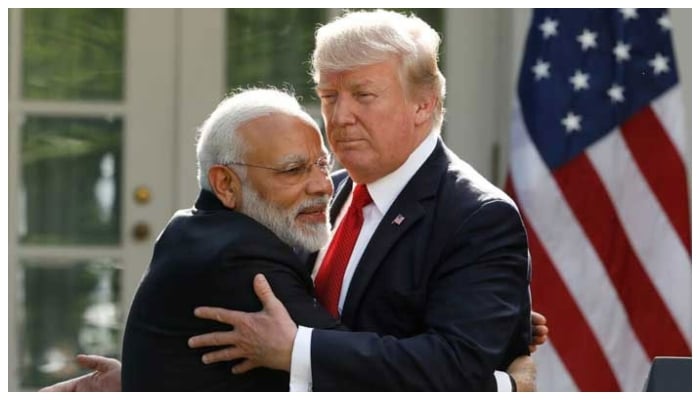
WASHINGTON: When President Trump fired off a social media post on Feb 3 to proclaim that the United States was immediately ending the extraordinary 50 percent tariff on most Indian goods exported to the United States, Indian businesses heaved a sigh of relief, New York Times reported.
India’s Prime Minister Narendra Modi responded with his own post: “Big thanks to President Trump on behalf of the 1.4 billion people of India for this wonderful announcement.” This week, further announcements from the White House turned that deal into a cluster headache for Modi. He secured a big decrease in the main tariff, to 18 percent, which is now in line with India’s main competitors in Asia. But, in exchange, the potential costs to be borne by India in terms of trade and foreign policy have turned out to be multiplying.
A commitment to buy $500 billion worth of American goods within five years, in effect doubling India’s imports, has raised questions, too.
Indian farmers, afraid that American imports will damage their livelihood, are planning a strike to demand that India not sign the deal. Modi’s parliamentary opposition has cried foul, saying the terms of the deal amount to a “wholesale surrender” of India’s national interests, exposing critical markets to unfair competition and giving up control over digital trade rules. Modi’s cabinet ministers have declined to answer basic questions about the new terms.
Last Friday, the American negotiators and their Indian counterparts issued a joint statement, confirming an interim agreement. India’s commerce minister Piyush Goyal said he expected the countries to seal a trade deal sometime in March. The outlook for India began to darken as discrepancies emerged between Indian and American statements. On Monday, the White House put out a fact sheet that landed with a thud in New Delhi.
The biggest difference in the documents, separated by all of three days, was what they said and didn’t say about India’s purchase of Russian oil. The joint statement had not mentioned Russia and said nothing about India’s having to quit buying Russian crude. The closest it came was to promise “economic security alignment,” and that energy products would be included in the $500 billion worth of American goods India had pledged to buy over the next five years. The fact sheet from the White House made it plain, though. It said the punitive tariff had been dropped “in recognition of India’s commitment to stop purchasing Russian Federation oil.” Goyal and Modi’s ministers for foreign affairs and oil dodged questions about it.
It was not just the language on oil purchases that has upset Indians. The joint statement said India would lower its tariffs on agricultural goods from the United States, including “fresh and processed fruit, soybean oil,” and several other categories. But the White House fact sheet squeezed a clause into the list, between the fruit and soybean oil: “certain pulses.” Those two extra words mean a lot in India: They refer to the dried seeds of legumes, the foundation of dal and most protein in the national diet.
Just two days earlier, India’s minister of agriculture Shivraj Singh Chouhan announced a new policy of self-reliance in pulses. “Importing pulses from abroad is not joy, but shame,” Chouhan had declared. At the same event, he defended the trade deal as something that would protect Indian farmers.
On Wednesday, the fact sheet on the White House’s website had been changed: “certain pulses” disappeared. There were other edits. The document had said India “committed” to buying $500 billion in American goods, and now it said India “intends” to do so.
A White House official said that “President Trump’s historic trade agreement with India is an objective win for American farmers, workers and industries,” and that “we expect all trading partners to uphold their deal commitments.”
The Samyukt Kisan Morcha, an organisation representing unions of farmers, was already unhappy with the trade deal. And agriculture is a touchy issue for Modi: The group’s members marched on New Delhi in 2020 to block a plan by the prime minister to overhaul Indian agriculture. The farmers’ group called the trade deal a “total surrender” by India and labeled Modi’s commerce minister Goyal a “traitor,” demanding his resignation.
More broadly, some business interests, like the farmers, fear that the bargain between Modi and Trump will expose Indian producers to crushing competition. At the same time, economic policy leaders, including some former officials, are lining up to complain that India is relinquishing too much autonomy.
Ajay Srivastava, an Indian former trade official who leads an independent think tank in New Delhi, wrote in a memo that the trade deal sacrificed India’s autonomy in foreign policy by aligning the country’s interests with Washington on the Russia issue and possibly others. For India, he wrote, “tying its economic and security policies too closely to any single country carries significant risks.”