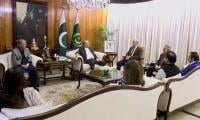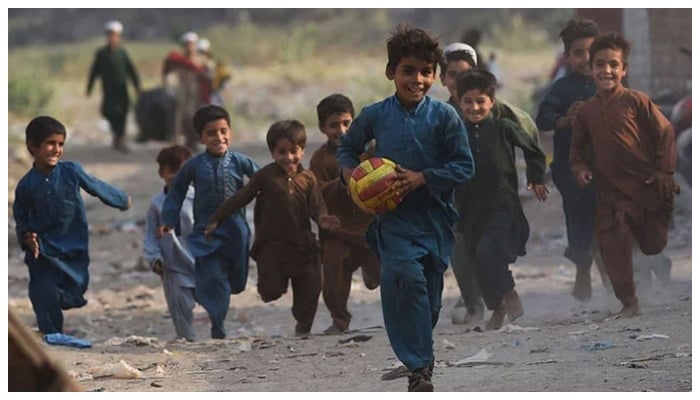
I was recently in a meeting on Pakistan’s SDG commitments. The language was familiar, which we have been hearing for many years now. Education emergency. Learning crisis. SDG-4. SDG-4. And there were renewed commitments of increasing enrolment and sending every OOSC (out of school child) to school.
Recently Prime Minister Shehbaz Sharif also declared a National Education Emergency, vowing to personally oversee a drive to bring 26 million out-of-school children back into the classroom. While sitting there in the meeting, I just could not stop wondering: where will the children sit? And has anyone in the room checked the numbers.
The way we talk about the issue suggests we are dealing with a fixed problem. We talk about the issue as if it is a backlog that can be cleared with enough effort. As if these 20-26 million children are waiting in a long line, and once we move them forward, the problem will be solved. In reality, the crisis is a high-speed conveyor belt that never stops; for every child we manage to ‘clear’ and seat in a classroom, the population growth adds three more to the other end. Pakistan’s population is growing at around 2.55 per cent every year. We are producing children faster than we can buy them seats or place them in a classroom.
To understand why the current model or our calculations seems like a mathematical fantasy, high-performing countries manage around 25 students per classroom. In urban Punjab, Sindh and Khyber Pakhtunkhwa, teachers face 50 or 60 children packed into a single room. Now zoom out and see the larger picture.
Let’s imagine 2050 as we may have already missed the SDGs’ deadline of 2030. By 2050, Pakistan will be the fifth most populous country in the world, with close to 400 million people. Around 120 million of them will be of school going age. Even if we collectively decide to do nothing, keeping our enrolment rates exactly where they are today, the sheer force of population growth makes even the status quo incredibly expensive.
To simply maintain our current, overcrowded student-to-classroom ratios for the massive wave of children arriving by 2050, we would need to build more than 1 million new classrooms across the country. We are looking at an infrastructure bill of tens of billions of rupees every year just to stand still and prevent the system from falling further behind.
But let us suspend disbelief for a moment and imagine the SDG dream actually comes true. What if Pakistan reaches 100 per cent enrolment by 2050? In Punjab alone, moving from today’s fragile status quo to universal enrolment for an estimated 65 million children would require more than 1.6 million classrooms across primary, middle, and matric levels. At a modest cost of four million rupees per classroom, the annual construction bill would approach Rs200 billion. That is before hiring a single teacher or paying a single utility bill.
Sindh’s numbers are no kinder. A province where less than one in four primary students has a seat waiting at matric level would need roughly 800,000 classrooms to educate all its children. Khyber Pakhtunkhwa would require more than 600,000. Balochistan, despite its vast geography, would still need around 275,000 classrooms to serve its 11 million school age children.
To put this into perspective, all four provinces combined currently struggle to complete 6,000-7,000 classrooms a year. To meet the 100 percent enrolment target by 2050, Pakistan would need to build close to 90,000 classrooms every single year. We are not behind schedule. We are in a different universe.
The problem becomes further complicated when you look at the needed land, or the lack of it. In the dense sprawl of Karachi, Lahore, Multan or Faisalabad, there is simply no government land available anymore. By 2050, buying land for even a single primary school in a crowded urban neighbourhood would cost more than building the school itself. The secondary system is even worse. Our modest success in enrolling children at the primary level has created a delayed crisis at middle and matric levels, where there are literally no classrooms ready to receive them as they grow older. What looked like progress in the early years turns into a bottleneck that the system has no capacity to handle.
Lastly, and most importantly, bricks and mortar are only half the problem; the real fiscal time bomb is the human resources needed. To achieve 100 percent enrolment for 120 million children by 2050 while maintaining a ratio of 40 students per teacher, Pakistan would need to employ an army of roughly three million teachers. That is nearly double the 1.7 million we have today. Current spending patterns suggest we are already at a breaking point. In the 2025-26 budget, more than 80 per cent of Pakistan’s total education expenditure is absorbed by ‘recurrent costs’, the polite term for a massive, ever-expanding bill for teachers’ salaries and pensions. How will we pay the three million teachers?
‘The math isn’t mathing’. Perhaps it is time to be honest about what the state can and cannot do. The government cannot act like a landlord and recruiter anymore. The state cannot solve this crisis by pouring more concrete into classrooms that take years to finish and for which we don’t have money to staff them appropriately.
The government needs to change how it thinks about education. Instead of owning every building and running every classroom, it should act more like a regulator and partner. Public money should follow the child, not the brick. In other words, pay for children who are actually in classrooms learning, and let others, private schools, NGOs or communities, manage the buildings and staff. Without this shift, the education emergency will remain permanent. We are running out of money, running out of land and running out of time.
To reach universal enrolment by 2050, Pakistan must rethink the entire model. Otherwise, all the promises, speeches, and SDG targets will collapse under the weight of numbers nobody wants to calculate.
The writer is a development professional based in Peshawar, who works on governance reforms and institutional development.