KARACHI: Pakistan’s solar photovoltaic (PV) capacity could save more than $100 billion in fossil fuel imports, as the country’s official energy statistics present an incomplete picture of its rapidly evolving energy landscape, according to new research by Renewables First, a think-tank.
The policy paper, titled ‘Electrons In, Hydrocarbons Out: Pakistan’s Quest for Economic and Resource Efficiency’, argues that Pakistan’s continued reliance on imported fossil fuels imposes recurring macroeconomic costs and significant physical energy losses, while consumer-led electrification and renewable energy adoption is proving to be more efficient and resilient.
“Much of Pakistan’s energy debate continues to rely on incomplete data; we aim to plug that gap,” said Sohaib Malik, senior fellow -- energy transitions at Renewables First. “Our research shows how the rapid uptake of distributed solar is already reshaping Pakistan’s energy system and provides a more consistent basis for policymakers to achieve energy security and economic resilience.”
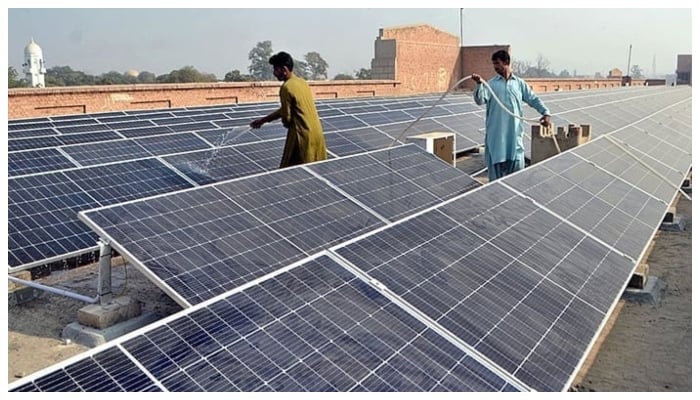
For years, Pakistan’s energy statistics have overlooked a growing shift. Despite economic growth and an expanding population, reported energy supply has remained largely unchanged. The research suggests this is not due to structural changes in the economy or significant efficiency gains, but rather incomplete measurement. Households, farmers and businesses have been installing solar panels to cope with high electricity costs and unreliable supply, effectively creating a parallel energy system outside official reporting.
The analysis shows that in FY24 alone, distributed solar PV could have generated 19 terawatt hours (TWh) of electricity (nearly one-fifth of national grid supply), displacing roughly five million tonnes of oil equivalent (MTOE) of fossil fuels. This indicates that Pakistan’s energy demand has not fallen; it has simply shifted into a form the system was never designed to record.
This transformation becomes more striking when compared with the structure of Pakistan’s fossil-fuel-based energy system. Imported oil, gas, and coal place a heavy macroeconomic burden on the economy, given the volatility of global fossil fuel prices and Pakistan’s currency depreciation, while delivering energy very inefficiently. The data show that every rupee spent on fossil fuels loses about 59 per cent of its energy value to physical losses.
Unlike fossil fuels, solar PV is a long-term asset. What may appear in trade data as an import expense is, in effect, the creation of an energy asset that will continue producing electricity for decades.
“This is a structural shift in how foreign exchange is used,” said Nabiya Imran, co-author of the paper. “Solar converts upfront imports into decades of domestic energy supply, rather than ongoing fuel dependence.”
From the fiscal years 2017 to 2025, Pakistan imported $7.4 billion worth of solar panels and an additional $2-3 billion in inverters and balance-of-system equipment. Together, these imports represent generation infrastructure rather than fuel consumption. By June 2025, Pakistan had imported around 48 gigawatts (GW) of solar PV capacity, which could help avoid $100-120 billion in future fuel imports over its lifetime. Factoring in the more than 50 GW of solar PV capacity imported to date, potential savings could be even higher. This shift effectively converts spending that would otherwise go to volatile fuel markets into a domestic, enduring energy resource.
As solar generation and electrification expand, Pakistan is gradually moving towards what the paper describes as an “electrostate”, where electricity becomes the dominant carrier of energy in the economy due to its superior efficiency. Electric technologies convert 80-90 per cent of energy into useful work, compared with 20-40 per cent for combustion systems.