The government of Pakistan has done something no ruler, empire, dynasty or civilisation in human history has managed to do: It has taxed the sun. From the Pharaohs to the Romans. From the Mughals to the British Empire. Kings taxed land. Emperors taxed salt. Colonial powers taxed tea. But no one -- not even at the height of imperial ambition -- taxed sunlight. Until now.
For 4.6 billion years, the sun has risen without invoice. It has shone without a billing code. It has powered crops, warmed oceans and lit villages free of charge. Civilizations have worshiped it, feared it, depended on it. No one has ever sent it a tax notice. Until now.
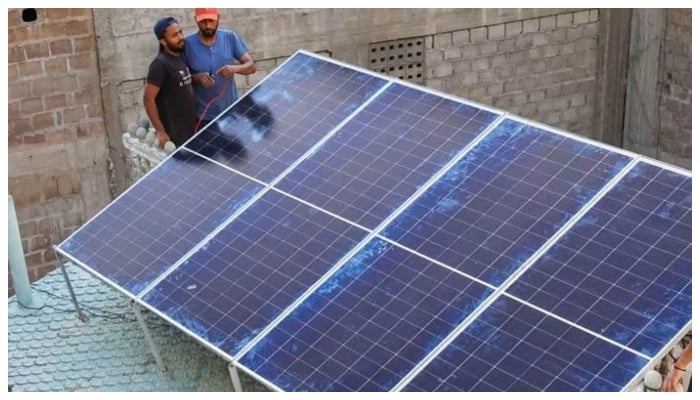
A Pakistani household installs solar panels to escape soaring electricity tariffs. A Pakistani household invests its own savings. A Pakistani household takes its own risk. A Pakistani household reduces pressure on the grid. A Pakistani household reduces imports of furnace oil, coal and LNG. A Pakistani household reduces circular debt.
And the government of Pakistan responds: Thank you. Please pay. This is energy reform!Let us now do the arithmetic. If a household exports one unit of solar electricity to the grid, it is paid roughly Rs8 per unit. If that same household imports one unit from the grid, it pays roughly Rs50 per unit. Same electron. Same country. Same wire.
One direction: Rs8. The other direction: Rs50. The difference? Rs42. Call it what you like -- adjustment, rationalisation, restructuring -- it is a Rs42 tax on sunlight. And in all of human history, no state has managed to tax the sun itself.
The government of Pakistan’s stated objective is to protect the grid -- the unstated reality is to protect inefficiency. Fact 1: Pakistan does not import sunlight. Fact 2: Pakistan imports fuel.Red alert: In a dollar-short economy, discouraging free energy is not reform. It is arithmetic denial. The new solar policy violates Pakistan’s Alternative & Renewable Energy Policy 2019.
The new solar policy runs contrary to Pakistan’s commitments under the Paris Agreement. The new solar policy undermines progress toward UN Sustainable Development Goals on clean energy and climate action. The new solar policy violates Article 24 of the constitution of Pakistan. The new solar policy breaches the doctrine of legitimate expectations.
The government of Pakistan must tax three more things: moonlight, oxygen and rainfall. The government of Pakistan must begin working on a ‘cloud utilisation adjustment surcharge’.Someone in the government deserves a Nobel Prize for discovering this new economic principle: if you produce something yourself, it is worth less; if the system produces the samething inefficiently, it is worth more. This is not classical economics. This is reverse economics -- where efficiency is discounted and inefficiency is rewarded.
Red alert: Oil is imported. LNG is imported. Coal is imported. Sunlight is domestic. And a country short on dollars has chosen to discourage what it has in abundance.For 4.6 billion years the sun has risen tax-free. The government of Pakistan has finally sent in a bill. The sun will rise tomorrow. The question is whether we will tax it again. And when a state begins taxing sunlight, the problem is not energy — it is economics.
The writer is an Islamabad-based columnist.