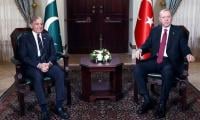
ISLAMABAD: Prime Minister Shehbaz Sharif on Monday cleared Pakistan cricket team to play India in the T20 World Cup on February 15 in Colombo, ending a week-long stand-off.
“In view of the outcomes achieved in multilateral discussions, as well as the request of friendly countries, the Government of Pakistan hereby directs the Pakistan national team to take the field against India,” Sharif posted on X.
Sources privy to the matter revealed that the decision was made during a telephonic contact between Prime Minister Shehbaz Sharif and Sri Lankan President Anura Kumara Dissanayake. According to a statement from the Prime Minister’s Office, the two leaders discussed the T20 World Cup match between Pakistan and India during the call. The Sri Lankan president requested PM Shehbaz that Pakistani cricket team should play the match against India in Sri Lanka.
Pakistan fully supported Sri Lankan cricket during terrorism in Sri Lanka, the president said, adding that Pakistan gave priority to its long-standing relations with Sri Lanka above everything else and the Pakistani cricket team continued touring Sri Lanka to play cricket despite terrorism.
PM Shehbaz welcomed the sentiments of the Sri Lankan president. He said that Sri Lanka also provided full support in difficult times and cricket continued in Pakistan. “Recently, the Sri Lankan team took an unforgettable step for the Pakistani nation and cricket fans by not cancelling the tour of Pakistan,” the PM added. He told the Sri Lankan president that he would inform him of the final decision after consultations regarding the Pakistan-India match of the T20 World Cup.
Sources confirmed earlier on Monday that PM Shehbaz Sharif would make the ultimate decision after consultations with PCB Chairman Mohsin Naqvi, who was scheduled to brief him on recent negotiations with the ICC and Bangladesh Cricket Board (BCB).
Talks in Lahore over the weekend brought together ICC Deputy Chairman Imran Khwaja and BCB President Aminul Islam, with the PCB playing the role of facilitator. Discussions lasted over five hours, focusing on Pakistan’s refusal to play India and Bangladesh’s grievances over exclusion from certain ICC arrangements. While the ICC responded positively to some of Bangladesh’s demands, no breakthrough was achieved regarding Pakistan’s stance.
The ICC warned of massive financial losses — estimated at PKR 140 billion (over $500 million) — if the February 15 clash in Sri Lanka does not go ahead. Reports suggested Pakistan tabled conditions for reconsideration, including increased ICC revenue share, restoration of bilateral cricket with India, continuation of the hybrid hosting model, and compensation for Bangladesh.
Analysts are calling a “masterstroke of cricket diplomacy,” as Lahore became the focal point of international cricket politics. The arrival of ICC Deputy Chairman Imran Khwaja and BCB President Aminul Islam for high-level talks with PCB Chairman Mohsin Naqvi signalled Pakistan’s growing influence in shaping the sport’s governance.
The meetings, held at Gaddafi Stadium, were not mere courtesy calls. They addressed pressing issues: Pakistan’s boycott of the India match, Bangladesh’s demands for fair treatment, and the ICC’s financial concerns. Sources say Pakistan strongly advocated for Bangladesh, demanding full revenue shares, hosting rights for future ICC events, and guarantees against exclusion.
By hosting both ICC and BCB leaders simultaneously, Naqvi positioned Pakistan as a bridge-builder and a potential leader of a new Asian cricket bloc. This move challenges the dominance of the BCCI, which has long held sway over ICC finances and scheduling. Analysts suggest Pakistan is leveraging the India boycott to push for broader reforms, aligning with Bangladesh to create a counterbalance within the ICC.
The symbolism of Lahore hosting these talks is significant. It projects Pakistan as a safe, central hub for cricket diplomacy and event hosting. With the Champions Trophy and World Cup security arrangements also on the agenda, the PCB is using this moment to reinforce its credibility on the global stage. The broader outcome of these talks would reshape cricket’s power dynamics.
Separately, the International Cricket Council (ICC) press release said on Monday that an open, constructive and cordial dialogue with the Pakistan Cricket Board (PCB) and the Bangladesh Cricket Board (BCB) had been concluded, covering a range of matters, including the ICC Men’s T20 World Cup 2026 and the broader outlook for cricket in South Asia.
During the discussions, the ICC reflected on the Bangladesh national team’s absence from the ICC Men’s T20 World Cup and reaffirmed the Bangladesh Cricket Board’s standing as a valued full member of the ICC, with a proud cricketing heritage and a vital role in the global growth of the sport.
The ICC reiterated its continued commitment to supporting the development of cricket in Bangladesh—one of the game’s most vibrant markets with over 200 million passionate fans—and stressed that the team’s non-participation in the tournament would not have any long-term adverse impact on cricket in the country.
The outcomes of the dialogue, reached in good faith, reflected a forward-looking alignment among the stakeholders and were intended to provide clarity on the current position. These understandings did not alter or detract from the ICC’s constitutional autonomy, governance framework, or established decision-making processes, which remain fully applicable.
The statement made it clear that it was agreed that no financial, sporting, or administrative penalties would be imposed on the BCB in relation to the current matter.
The discussions also acknowledged that the BCB retained its right, under existing ICC regulations, to approach the ICC Dispute Resolution Committee (DRC), should it choose to do so. “The ICC’s approach is guided by principles of neutrality and fairness, reflecting a shared objective of facilitative support rather than punitive measures,” added the statement.
The statement said that as part of the understanding reached, it was agreed that Bangladesh would host an ICC event between 2028 and 2031, prior to the ICC Men’s Cricket World Cup 2031, subject to standard ICC hosting processes, timelines and operational requirements.
The agreement reflected confidence in Bangladesh’s hosting capabilities and reinforced the ICC’s commitment to providing meaningful hosting opportunities across its membership to support the development of cricket in the country.
The ICC, PCB and BCB, along with other Member Boards, reaffirmed their commitment to continued dialogue, cooperation and constructive engagement in the best interests of the sport, according to the statement. All parties stressed that the spirit of the understanding was to protect the integrity of the game and preserve unity within the global cricket fraternity.
Commenting on the discussions, ICC Chief Executive Sanjog Gupta said: “Bangladesh’s absence from the ICC Men’s T20 World Cup is regrettable, but it does not alter the ICC’s enduring commitment to Bangladesh as a core cricketing nation. Our focus remains on working closely with key stakeholders, including the BCB, to ensure the sport grows sustainably in the country and that future opportunities for its players and fans are strengthened. Bangladesh remains a priority cricket ecosystem deserving of long-term investment in its development, competitiveness and global integration, and is not defined by short-term disruptions.”
Meanwhile, the Bangladesh Cricket Board (BCB) in a statement extended its sincere appreciation to the Pakistan Cricket Board (PCB), the International Cricket Council (ICC) and all involved for their positive roles in trying to overcome recent challenges.
It said, ““In particular, the BCB wishes to express its profound and heartfelt gratitude to PCB Chairman Mohsin Raza Naqvi, his Board and the cricket fans of Pakistan. Throughout this period, the PCB has demonstrated exemplary sportsmanship and solidarity.”
BCB President Md Aminul Islam said: “We are deeply moved by Pakistan’s efforts to go above and beyond in supporting Bangladesh during this period. Long may our brotherhood flourish. “Following my short visit to Pakistan yesterday and given the forthcoming outcomes of our discussions, I request Pakistan to play the ICC T20 World Cup game on 15 February against India for the benefit of the entire cricket eco system.”