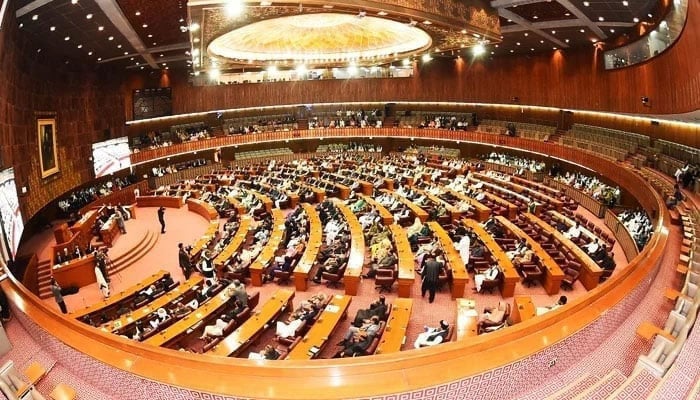
ISLAMABAD: The National Assembly on Tuesday passed ‘The Virtual Assets Bill, 2026’ which aims to establish a regulatory authority for the licensing, regulation and supervision of virtual assets and virtual assets service providers.
The bill, already passed by the Senate, was moved by Minister for Parliamentary Affairs Dr. Tariq Fazal Chaudhry for passage after suspending business of the private members’ day through a motion. The bill provides a comprehensive legal framework to empower the said authority to combat money laundering, terrorist financing, proliferation financing and other illicit activities involving virtual assets, in accordance with international standards.
The Pakistan Virtual Asset Regulatory Authority (PVARA), as an autonomous corporate body, shall be empowered to licence, regulate and supervise virtual asset service providers and issuers in the country. The PVARA was already established under a presidential ordinance promulgated in July last year and the same was going to lapse this month.
The bill says it will “protect customers and investors and the integrity of Pakistan’s virtual asset markets by establishing and enforcing appropriate safeguards and conduct of business requirements, prudential and operational-resilience, risk-management standards and measures to prevent money laundering, terrorist financing and other illicit use of virtual assets”. It shall also attract investment and encourage companies operating in the field of virtual assets to base their businesses in Pakistan. Moreover, Authority shall “promote responsible innovation, digital financial inclusion and development of compliant virtual asset markets within a framework that manages risks and supports financial stability and market integrity”. The body shall promote, develop, govern, and regulate the adoption, deployment, and scalable use of blockchain technology and distributed ledger technology across Pakistan, the bill further states.
The legislation also states that the PVARA will coordinate with the Financial Monitoring Unit, National Anti-Money Laundering and Counter Financing of Terrorism Authority and other relevant authorities, as well as law enforcement agencies, to combat money laundering, terrorist financing and other illicit activities associated with virtual assets, in accordance with the Anti-Money Laundering Act, 2010, other applicable laws and international standards. It will also advise the government on “regulatory, supervisory, technical or emerging-risk matters relating to virtual assets, digital asset markets, tokenisation, stablecoin structures, blockchain, distributed ledger technology, cyber-risks or any matter connected with its mandate”.
The bill also authorises the Authority to devise “regulations, standards, directives, guidelines, handbooks and circulars, or any other instrument”, consistent with the objectives of the legislation and other applicable laws. It will also be authorised to set risk-management, cybersecurity, data protection and technical standards and “issue, vary, suspend or revoke licences, approvals or directives under this Act and prescribe conditions for such actions”.
The bill further states that it may prescribe licencing conditions, eligibility criteria, renewal requirements and any additional obligations for those issued licences under the yet to be formalised PVARA law. It will also be authorised to conduct on-site inspections and off-site monitoring of licencees and other entities to ensure compliance with this PVARA law and other relevant rules and regulations.
The body may also ensure compliance with “data protection, data governance and cyber security obligations by virtual asset service providers subject to supervisory follow-up”. It will also be empowered to impose administrative sanctions in accordance with the provisions of the PVARA law and “levy such fees, charges and penalties as may be prescribed by rules” devised under this law.
The bill states that “whoever, willfully, provides an unlicenced virtual asset service shall be punishable with imprisonment for a term up to five years, or with fine up to Rs50 million, or both”. It also says that whoever conducts an initial virtual asset offering in contravention” of the rules and regulations established under the PVARA law shall be punishable with imprisonment for a term up to three years or with fine up to Rs25m or with both.The bill also penalises market manipulation and insider trading.