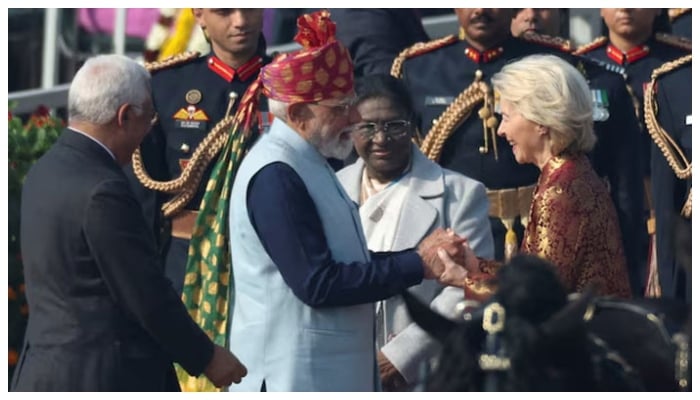
On January 27, 2026, the signing of the India-EU Free Trade Agreement, widely seen as the mother of all trade deals, effectively ended the era of preferential dominance by Pakistan and Bangladesh in European markets.
For Pakistan, the zero-tariff moat provided by the GSP Plus status is no longer a competitive advantage; it is now the baseline. To survive this shift, Pakistan must pivot from reactive diplomacy to a strategy I call ‘economic preemption’.
Economic preemption is a precautionary political doctrine in which a state aggressively restructures its domestic cost base and regulatory framework before external shocks, such as a rival’s FTA, render its industries obsolete. It moves beyond strategic hedging by focusing on an internal radicalisation of efficiency rather than just external balancing of alliances.
The current reality is that Pakistan has enjoyed a 10-12 per cent tariff advantage over India in the EU for years. With that gap closing to zero, the battlefield has shifted from market access to operational efficiency. Bangladesh is already suffering because its graduation from Least Developed Country status coincides with India’s new zero-duty access, creating a potential 24 per cent price swing against Dhaka.
Pakistan finds itself in a precarious middle ground. It retains GSP Plus for now, but its edge has eroded. If an Indian factory and a Pakistani factory both export a shirt to Berlin at zero per cent duty, the buyer will choose the one with lower energy costs, faster shipping, and better compliance. Currently, Pakistan is losing on all three.
Pakistan’s mission must shift from seeking additional concessions to aligning with the regional price floor. The first target is the energy benchmark. Pakistani exporters pay nearly twice as much for electricity as their Indian and Vietnamese counterparts. Preemptive politics requires an export-first energy grid that decouples industrial feeders from the circular debt burden to ensure regional parity. The second target is logistics compression. India’s FTA is backed by massive infrastructure investments. Pakistan must operationalise the CPEC Phase II Special Economic Zones not as real estate projects, but as duty-free manufacturing islands that bypass the systemic inefficiencies of the mainland.
To counter the Indian surge, Pakistan must hit specific diversification targets by 2027. Textiles dominate 60 per cent of current exports. Pakistan must aggressively incentivise the IT and green manufacturing sectors to account for 40 per cent of the export basket. We cannot win a price war on basic yarn against India, which has zero-duty access and superior economies of scale.
Pakistan must also build a compliance fortress. The EU is moving toward the Carbon Border Adjustment Mechanism. Pakistan must pre-emptively adopt EU-standard environmental and labour audits. If we cannot compete on price, we must compete on clean trade credentials, which India’s coal-heavy industrial base may struggle to pivot toward quickly.
Finally, Pakistan should position itself as the gateway for Central Asian goods to the EU. By leveraging the TIR Convention and modernised rail links, Pakistan can earn transit rent and integrate its own products into wider regional supply chains. The India-EU FTA is a terminal wake-up call. Bangladesh’s current anxiety is a trailer for Pakistan’s future if it remains tethered to the rent-seeking model of seeking international pity-concessions.
The mission is no longer about maintaining GSP Plus. It is about making GSP Plus irrelevant by becoming so efficient that we could compete even if we paid full duties. Through economic preemption, Pakistan must dismantle the systemic inefficiencies of tax burdens and red tape or watch its $9 billion EU export share be swallowed by a more agile neighbour.
The writer is the manager of R&D at Carbo-X.