When Nawab Akbar Bugti was killed in August 2006, I was in Mastung on a work-related assignment with the UNDP. What was meant to be a routine field visit became an extended and unsettling stay. Roads were blocked, transport ceased and movement across the region became impossible for several days as Balochistan entered yet another phase of unrest.
Bugti’s killing sent shockwaves across the province, hardening emotions and paralysing daily life. That episode remains vivid not merely because of the inconvenience or uncertainty it caused, but because it offered a stark illustration of how quickly political decisions taken at the centre can reverberate across Balochistan. The Musharraf government’s decision regarding Akbar Bugti was defended at the time as a matter of state authority. Yet among those I spoke to while stranded in Mastung – teachers, traders, local officials – the prevailing sentiment was despair. Bugti was not viewed as a militant commander operating outside the political system; he was seen, however controversially, as a constitutional actor with a long, if turbulent, engagement with the Pakistani state. His death reinforced a deeply rooted belief that when political disagreement in Balochistan reaches an uncomfortable point, coercion tends to replace dialogue.
Nearly two decades on, it is difficult to escape the conclusion that the events of 2006 marked a turning point. The insurgency did not begin with Bugti’s killing, but that episode widened it, radicalised it and altered its social base. It also entrenched a pattern that continues to shape the state’s approach: Balochistan is treated primarily as a security problem, and dissent is viewed through the prism of disloyalty rather than democratic disagreement. The consequences of that approach are now unfolding with renewed intensity.
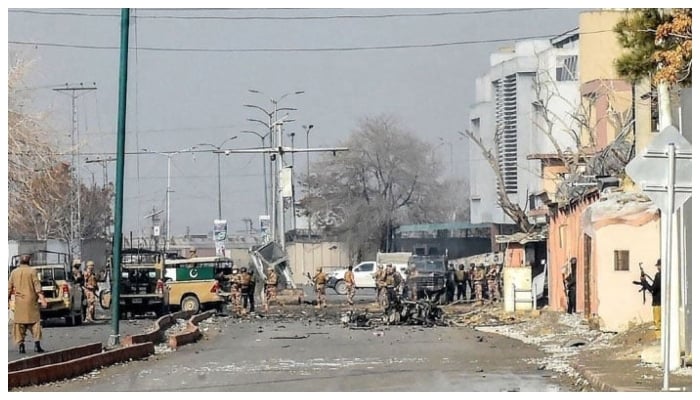
There is no denying the seriousness of the current security challenge. There have been highly lethal terror attacks on civilians, security personnel and infrastructure across the province. These actions are reprehensible and cannot be justified under any political or moral framework. The state has a legitimate duty to protect life and uphold public order, and that includes the use of force. But force alone has never constituted a sustainable strategy. When kinetic action becomes the dominant lens through which Balochistan is viewed, it risks perpetuating the very instability it seeks to contain.
Years of intellectual and professional engagement in the province suggest that the roots of the problem lie well beyond militancy. Over the past two decades, through development-sector work with UN agencies and through sustained association with the Human Rights Commission of Pakistan, I have travelled extensively across Balochistan and spent long hours in conversation with political workers, lawyers, educators, civil servants and ordinary citizens. These interactions consistently point to a political and governance deficit that predates and outlasts any particular insurgent group.
Balochistan’s alienation has been shaped by a history of interrupted political processes, weak civilian administration and contested resource sharing. Elected governments have repeatedly been dismissed or rendered ineffective. Large swathes of the province experience the state primarily through security checkpoints rather than through schools, courts or healthcare facilities. Development initiatives, when undertaken, are often perceived as externally driven and insufficiently consultative. When people experience governance as distant and unaccountable, the space for constitutional politics narrows. Despite repeated security operations, attacks have grown in scale and sophistication. These violent groups have demonstrated the capacity to mount coordinated assaults across multiple locations.
Particularly troubling is the changing profile of those drawn into terrorist violence. In conversations across the province, a recurring theme is the perception that peaceful avenues for dissent have been systematically closed. Instead of addressing the legitimacy gap, the state has increasingly turned towards regulating and criminalising speech. Laws originally framed to counter cybercrime and terrorism have been used to target journalists, activists and lawyers. Advocacy on issues such as enforced disappearances, criticism of security policies, and even the sharing of dissenting opinions on social media have been treated as criminal acts.
The recent convictions of rights advocates Imaan Mazari and Haadi Ali Chattha have drawn strong domestic and international criticism. The damage is not limited to reputation abroad. In Pakistan, such cases reinforce the perception that the state is unwilling to tolerate peaceful dissent. None of this diminishes the reality of external interference, though. Regional geopolitics, cross-border sanctuaries and foreign support for militant groups have undoubtedly complicated the security environment in Balochistan. Pakistan is justified in raising these concerns at international forums and in seeking action against armed groups operating beyond its borders. But external factors can only exploit existing vulnerabilities. Internal legitimacy remains the most effective defence against external manipulation. A recalibration of policy, therefore, must begin by restoring politics to the centre of the state’s engagement with Balochistan. This requires credible elections, strengthened provincial institutions, and genuine engagement with non-violent nationalist forces.
Dialogue should not be viewed as a concession but as an essential function of federal governance. History suggests that insurgencies and violent militants lose traction where political processes are seen as meaningful. Addressing enforced disappearances through transparent, lawful mechanisms is equally critical. Due process is a prerequisite for trust. A state that insists on legality strengthens its own authority.
The development policy must also be reimagined. Large infrastructure projects and strategic investments will not build legitimacy unless they translate into tangible improvements in local lives. Communities must see themselves as partners rather than spectators. This means employment opportunities, environmental safeguards and meaningful consultation. Development imposed without consent risks reinforcing alienation. Above all, the state must reconsider its conception of loyalty. In a diverse federation, patriotism cannot mean uniformity of opinion. It must be grounded in adherence to a constitutional order that protects disagreement. Treating dissent as treason may produce temporary silence, but it undermines the social contract that sustains the state in the long run.
Balochistan cannot be pacified into loyalty, nor can its grievances be legislated away. A state that listens signals confidence; a state that silences reveals insecurity. Treating Balochistan as a permanent security file – and dissent as a threat to be eliminated – has brought Pakistan to its current impasse. Treating Balochistan as a political partner and dissent as a democratic necessity is a more demanding path. It is also the only one that offers a credible route out of a cycle that has already exacted too high a cost.
The writer is dean of the faculty of liberal arts at a private university in Karachi. He tweets/posts @NaazirMahmood and can be reached at: [email protected]