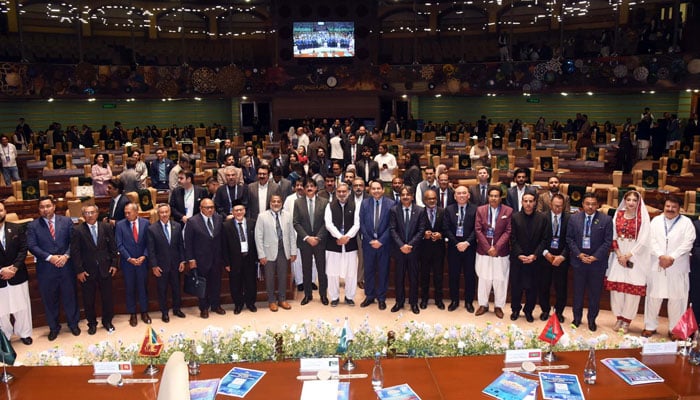
Hosted by the Sindh Assembly, the 7th CPA Asia Regional Conference and the 2nd Joint CPA Asia & South-East Asia Regional Conference concluded on Friday. Sindh Chief Minister Syed Murad Ali Shah was the chief guest of the closing ceremony of the three-day conference.
Addressing the ceremony, Sindh Assembly Speaker Syed Awais Qadir Shah said hosting foreign parliamentary delegates within the historic Sindh Assembly was a milestone, reflecting institutional confidence, transparency and openness. He noted that while previous CPA Asia conference in Karachi was limited to hotel, this time the Assembly building itself was opened for an international conference.
Awais said the presence and active participation of foreign delegates was the true success of the conference. Key subjects discussed in the event included parliamentary accountability; responsible innovation; inclusion of youth, women and marginalised communities;, and the role of parliaments in peace and democratic stability.
CPA Secretary General Stephen Twigg termed his participation in the conference an honour and praised the Sindh Assembly and the host team for exemplary arrangements and outstanding hospitality.
He said the next CPA Asia Regional Conference would be held in Sri Lanka. He added that the CPA’s new strategic plan would be launched in London later this month, providing a comprehensive roadmap to strengthen parliaments by 2030. He outlined the CPA’s three core objectives: strengthening parliaments, providing training, and promoting shared values.
He added that gender equality, persons with disabilities, youth, technology, and climate change were among the CPA’s key priorities, as the world currently faced serious challenges related to democracy, human rights, trust, climate change, conflict and instability.
The conference concluded with the adoption of the Karachi Declaration. He said the Karachi Declaration reflected a collective resolve to address these challenges, emphasising that cooperation between Asia and South-East Asia was the CPA’s real strength, while regional forums remained the organisation’s backbone.
Sri Lankan Deputy Speaker Dr Rizvi Salih described the conference as memorable and highly successful, praising the Sindh Assembly and CPA Sindh Branch for setting a high standard of parliamentary hospitality. He added that Pakistan had reaffirmed its commitment to parliamentary democracy and regional cooperation, while the reception hosted by the Sindh chief miof beautifully reflected Sindh’s culture and traditional hospitality.
Maldives Deputy Speaker and CPA International Executive Committee Member from the Asia Region Ahmed Nazim praised Pakistan, the Sindh Assembly and organising committee for their hospitality and excellent arrangements.
He stated that Maldives would host the conference next April, and acknowledged that the current conference had set a benchmark for future hosts. The closing ceremony was also addressed by Punjab MPA Zulfiqar Ali Shah, Leader of the Opposition in the Sindh Assembly Ali Khurshidi, and Balochistan MPA Farah Azeem Shah along with Speaker of the Perak State Legislative Assembly, Malaysia, Dato’ Seri Mohammad Zahir Bin Abdul Khalid.
The Sindh Assembly speaker formally unveiled the Karachi Charter, which was unanimously adopted at the conclusion of the conference. The charter reaffirmed commitments to strengthening democratic institutions, restoring public trust, promoting inclusive parliaments, responsible innovation and sustainable peace.
It emphasised the essential role of parliaments, constitutional supremacy and executive accountability in strengthening democratic systems. It supported robust parliamentary oversight mechanisms, particularly the public accounts committees, transparent governance, and responsible use of public resources.
It also called for meaningful inclusion of women, youth, persons with disabilities, religious minorities, and marginalised groups through reforms in parliamentary rules, public awareness, democratic education, and capacity-building initiatives.
Acknowledging the growing impact of technology and artificial intelligence, the Karachi Charter stressed digital governance, open parliament initiatives, countering misinformation, hate speech, and digital harassment, while safeguarding freedom of expression.
Addressing the ceremony, the Sindh CM said trust was built not merely through speeches but through transparency, accountability, justice, and responsible use of public resources. He stressed the importance of genuine representation of women, youth, minorities, and persons with disabilities for a strong democracy.
He expressed the hope that the Karachi Declaration would be implemented as a practical commitment rather than remaining a symbolic document. After the closing ceremony, a Sindh cultural bazaar was set up on the lawns of the Sindh Assembly, showcasing traditional cuisine and handicraft highlighting Sindh’s rich heritage.