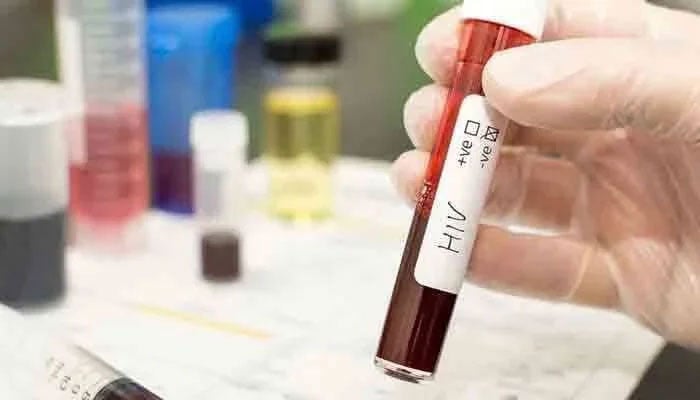
Fears of another HIV outbreak in Sindh intensified on Saturday after 26 children and two healthcare workers at the Gambat Institute of Medical Sciences (GIMS) in Khairpur tested positive for HIV within the last 10 days, while fresh HIV cases continued to emerge from Ratodero and Larkana, the districts previously hit by Pakistan’s worst paediatric HIV outbreak.
Health officials said that five new paediatric HIV cases were detected at GIMS on Saturday alone, while six more HIV cases, including four children and two adults, were reported from Ratodero during the day.
In addition, two adults tested positive for HIV in Larkana on Friday, taking the total number of newly reported HIV cases from Ratodero and Larkana to eight over the last two days.
Officials said that eight HIV infected children had been admitted to a special isolation ward at GIMS, where one girl later died due to complications, while seven critically ill HIV positive children remained under treatment with severe pneumonia and diarrhoea.
Officials of the Sindh Health Department and GIMS also confirmed that screening of healthcare workers at the facility revealed HIV infection in two members of the nursing and paramedic staff, raising concerns about infection control practices and possible healthcare associated transmission of blood-borne infections.
GIMS Director Dr Rahim Bux Bhatti said that seven HIV positive children were currently admitted at the hospital, while one infected child had died during treatment, adding that most children reaching GIMS were already critically ill and had been referred from different districts of upper Sindh for emergency care.
“Severely sick children are being referred to GIMS, and when they are screened for HIV, some of them are testing positive,” Dr Bhatti said.
He added that GIMS did not have a dedicated HIV treatment centre and, therefore, only critically ill children were being admitted, while stable patients were being referred to HIV treatment centres in Larkana, Sukkur and other districts.
According to Dr Bhatti, HIV screening at GIMS was initially being carried out through rapid testing kits, while confirmation required HIV PCR (polymerase chain reaction) blood testing, which detects the genetic material of the virus.
He said children from Sukkur, Naushahro Feroze and Shaheed Benazirabad were also being referred to GIMS, and added that all admitted children were being screened for HIV, and hepatitis B and C.
“As we are screening all admitted children for HIV and viral hepatitis, some are testing positive either for HIV, hepatitis or both infections,” he said.
Officials of the Directorate General of Health Services Sindh confirmed the newly reported HIV cases but maintained that the number of confirmed infections was not as high as being reported by some sections of the media.
A senior Sindh health official said that screening at GIMS was not entirely being carried out through World Health Organisation (WHO) pre-qualified kits and, therefore, all positive cases required verification through approved testing protocols before official confirmation.
However, district health officials in Khairpur and some GIMS officials claimed that the actual number of HIV infections detected in recent weeks could be significantly higher than officially documented.
According to them, at least 125 HIV cases have been identified since April 1, 2026, but many earlier patients had already been referred to HIV treatment centres in Larkana, Sukkur and other districts.
Health officials said that screening of all children for HIV and viral hepatitis was intensified after the recent Mpox outbreak in Khairpur and the surrounding areas.
“It was decided after the Mpox outbreak that every child brought to GIMS would be screened for HIV, and hepatitis B and C,” a health official said, adding that HIV had now emerged as one of the most commonly detected infections among seriously ill children arriving at the hospital.
Officials further disclosed that a team from CDC-I Sindh independently screened several HIV positive children at GIMS using WHO pre-qualified kits and some cases were again found positive.
According to officials, the Sindh Health Department had assured GIMS authorities of supplying WHO pre-qualified HIV screening kits, but the kits had yet to reach the hospital.
Health experts associated with the investigations said that reuse of syringes, IV cannulas, IV sets, contaminated needles, unsafe blood transfusions, and poor infection control practices by quacks and careless healthcare providers remained the most likely causes behind rising HIV infections among children in upper Sindh.
The continued emergence of HIV cases from Ratodero and Larkana has alarmed health experts because Ratodero was the epicentre of Pakistan’s largest paediatric HIV outbreak in 2019, with hundreds of children there having been infected due to unsafe medical practices.
The latest cases have emerged at a time when Sindh continues to report one of the country’s highest HIV burdens among children.
Official HIV surveillance data shows that Sindh reported 3,859 new HIV cases during 2025, while another 894 cases were registered during the first three months of 2026, averaging nearly 300 new HIV infections per month in the province.