PESHAWAR: The Khyber Pakhtunkhwa Apex Committee meeting chaired by Chief Minister Muhammad Sohail Afridi on Thursday marked a decisive reset in the province’s counterterrorism policy and civil-military coordination. The provincial government, security institutions and military leadership publicly demonstrated institutional alignment.
They agreed that terrorism can no longer be addressed as a narrow security issue but must be confronted through an integrated framework combining force, governance reform, political consensus and public partnership.
“The civil government, administration and Pakistan Army are all on the same page to maintain peace and stability and will work together. This is our joint war and it can be won through collective efforts,” the chief minister remarked while speaking at the Apex Committee meeting.
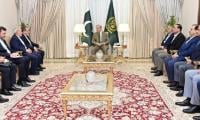
The high-level meeting, held in Peshawar on February 4, brought together provincial ministers, corps commander of Peshawar, chief secretary, inspector general of police and senior civil, military and law enforcement officials.
At the outset, the forum offered fateha for civilians, security personnel and members of law enforcement agencies martyred in recent terrorist attacks, paying tribute to their sacrifices.
The committee undertook a comprehensive review of the security situation across Khyber Pakhtunkhwa, with particular focus on the rise in terrorist incidents and the threat posed by terrorists.
Participants agreed that the resurgence of militancy poses a direct challenge not only to law and order but to governance, public confidence and institutional credibility, requiring a unified and sustained response.
The meeting marked a dramatic shift in the province’s political and institutional dynamics. Since taking office on October 15, 2025, the chief minister had been seen maintaining a cautious distance from the security establishment, a stance that drew close attention from political and institutional circles.
However, after his recent meeting with Prime Minister Shehbaz Sharif, Sohail Afridi’s approach underwent a transformation, signalling alignment with the establishment on key security and governance issues.
In contrast, former chief minister Ali Amin Gandapur has long been perceived as enjoying strong ties with the establishment, a perception reinforced by party insiders who often described him as being the establishment’s preferred point of contact.
The Apex Committee session, therefore, not only reflected policy convergence but also a recalibration of political positioning at a moment when security imperatives demanded unified action.
The forum agreed that the success of a comprehensive counterterrorism policy depends on collective consultation and cooperation among all political parties, elected representatives, community elders and the federal government.
It was emphasized that militancy cannot be defeated by institutions acting in isolation, and that political ownership and societal engagement are essential to restoring stability. The committee resolved that the provincial government would deploy all available resources without hesitation to restore peace, including the police, Counter Terrorism Department and other law enforcement agencies, in close coordination with security forces.
Peace and public safety were reaffirmed as the government’s foremost priorities, with participants agreeing that no compromise would be made on law and order.
In a notable conceptual shift, the Apex Committee termed terrorism as a multidimensional governance and development challenge. The forum acknowledged that militancy feeds on administrative weaknesses, service deprivation and public alienation, and that eliminating these underlying drivers is critical for sustainable peace.
As part of a long-term strategy, the committee decided that terrorism-affected regions would be transformed into model good-governance districts in the first phase.
All provincial resources will be mobilised to address long-standing deficiencies by improving security, communications, healthcare, education, employment opportunities and access to basic services, with the objective of rebuilding public trust and strengthening the state’s presence.
Under a structured programme, special development and social sector packages will be introduced in these areas to support economic recovery and service delivery. Officials maintained that visible governance, development and opportunity are essential to closing the space exploited by militant networks and preventing the recurrence of violence.
The Apex Committee also addressed the issue of temporary displacement resulting from security operations, stressing that sustainable stability cannot be achieved without protecting affected populations.
It was decided that during any displacement, the government would ensure full care, rehabilitation and provision of basic necessities, declaring the dignified return of affected families a top priority.
The chief minister reiterated that peace remains the government’s highest priority and that it will not be compromised. He emphasised that the civil government, provincial administration, military leadership and law enforcement agencies are now aligned and will continue joint efforts against terrorism, describing it as a collective struggle that requires collective resolve.
The Apex Committee endorsed a clear policy direction: Khyber Pakhtunkhwa’s counterterrorism posture will now move forward as an integrated civil-military governance model, where coordinated operations, political consensus, governance reform and development delivery operate as mutually reinforcing pillars.
The message emerging from the Apex Committee was unambiguous; peace will be secured not only by eliminating militants, but by eliminating the conditions that allow militancy to endure.