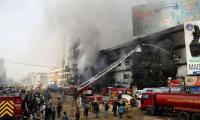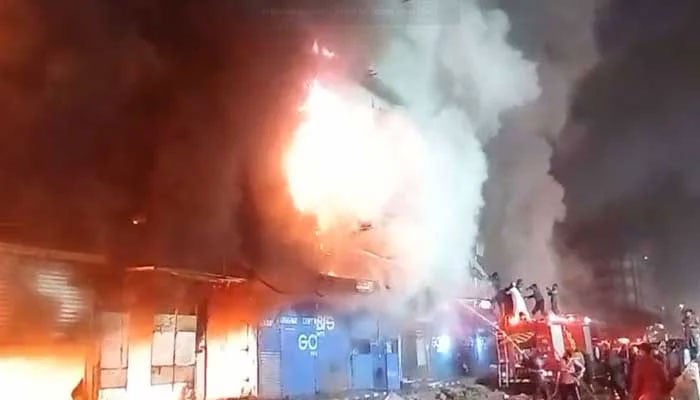
Urban planners, fire safety experts, civil society representatives, and labour rights activists have called for immediate reforms to prevent recurring fire tragedies in the biggest city of the country, Karachi.
They expressed serious concerns over fire safety, weak building regulations, and the absence of workers’ protection mechanisms in the public buildings as they spoke at a multi-stakeholder dialogue titled ‘Fire Safety: Building Regulations and Workers Protection’ organised by The Knowledge Forum at the Karachi Press Club on Saturday.
Amber Alibhai of the Shehri-Citizens for a Better Environment (CBE) highlighted the lack of awareness among both citizens and government agencies regarding fire safety. She criticised the provincial government for converting public spaces into commercial areas without ensuring basic safety provisions.
“Many commercial buildings do not even have fire extinguishers. In case of fire, there are no emergency exits or alternative escape routes,” she said, adding that such negligence placed thousands of lives at risk on a daily basis.
Occupational Health and Safety expert Naeem Sadiq suggested forming a citizens’ commission to monitor the health and safety arrangements in public places. The commission should ensure that building bylaws were enforced, launch awareness campaigns, advocate for increasing fire stations and personnel, and prioritise safety over security, he added.
He said the city’s resources and response capacity had failed to keep pace with rapid urbanisation. Referring to past tragedies such as the Baldia factory fire, he said that despite repeated incidents, no serious or sustained debate had taken place.
“Over a thousand people have lost their lives due to chemical exposure, suffocation, and boiler explosions,” he remarked. He also highlighted the deaths of over 300 sanitary workers across Pakistan while cleaning manholes, terming it a failure of occupational safety systems.
He expressed apprehension that tragedies like the Gul Plaza blaze might not stop because we did not treat people as human beings. “We focus on compensation rather than accountability,” he said.
Zahid Farooque of the Urban Resource Centre (URC) said the recent Gul Plaza fire had deeply saddened the citizens. He said Karachi, now among the world’s largest cities, continued to witness unchecked high-rise construction without adequate safety planning. “Multi-storey buildings mushroomed, but emergency exits and safety systems were ignored,” he lamented.
Tariq Moin of the Fire Protection Association of Pakistan (FPAP) discussed the technical and legal dimensions of fire safety. He said the Building Code of Pakistan 2016 provided clear guidelines, but their implementation remained weaker. “The real killer is not fire, but smoke,” he said, adding that emergency exits, smoke detectors, sprinklers, fire hoses and evacuation drills were essential.
He noted that fire extinguishers had become scarce and expensive following recent incidents, while controlling authorities were virtually non-existent. Fire expert Saeed Jadoon listed major fire disasters in Karachi such as the fires at the Regent Plaza, Baldia factory, Nishtar Park, Karsaz and several markets.
He said the fire brigade received 20 to 25 fire calls daily, but only Gul Plaza attracted the attention of the media. “The fire department is efficient, but firefighting must be modernised. There is no firefighting law in Pakistan, only a civil defence law,” he said, advocating for remote-control firefighting technology and institutional mergers.
Other speakers suggested the continuation of such meetings of the experts in the city so that a long-term strategy could be developed. Chairman of the National Forum for Environment and Health Naeem Qureshi, journalist Sarfraz Ahmed, Shujauddin Qureshi, Munaza Rajput and Director of The Knowledge Forum Zeenia Shaukat also spoke.