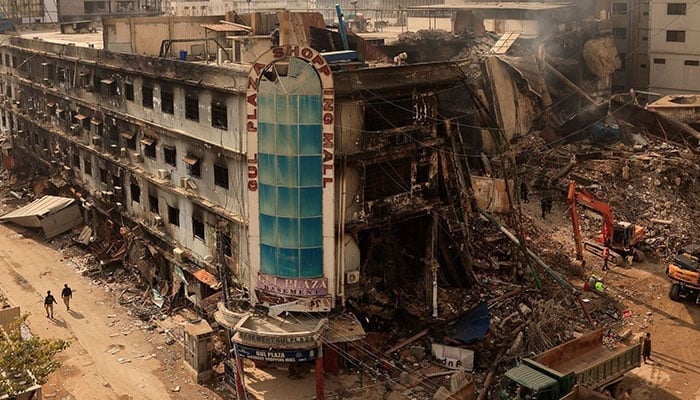
I first came to know Gul Plaza not as a headline, but as a place woven into the ordinary rhythms of life. In the 1990s, when I taught at the IBA City Campus, the plaza lay barely a few minutes’ walk away. It was part of the neighbourhood’s commercial geography – familiar, crowded, imperfect, yet alive.
Years later, when my wife’s sister was getting married, we visited Gul Plaza several times to buy household items, clothes and wedding essentials. Like thousands of Karachiites, we navigated its narrow corridors without ever imagining that one day those same passages would turn into death traps. Even today, I live barely a kilometre from where the blaze erupted. On the night of January 17, I watched from close quarters as flames engulfed the building and smoke rose over the city’s historic core. I also witnessed something else: a swelling crowd that, despite good intentions, clogged access roads, slowed emergency vehicles and complicated rescue efforts.
It was a painfully familiar Karachi scene: tragedy magnified by disorder. That night, it became impossible to view the Gul Plaza fire as an abstract policy failure. It was personal. And it is precisely for that reason that this tragedy demands more than ritual outrage. The inferno that tore through Gul Plaza on Karachi’s MA Jinnah Road, killing around 79 people and leaving dozens of families suspended between grief and waiting, was not a freak accident. It was not an unpredictable act of fate, nor can it be reduced to the convenient fiction of a careless spark.
It was the foreseeable outcome of governance failure. Karachi has seen fires before. Pakistan has seen them too often. Yet each time, the same ritual unfolds: shock, condolences, promises of inquiry, selective suspensions, political shouting matches – and then, quietly, amnesia. Gul Plaza must not be allowed to join that list without forcing a reckoning. What burned at Gul Plaza was not merely a commercial complex of 1,100 shops; it was the credibility of regulatory institutions entrusted with public safety. Old, congested, poorly ventilated, and structurally compromised, the building had operated for decades despite repeated warnings, audits and court cases.
Emergency exits were locked as a matter of 'routine practice'. Fire alarms, smoke extraction systems and basic evacuation planning were absent or dysfunctional. These were not hidden flaws. They were documented. The crucial question, therefore, is not what ignited the fire, but why a structure with such a long and visible history of violations was allowed to function at all. Pakistan’s urban history is littered with similar tragedies. In 2012, a blaze at the Ali Enterprises garment factory in Karachi killed more than 250 workers trapped behind barred windows and locked doors. In 2014, the Lakhani factory fire claimed lives under eerily similar conditions. Lahore’s Hafeez Centre fire in 2020 destroyed livelihoods and exposed gross violations of fire safety codes in one of the city’s busiest commercial hubs. In Peshawar, fires in markets such as Saddar and Chowk Yadgar have repeatedly laid bare the absence of enforcement and preparedness.
Each incident has followed the same script: illegal construction, ignored inspections, underfunded emergency services, congested access roads, and post-disaster inquiries that rarely translate into sustained reform. The lesson has been written repeatedly in smoke and ash, yet institutions behave as if each tragedy were unprecedented.
At Gul Plaza, failure was systemic and multi-layered. Start with the Sindh Building Control Authority (SBCA), whose statutory responsibility is to ensure compliance with building codes. Records show Gul Plaza was flagged repeatedly – in 1992, 2015, 2021 and again in audits conducted after 2023. Violations were documented. Notices were issued. Court cases were filed. Yet the building remained operational, its risks compounding year after year. This is not mere negligence; it is institutional paralysis. Over the past decade, the SBCA has been weakened by constant leadership churn. Directors-general have come and gone with alarming frequency, often without explanation.
Equally troubling is the role of Civil Defence, which conducted audits, issued warnings and then failed to follow through. Notices without enforcement are bureaucratic alibis. The suspension of two officials after the fact may satisfy procedural optics, but it raises a deeper question: how many such notices across Karachi and Sindh are currently gathering dust, waiting for the next tragedy to expose their irrelevance?
Then there is plaza management, which bears direct responsibility for locking exits, ignoring safety upgrades and continuing operations despite repeated warnings. That management did not respond to media queries is telling. But private negligence flourishes only when public oversight is weak. Even after the fire broke out, the city’s structural weaknesses compounded the disaster. Fire tenders reportedly faced delays in water supply. Access was hindered by traffic congestion, encroachments and narrow roads. Rescue 1122 and KMC firefighters reportedly worked with courage but had inadequate equipment, training and coordination. One firefighter, Furqan Shaukat, paid with his life.
This is the hidden cost of underfunding emergency services. Fire brigades cannot compensate for decades of neglect with bravery alone. Nor can ambulances and rescue teams overcome urban dysfunction created by poor planning, broken roads and unmanaged crowds. In a city that contributes billions to the exchequer, the persistent weakness of firefighting and rescue capacity is a political choice. Sindh Senior Minister Sharjeel Inam Memon’s announcement of a judicial inquiry acknowledges, at least rhetorically, that accountability is necessary. The suspension of officials, removal of the KMC municipal commissioner and calls for institutional consolidation under one umbrella may be steps in the right direction.
But accountability is not declared; it is demonstrated. Public confidence has been further eroded by reports suggesting that the fire was caused by a minor child playing with matches – a narrative that opposition parties have rightly rejected as implausible and morally evasive. Blaming an 'innocent child', whether metaphorical or literal, shifts focus from decades of documented violations to a convenient, voiceless scapegoat. If accountability is serious, it must examine not just frontline officials but policy decisions, leadership instability, budgetary neglect and political interference. Why were repeated warnings ignored? Why were unsafe buildings allowed to remain operational? Why do inspections rarely result in closures? Why are enforcement officers transferred when they attempt to do their jobs?
The controversy surrounding celebrity remarks, and the government’s sharp reaction to them, reveals another troubling dimension: an intolerance for criticism that distracts from substantive issues. Political point-scoring after mass death is indeed in bad taste. But so is conflating criticism with disrespect. Satire often emerges where accountability is absent. The anger directed at a comedian, rather than at the conditions he was highlighting, reflects a deeper insecurity within governance structures.
The public outrage following Gul Plaza did not originate on a television show; it arose from lived experience. Numbers, however grim, cannot capture the full weight of this tragedy. Survivors like Muhammad Imran describe darkness so complete that people could not see their own hands. Locked doors turned corridors into traps. Smoke funnelled upward by poor design suffocated those who tried to escape. Others went back inside to help colleagues or search for family members and never returned.
Parents now visit the site daily, not asking for compensation or statements, but for remains. Voice messages of farewell circulate on social media, haunting reminders of lives lost while institutions failed. This is what bad governance looks like when it becomes intimate – when it reaches into families, livelihoods and memory. What makes Gul Plaza especially unsettling is how unexceptional it is. Similar risks exist across Pakistan’s cities. Residential areas quietly converted into commercial zones. Low-rise plots sprouting extra floors. Fire exits blocked to create more rentable space. Inspections conducted, reports filed, violations ignored.
When conscientious officers attempt enforcement, they are often transferred. When master plans conflict with commercial interests, the plans quietly lose. Over time, citizens internalise the message: rules exist only on paper. In Pakistan, prime ministers have been removed over legal and constitutional disputes. Courts have taken suo motu notice of matters far less consequential than mass loss of life. If governance is truly a trust delegated by citizens, then repeated failures that kill dozens should provoke accountability at the highest levels.
The writer is dean of the faculty of liberal arts at a private university in Karachi. He tweets/posts @NaazirMahmood and can be reached at: [email protected]