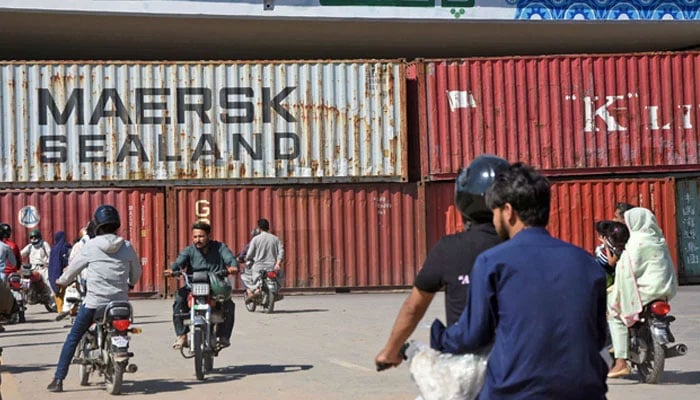
What does it take for downtown Karachi to be pushed into traffic mayhem during evening peak hours, affecting thousands of commuters? The threat of a protest demonstration by, potentially, a few hundred civil society activists.
This is what happened on Monday: roads leading to the Karachi Press Club were blocked for hours by containers and buses. This was an attempt by the local administration to deny lawyers, journalists and human rights defenders the right to protest the trial and conviction of advocates Imaan Mazari and Hadi Ali Chattha.
A sessions court in Islamabad had sentenced Mazari and her husband Chattha to a total of 17 years in prison on the previous Saturday in a case linked to social media posts. But my point of reference here is the disruption in Karachi and how it was just one example of what citizens have to bear almost on a daily basis.
As for Monday’s protest outside the Press Club, it should be noted that it is there that most protests are staged. It is the destination of rallies held by various political and trade union groups. Occasionally, law-enforcement agencies come down hard to block a particular demonstration, as was the case this time.
It did not seem to matter that the Press Club’s president, Fazil Jamili, called the operation a violation of the fundamental right of peaceful assembly. Apparently, the club was put under siege to stop citizens from joining the protest which, incidentally, was held and reported. One person they stopped on the way was Zulfiqar Bhutto, Jr.
When discussing fundamental rights, it should be possible to spare some thought for the rights of Karachi’s ordinary citizens, who do not generally intend to bring about a revolution. In fact, they get exhausted in their daily struggle for survival. And in this struggle, their daily commute between home and work is increasingly an unbearable burden.
This is where a traffic jam plays a sinister role. It is true that Karachi’s traffic woes have worsened due to the slow pace of construction on the Bus Rapid Transit (BRT) Red Line project, leaving University Road in constant disrepair. But beyond this major barrier, traffic conditions across all sectors of the city remain critical.
By the way, the Sindh government announced on Wednesday that it plans to open the main corridor of the Red Line project on the University Road by March. It would appear that this relief is being promised against the backdrop of mounting criticism of the provincial government’s governance in Karachi in the wake of the Gul Plaza disaster.
The human tragedy that the Gul Plaza fire is unfolding has become the latest catalyst in reviving all kinds of political and administrative tensions that are exclusive to Karachi and this is one of my justifications for writing one more column on the abiding sorrows of this city by the sea. Despite the present efforts to create a public transport system, belated by ages, it is hard to imagine that Karachi can be a city at peace with itself. So deeply is it wounded.
That is why I am using the idea of a traffic jam as a metaphor. It means to be caught in a difficult situation. Karachi cannot find its way out of the quagmire it has become because of its exploitation, often lawlessly and senselessly. The story of Gul Plaza itself would exemplify some congenital traits of Karachi’s development.
One way to look at Karachi is to borrow the perspective of someone visiting the city after an interval. I have had an occasion to do that a number of times in recent days, since many relatives and friends were here from abroad on vacation and to attend weddings. Invariably, they see Karachi in decline and the traffic situation is a major source of their dismay.
A friend was exceptionally frustrated because he was in Gulistan-e-Jauhar and all family gatherings and dining outs were in the Defence area. He could not decipher the quicker route at any given time.
Now, carping about traffic congestion in a big city like Karachi would seem like a frivolous exercise. It is common in many other places, though an efficient mass transit system is the hallmark of major cities even in the developing world. And Karachi has other measures to judge its status. I have mentioned Gul Plaza. But this is not the occasion to consult experts in, say, town planning and the management of public utilities.
In addition, there are other aspects that make Karachi somewhat unique. Consider the complexities of its ethnic and linguistic divides and the endless inflow of people from other parts of the country. After all, Karachi for so many years was very much like a fiefdom of the MQM and it is also the largest Pashtun city in the world. A person I met in Peshawar wouldn’t believe this observation.
Leaving expert opinions aside, I would suggest another way of searching for the reality of Karachi. Just drive around the city, jams or not, and explore all its neighbourhoods. It might take days but it can be very revealing. The traffic itself, with impatient bikers ruling the roost on potholed streets, might take your breath away.
Then, compare the poor, distant localities with the posh sectors situated nearer the sea. Imagine the ways in which they relate to each other in the same city. There is one sight that you are unlikely to encounter in any other city, if you happen to be a traveler. It is the presence of armed guards, many in uniform, either outside large mansions or following their masters’ SUVs in double cabins on main roads.
What does this open show of force indicate? Experts tell us that uniformed men on the streets are a sign of social disequilibrium. And the rulers’ loss of authority.
The writer is a senior journalist. He can be reached at: [email protected]