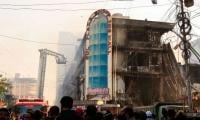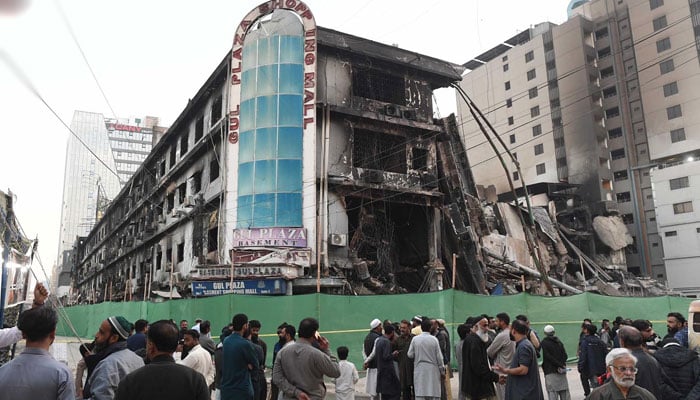
Authorities have decided to re-record the statements of the children, as new questions emerge over legal responsibility following the inquiry findings into the Gul Plaza tragedy.
While the deadly fire at Karachi’s Gul Plaza exposed serious negligence on the part of government administration, rescue agencies, plaza association — failures that not only caused losses worth billions of rupees but also claimed 79 lives according to official figures — a fresh and complex legal question has now surfaced: who should be held legally responsible?
The key questions now are whether, in light of the inquiry report prepared by the Karachi commissioner and the additional inspector general of police, the names of the children will be included in the FIR, or whether proceedings will instead be initiated only against their guardians — or against both. Another critical issue is whether, if the children are found to have been working in the shops, cases will also be registered against their parents under the Child Labour Act. Furthermore, it remains to be seen whether legal action will be taken against the market association for failing to prevent the employment of children in shops within the market.
The FIR registered in the case does not nominate any individual for starting the fire. However, a report prepared by the Karachi commissioner and released earlier this week has categorically concluded that the blaze was triggered by a 13-year-old boy playing with matchsticks.
According to the inquiry report, after closing his shop, the boy, Aryan, 13, went to a neighbouring artificial flower shop, where he was playing with matchsticks along with another child Huzaifa, 11, — his friend and the neighbouring shop owner’s son. The fire allegedly started during this activity and rapidly spread, eventually turning into the deadly inferno that engulfed Gul Plaza.
This finding has raised serious legal questions, especially since the FIR includes Section 322 of the Pakistan Penal Code, which pertains to qatl-bis-sabab (death caused without intention). The commissioner’s report states that statements of the children were formally recorded, in which they admitted that the fire started due to their actions.
The key question now is: if an FIR has been registered under Section 322 PPC and the inquiry report establishes responsibility, will legal action be taken against the children involved? Will their names be added to the FIR, despite the fact that one child is 13 years old and the other only 11?
These unresolved questions have placed both the investigating officers and the administration under renewed pressure. When The News sought comments from Inspector General of Police Sindh Javed Alam Odho and Additional IG Karachi Azad Khan, no response was received. A senior Karachi police officer closely monitoring the case since day one also failed to provide a clear answer. “We are still undecided and are recording their statements again,” the officer said.
To seek legal clarity, The News contacted SSP (retd) Niaz Khosa, a former senior police officer who has investigated hundreds of cases and is currently practising law. He explained that negligence is the central issue in this case.
“In such cases, the children are minors, and whatever happened occurred due to immaturity and negligence,” Khosa said. “Under the law, legal responsibility may extend to the parents or guardians of the child whose negligence caused the incident.”
Elaborating further, he gave an example: “If a person’s pet causes harm to someone, the FIR is not registered against the animal but against its owner. Similarly, in the Gul Plaza case, if negligence is established, legal proceedings would likely be initiated against the guardians — not the children themselves.”
As investigations continue, the Gul Plaza tragedy has now entered a new phase, one that will test not only the investigative framework but also the legal and moral responsibilities defined under Pakistan’s criminal justice system.
On the other hand, when The News contacted senior advocate of the Sindh High Court Abid Zaman, a seasoned criminal law expert, he said that in this case both the children and their parents were negligent and would have to face legal action. “Pakistan has a well-defined juvenile justice system in place, under which, if it is established that the fire was caused by the children, they would be proceeded against strictly under juvenile laws,” he explained.
Zaman added that legal action would also be initiated against the parents (fathers) on charges of negligence for leaving the children unattended. “If it is found that the children were working at the shops, proceedings will also be initiated against the parents under child labour laws,” he said. “In addition, action would be taken against the market’s traders’ association or union for allowing children to work in shops within the market.”
Further explaining his position, Abid Zaman cited an example, stating that if an underage child causes a road accident while driving a car, legal proceedings are initiated not only against the minor but also against the owner of the vehicle.
He also raised serious concerns over the nature of the investigation, stressing that the case cannot be decided solely on statements and assessments. “Forensic and scientific evidence is extremely important in such a case,” he said, adding that one of the most critical aspects of the Gul Plaza fire inquiry is determining whether the incident was an act of sabotage — and, if so, identifying who stood to benefit from it.
According to the report, the fire was triggered by a 13-year-old boy who, after closing his shop, was playing with matchsticks at a neighboring artificial flower shop owned by his 11-year-old friend, Huzaifa. The matchsticks ignited the flowers, which quickly caught fire and spread.
“I was playing with matchsticks. The flowers caught fire. Everyone there tried to extinguish it, but the fire spread rapidly. My father and I then evacuated the area along with others to save our lives,” the report stated.
In the report, a 13-year-old Aryan, son of a shopkeeper, Muhammad Adil and a resident of Rehman Chowk, Hussainabad, told the investigators in the report that on January 17, he was at their shop on the ground floor of Gul Plaza with his father. Around 10pm to 10:15pm, after closing the shop, he went to his friend Huzaifa’s artificial flower shop, where he was playing with matchsticks. The flowers caught fire, and despite efforts by people nearby to extinguish it, the fire spread rapidly throughout the lane. His father and he himself evacuated the area along with others to save their lives.
The investigators also recorded Huzaifa’s statement. Muhammad Huzaifa, son of Naimatullah, a resident of Pathan Colony, Nazimabad, stated that on January 17, while he was at artificial flower shop in Gul Plaza, Aryan threw a matchstick, which caused the fire. He and neighbouring shopkeepers tried to extinguish it, but the fire spread rapidly. Waleed, a neighbouring worker, pulled him out, and the fire quickly spread throughout the lane. He informed my brother Kamran, who advised us to evacuate immediately.
The investigators also recorded the statement of the artificial shop owner, Naimatullah, father of Huzaifa. According to the report, in his statement, Naimatullah said that he had been working at Gul Plaza shopping center for about 15/20 years. In 2018/2019, he started a second shop number 193 Ground Floor, New Tawakal Gift and Flower Shop. He and his sons Kamran, 26, and Huzaifa aged, 11 years, used to come to the shop from home at 12:45pm in the afternoon. He would open the shop by 1:15pm after offering Zuhr prayers and would close the shop at night around 11pm. On 17 January, he went to a wedding in Zia Colony at 8:30pm, leaving behind Kamran at shop number 287 and Huzaifa at shop number 193. At night, around 10:15pm, his son Kamran called him that there was fire in shop 193. He reached Gul Plaza at around 10:40pm to 10:45pm, when he looked at gate number 12 there was nothing but fire and smoke, there was chaos of people running around, the intensify of fire and smoke were very severe.
The investigation report into the Gul Plaza tragedy revealed that the fire, which broke out in a shop, went out of control within minutes. Rescue teams faced severe challenges in extinguishing the blaze due to an acute shortage of water, limited access to the building, and the unavailability of modern firefighting equipment.
According to the report, Gul Plaza was not equipped with a fire alarm system, sprinklers, or any fire suppression mechanism. A delay in cutting off the electricity further intensified the fire. The building also lacked adequate and accessible emergency exits, many of which were found blocked or closed. Thick smoke filled staircases and corridors, trapping occupants inside, while the mezzanine floor was the worst affected.
Rescue 1122 stated that it received information about the fire at 10:36pm; however, by that time the blaze had already spread to a dangerous extent. Heavy smoke and darkness posed life-threatening conditions for rescue personnel, while the absence of timely cutting tools caused delays in removing iron grills. The report also highlighted negligence on the part of the Water Board, noting that delays in water supply from hydrants and low water pressure severely hampered firefighting efforts.