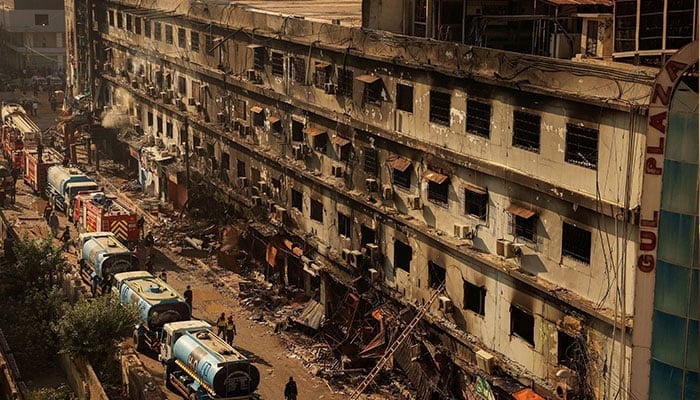
The site where Gul Plaza once stood is now a graveyard. It is the site where horrific scenes emerged of people desperately trying to escape in the darkness after the electricity was cut, and on finding doors locked, no way out. Those who managed to escape and the thousands of people who have passed by since saw the fire’s intensity and the dark smoke that rose from it.
As of last count, 79 people have been killed, with the remains of 23 identified. After 10 days of fighting the blaze and conducting search operations, what remains of Gul Plaza has now been sealed. Forensic and inspection teams have been called in.
What is to happen next? Barely 48 hours after the fire began, real estate developers announced that they will rebuild Gul Plaza. On the floor of the Sindh Assembly last Friday, Chief Minister Murad Ali Shah presented plans to reconstruct Gul Plaza within two years.
A rebuilt Gul Plaza will reverberate with the screams of the dead. Scenes of flames and thick smoke billowing will engulf visitors upon entry. Gul Plaza, as it was, is no more. Today, it is a graveyard. To think of it as anything else except for a place where those who have been killed by the negligence of several government departments is nothing but callous.
A memorial dedicated to those killed is the only thing that must exist on the site now. It must serve as a brutal reminder for those whom the city failed. It must make our administrators feel pain, or expose their lack of it.
Memorialising after a tragedy is not only about mourning the dead; it also helps us reflect on the scale of the disaster. Disasters rupture everyday life so completely that there is an inadequacy of words and even time itself. A memorial at the site of Gul Plaza will create a space where Karachi can acknowledge its grief. If we do not memorialise, we also risk the reduction of those dead to mere statistics, alongside a Rs10 million compensation for those killed, and a five lakh rupee subsistence for traders.
It is also important that the Gul Plaza Memorial be located at the site of Gul Plaza itself, not elsewhere. We must not only memorialise it by an artwork in a government office, or by an essay years after the tragedy. Physical sites carry memory in ways that archives and reports cannot. A yearly Twitter reminder or a news story commemorating the disaster’s anniversary is simply not enough.
The Gul Plaza Memorial must demand accountability by fixing responsibility in place, making it harder to displace blame or rewrite history, something which, of course, has already begun on the floors of our assemblies and the screens glued to our palms.
Karachi has a history of building over the dead. In the 1857 War of Independence, those who fought for a free Sindh and the Subcontinent were executed by tying them in front of cannons. To commemorate these freedom fighters, the people of Karachi would lay flowers and light oil lamps at the site of the execution. The making of a shrine had emerged.
To avoid the memorialisation of those who had fought for the Subcontinent, the British Raj established the Empress Market. Today, we do not remember Sooraj Bali Tivari and Ram Din Panday. We instead buy cheap groceries, take architecture students on field trips, and become fascinated by a clock tower. In the last decade, the KMC has removed hundreds of stores from Empress Market, depriving thousands of workers of a livelihood, yet has still not put up a single sign indicating that this is where Karachi resisted the Raj.
After 9/11, when the twin towers of the World Trade Centre were destroyed, New York City decided upon the construction of the 9/11 Memorial, where two giant square reflecting pools are present today, at the site where the towers once stood. They remember those killed by Al-Qaeda in New York and the thousands killed in the Iraq War.
Memorials are also in vogue in Pakistan. India’s attack and Pakistan’s victory last year is being commemorated by a massive Marka-e-Haq Monument in Islamabad.
Will we make Gul Plaza a painful reminder, or do we only care about going to a shopping mall?
The writer is the managing editor of Folio Books.