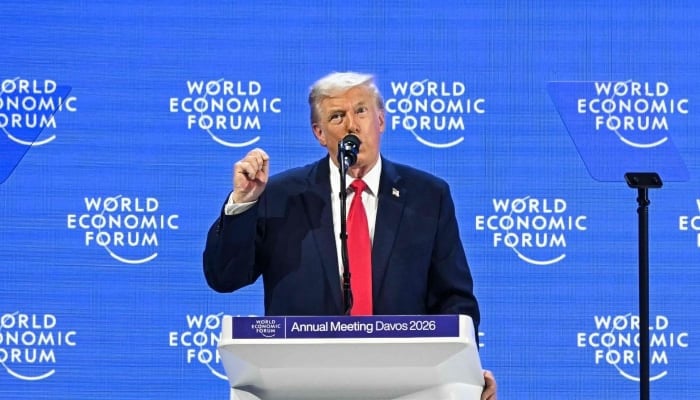
Davos 2026 was not a celebration of globalisation but a stark confrontation with its unravelling assumptions. For decades, the World Economic Forum symbolised the steady advance of integration – deeper trade ties, expanding supply chains and the belief that economic interdependence would anchor stability and prosperity.
This year, that confidence was replaced by unease. Geopolitical risk dominated conversations and the familiar language of multilateralism sounded hollow against escalating trade tensions, coercive diplomacy and strategic rivalry.
The central question was no longer how to deepen globalisation, but how to navigate a world in which economic relations are increasingly shaped by power.
Two speeches encapsulated this shift. US President Donald Trump’s address was muscular, transactional and unapologetically unilateral, reaffirming a worldview in which tariffs, pressure tactics and leverage are legitimate instruments of statecraft. In contrast, Canadian Prime Minister Mark Carney delivered a sobering diagnosis: the US-led rules-based international order has effectively ended – not through a gradual transition, but through a rupture. The old agreement under which predictable rules moderated power is collapsing, and with it the comfort that interdependence automatically delivers security and prosperity.
Trump’s recent policies are no longer skirmishes. His sweeping tariff strategy now touches China, Europe, Canada and much of the global trading system, effectively weaponising trade as a tool of foreign policy. Added to this are a hard line on Venezuela’s energy sector and the extraordinary Greenland gambit, which rattled Nato allies and damaged transatlantic trust. These are not routine policy disagreements but serious geopolitical stress tests.
Economic tools that once served efficiency and growth are now instruments of coercion. Alliances built on trust and predictability are being tested in ways unseen in recent decades.
The cumulative impact is increasingly visible: trust in predictable US leadership is eroding; governments are accelerating hedging across trade, technology, energy, and finance; multilateral rules are weakening as power politics returns; and states are reclaiming policy space and emphasising sovereignty over efficiency.
Yet these strains have not led to widespread decoupling from the US, which remains central to global finance, security and innovation. There is no immediate alternative to the scale, liquidity or institutional depth of American markets. Global portfolios remain heavily ‘long America’, reflecting both confidence and the absence of credible substitutes.
That position – the world’s net $27.6 trillion exposure to US assets – underscores how deeply embedded the US remains in the global financial system. Foreign investors hold approximately $68.9 trillion in US securities, while US investors hold about $41.3 trillion abroad, leaving a sizeable net long position in US assets.
Yet even this bulwark of investment is now under reassessment. Recent geopolitical turbulence and policy unpredictability have reignited debate about whether such stretched exposure can be sustained. Some European pension funds have already begun trimming their US bond holdings, while advisers to major institutional investors report growing discussions about reducing exposure to American assets.
A wholesale exodus is unlikely in the near term. No other market matches the depth and liquidity of the U.S. capital markets, and large-scale divestment would entail forgoing exposure to many of the world’s most innovative companies.
But the pace of net capital inflows matters as much as the total stock of investment. The US currently relies on roughly $1 trillion or more each year in net foreign capital to finance its current account deficit. Should geopolitical risk gradually reduce these inflows – even without dramatic sell-offs – US asset valuations could come under pressure, borrowing costs could rise and the narrative of American financial exceptionalism could weaken.
In short, a gradual realignment of global investment flows, driven by strategic hedging, could have real macroeconomic consequences for the US itself.
Europe’s response at Davos was telling. Leaders spoke openly of ‘derisking’ not only from China, a theme of recent years, but also increasingly from the US. Supply chains are being redesigned for resilience. Capital flows are being diversified. Indigenous defence capabilities are rising on national agendas. New coalitions are forming beyond traditional alliances.
This is not dramatic decoupling. It is a quiet, enduring recalibration.
Carney’s call for values-based realism resonated because it rejected nostalgia for a vanished order and blind faith in its return. He urged middle powers to act together, build partnerships grounded in shared standards and reduce vulnerability to coercion. Sovereignty, he argued, is not preserved through dependence on a hegemon but through resilience and collective action.
The assumption that economic integration alone would contain geopolitical rivalry has proven false. Interdependence can be weaponised and reliance without contingency can quickly become vulnerability.
For emerging economies and the Global South, this rewiring of globalisation presents both risks and opportunities. A more fragmented global landscape weakens multilateral safety nets and heightens volatility. Trade and investment disputes are becoming more politicised. Financial flows may increasingly respond to strategic as well as economic considerations.
But diversification also opens space.
As companies and governments seek alternatives to concentrated supply chains, new production hubs and financial centres will be needed. Countries that can offer stability, policy credibility and competitiveness can attract investment that once gravitated almost automatically towards traditional hubs.
This will not happen by default. In the new realism, credibility matters more than access, and resilience matters more than alignment.
For Pakistan, the implications are particularly sharp. For too long, economic strategy has leaned on external lifelines – short-term financing, preferential access and geopolitical leverage – rather than on productivity, export competitiveness and institutional reform. In a world that is recalibrating, such dependence is increasingly risky. As major powers hedge and diversify, tolerance for weak fundamentals will shrink.
Pakistan’s opportunity lies in positioning itself as a reliable and competitive participant in diversified global supply chains – not through slogans, but through sustained reform: rationalising energy markets, drastically reducing tax rates and simplifying underlying system, facilitating trade, ensuring regulatory consistency and investing in human capital. Without these, Pakistan risks being left on the periphery – reacting to a reconfigured global order rather than shaping its place within it.
The world is not breaking away from the US. But it is breaking away from blind reliance on any single power. Davos 2026 confirmed it: not decoupling, but recalibration – and the rise of a new geopolitical realism that will shape the global order for years to come.
For Pakistan and other emerging economies, the message is unambiguous: adaptation is no longer optional; it is imperative.
The writer is a former managing partner of a leading professional services firm and has done extensive work on governance in the public and private sectors. X/Twitter: @Asad_Ashah