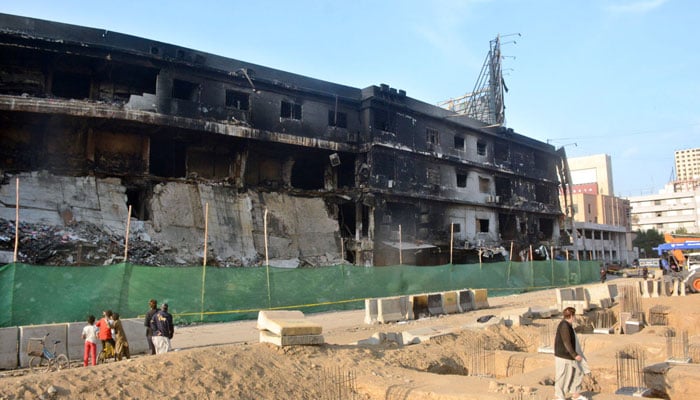
Almost a fortnight after the devastating fire at the Gul Plaza Shopping Mall, which claimed the lives of 79 people, a final inquiry report has been prepared. However, the report has not yet been officially released to the media.
Some points from the report have reached the press through sources, but these details offer little that is new. According to available information, the findings appear to be based primarily on statements and assessments, with no forensic or scientific evidence disclosed in the points that have been leaked so far.
This is not the first time that the authorities have attempted to keep an official report on the Gul Plaza incident confidential. Previously, when the FIR of the Gul Plaza fire was registered at the Nabi Bakhsh police station, it was sealed, even though it contained nothing particularly secret, confidential or sensitive. A few days later, the FIR was eventually shared with the media.
The Karachi commissioner has completed the detailed final inquiry report into the Gul Plaza fire, and is set to submit the findings to the Sindh chief minister for further action.
Interestingly, most of the information attributed to the inquiry largely repeats what has already been widely reported in the media over the past several days, including when, where and how the fire broke out, how it spread through the building, the fact that the building’s entrances were locked, and the number of people who were burnt to ashes in the blaze.
According to sources, the report reiterates that the fire originated at an artificial flower shop on the ground floor, allegedly due to the actions of children, and spread through air-conditioning ducts to other parts of the building.
It also confirms that 79 people lost their lives, with the highest number of fatalities occurring on the mezzanine floor. However, the information shared so far appears to be based largely on accounts provided by the affected shopkeepers and traders, eyewitnesses and rescue personnel, rather than on any scientific or forensic investigation.
Even the findings regarding the cause of the fire, the delay in response, and other critical aspects raise more questions than they answer, as no clear forensic or technical basis has been presented.
That said, according to the points that have reached the media, the report does appear to hold rescue agencies, particularly the fire brigade and Rescue 1122, partially responsible for reaching the site late and for failing to take certain crucial measures that were required at the time of the incident.
The final report was prepared by an inquiry committee comprising the commissioner and the city police chief. The report presents a detailed account of the cause of the fire, the sequence of events, and the response of firefighting and rescue agencies.
The report states that the fire broke out at around 10:15pm at a flower shop located on the ground floor of the Gul Plaza. The blaze was allegedly triggered by the children present at the shop.
Due to the presence of highly combustible material and structural vulnerabilities in the building, the fire spread rapidly. Flames and smoke travelled to the upper floors through air-conditioning ducts, engulfing large portions of the building within a short time.
According to the inquiry report, the fire brigade received information about the incident at 10:26pm. The first fire engine reached the site at 10:37pm. The District South deputy commissioner arrived at the Gul Plaza at 10:30pm to supervise the operation, while Rescue 1122 teams reached the scene at 10:53pm, subsequently joining the rescue and evacuation efforts.
The report outlines the firefighting and rescue operations, noting that the authorities faced multiple challenges, including dense smoke, limited access points, and the rapid spread of fire through the ventilation systems. Statements and information collected from victims’ families, eyewitnesses and rescue officials have also been included in the report.
The inquiry confirms that the Gul Plaza fire resulted in 79 deaths. Most of the victims lost their lives on the mezzanine floor, where they were trapped due to intense smoke and extreme heat. The report underscores the scale of the tragedy and the conditions that led to the unusually high number of casualties.
However, despite detailing the sequence of events, the report has raised serious questions. It does not clearly explain why Rescue 1122 took nearly 40 minutes to reach the site after the fire broke out, nor does it clarify why adequate and timely measures were not taken to save lives.
Eyewitnesses had reportedly informed the authorities that people were trapped inside the building, yet questions remain as to why the main entrance of the Gul Plaza was not forcibly opened. If the doors were locked, it is unclear why the windows were not broken to evacuate those trapped inside.
Moreover, as the fire was initially confined to one side of the building, the report does not explain why the rescue teams did not attempt to enter from the other side to save lives.
The report also fails to fix responsibility on individuals or departments whose negligence may have turned the incident into a major tragedy. It similarly does not clearly identify the shortcomings and systemic lapses that need to be addressed to prevent such disasters in future.