Fred A Canfil was a US Marshal and a close friend and associate of US president Harry Truman. In 1945, when visiting a federal reformatory, he was impressed by a sign that read: “The buck stops here”.
Canfil had a plaque made bearing the four words and sent it to Truman. The same adorned the presidential desk throughout Truman’s presidency. The phrase distilled a fundamental democratic ethic: that leadership and accountability are inseparable and that those in power must bear responsibility for events under their watch.
In Pakistan, death does not arrive primarily through war or natural disaster. It comes through fire and suffocating smoke in buildings that should never have been allowed to operate. It comes speeding in the form of dumpers and buses, unguided missiles that stalk their prey on broken roads. It comes stealthily, swallowing children and elders who fall into yawning manholes.
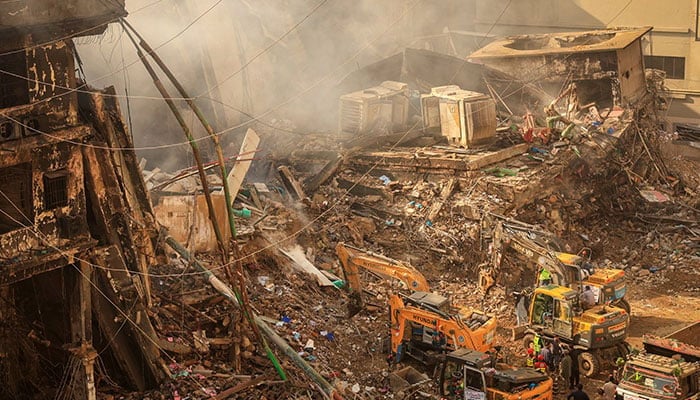
A story in this paper read that the death toll in the Gul Plaza inferno had risen to 60, with 30 bodies recovered from a single shop. It was immediately followed by a news item stating that parliament had passed the Election Amendment Bill, which restricts public access to lawmakers’ assets and liability disclosures.
As charred bodies were being recovered from the decimated Gul Plaza, lawmakers were legislating to shield themselves from financial scrutiny. Chillingly indifferent, few juxtapositions capture Pakistan’s class divide and moral bankruptcy more starkly.
The Gul Plaza fire was not an unforeseeable tragedy; it was one waiting to happen. Men, women and children were trapped in an inferno because exits were blocked and windows were caged with iron grills. Safety inspections, if conducted at all, were merely gratification-seeking rituals. Regulators colluded, confident that in this land of the pure, the buck stops nowhere.
Such disasters occur because our oversight system is designed not to prevent harm but to monetise risk. As personal interests prevail, every crushed body on Karachi’s roads, every life lost to infernos, collapsing buildings or uncovered booby traps is a certificate of state failure signed with the blood of innocent victims.
What makes this all the more reprehensible is that it unfolds persistently under a provincial government that has been in power for 17 years. Such an incumbency span is not a transition phase. It is an era that has overseen the steady erosion of regulation, enforcement and the most basic duty of the state: protecting the life and property of its citizens.
No wonder the ‘continuity of governance’ maxim, advocated with such candour these days, rings so cruelly hollow. Continuity of what? Of apathy? Of corruption? Of criminal negligence? Of a system where regulatory bodies exist primarily to extract rents rather than enforce standards? Long incumbency has not produced institutional maturity. It has bred entitlement and impunity.
Regulators do not fail occasionally; they do so structurally. Building authorities look away because anomalies are profitable. Traffic enforcement punishes helmetless motorcyclists while ignoring lethal heavy vehicles without permits driven by the untrained.
Roads are resurfaced for photo-ops while manholes remain uncovered for years. Relief efforts are hampered by stalled infrastructure projects. The Green Line project, in its ninth year, proved an impediment in relief efforts at the Gul Plaza. This is institutionalised culpability.
Each catastrophe is followed by the same nauseating choreography. Condolences, probes, committees, contrived wrath and symbolic suspensions. Regulators issue frivolous ultimatums, such as the SBCA’s recent one that gave owners three days to fix fire-safety flaws that have remained ignored for decades.
Then the curtain drops. The media moves on to yet another diplomatic coup in foreign lands or a wedding extravaganza. Disaster-prone buildings reopen, roads remain ever deadly and the manholes keep on snaring the unwary ones. There is no accountability or political cost. In the land of the pure, the buck stops nowhere.
Amidst the din of Pakistan attaining new heights, human life here is being increasingly reduced to a scrolling statistic. Loss of life and property provokes neither prosecutions nor exemplary punishment. The wails of bereaved families echo briefly before losing out into a system that has proved itself incapable of justice.
What is most damning is that solutions are neither complex nor prohibitively expensive. Enforce existing building codes. Digitise inspections and audit them. Shut down non-compliant structures regardless of ownership. Ban unsafe vehicles and enforce licensing procedures. Cover every manhole. Maintain infrastructure. These are not impossible demands; they are the bare minimum expected from any governing entity.
Yet the same remains elusive, not due to lack of capacity but because of a dearth of will. Genuine enforcement disrupts lucrative arrangements. Accountability exposes chains of complicity stretching far beyond clerks and inspectors to where we all know. The system, meticulously crafted to serve power rather than the people, works like a well-oiled machine.
The Gul Plaza fire, deaths from broken roads, gaping manholes, preventable diseases and the ravages of freak weather systems are not isolated incidents. They are manufactured tragedies and the inevitable outcome of a system that governs without accountability.
The tragic consequences are an indictment of a power elite that demands fealty and unquestioned perpetuation of its rule. The quid pro quo is death, disease and disaster.
How many more lives need to be sacrificed before criminal negligence is considered a crime? When will failure to enforce safety standards and regulations be treated as manslaughter? When will indifference and apathy be deemed culpability?
One cannot wield power and simultaneously abdicate the responsibility it demands. Until this basic imperative sinks in, Karachi will continue to burn, bleed and drown, not by accident but by design.
The writer is a freelance contributor. He can be reached at: [email protected]