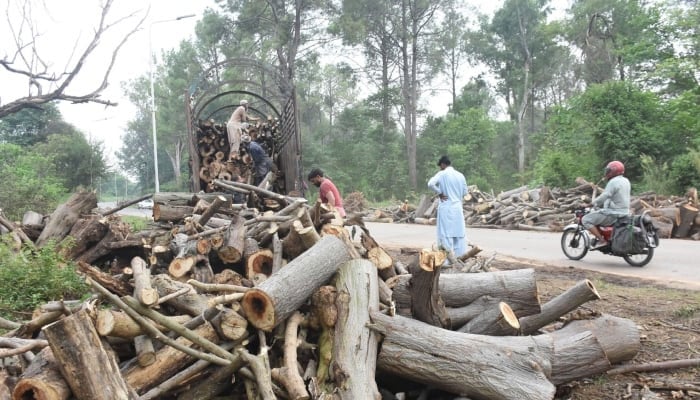
While the global political arena was peaking with tension and anxiety, the Capital Development Authority stirred a crisis of its own at home, effectively saying, “Hold my chai”.
Some 29,000 trees have reportedly been chopped across Islamabad. The government’s spin is neat and convenient: this was about pollen allergies and anyway, more trees are being planted than cut. At first glance, you might even buy it. Health matters – and nobody enjoys living through months of sneezing fits. But this is where the tidy narrative collapses. What is happening is not just about one problematic tree. Multiple species are being chopped indiscriminately, and not merely for health reasons, but to make way for car-centric development as well.
Let’s understand what went wrong here: the WWF’s ‘Report on Tree Removal, Paper Mulberry Eradication, and Land Clearing Activities in Islamabad’ makes one point very clearly: paper mulberry is a non-native, highly invasive species in Islamabad and Rawalpindi. But it also explains something the public debate keeps missing. Paper mulberry has male and female trees. The male trees produce the allergenic pollen. The female trees do not. Female trees bear fruit instead.
That difference matters. If pollen allergies are the stated reason, the logical approach is to remove targeted male paper mulberry trees, not to cut every paper mulberry tree in sight.
The report then warns what happens when the operation turns into all-out cutting and land clearing. It disturbs soil, damages the understory vegetation, displaces urban wildlife and increases the risk of accidentally removing native species and natural regeneration.
Now, back to the earlier point: this exercise was never purely about health. It brings to mind Ghalib’s blunt honesty: “Tere waade par jiye hum, to yeh jaan jhoot jaana; ke khushi se mar na jaate agar aitibaar hota.”
The WWF’s report also flags tree removal and land clearing at the Margalla Enclave site.
The CDA is constructing a 12-lane road, roughly four kilometres long, allegedly to serve a housing development. That scale is not a minor public health intervention. It is a major piece of car-centric infrastructure, the kind that typically comes with widening corridors, heavier construction and land clearing that does not stop neatly at one invasive species.
So, the question becomes unavoidable: what exactly does a city of 2.5 million need with a 12-lane road for a single housing scheme? What volume of traffic is being projected? Are we expecting dinosaurs to commute on it?
The same WWF report notes that over just two to three months, around 1-1.5 kilometres of this corridor, with an average width of about 100 metres, had already been cleared. This corresponds to an estimated loss of 10-15 hectares of vegetation.
More importantly, the trees removed were not limited to paper mulberry. The report lists multiple species, including paper mulberry, shisham, kachnar and simal. Several of these are native or well-adapted to local conditions and provide food and shelter for birds and urban wildlife. The WWF’s observations are explicit on this point: the clearing at this site appears to be driven by road construction rather than targeted eradication of paper mulberry.
Now that the facts are on the table, the real question is one of development, and more importantly, whose idea of development is being imposed on Islamabad. What we are witnessing is not growth without cost, but growth that externalises its costs onto the environment and, ultimately, onto the people who live here.
When urban flooding worsens, when air quality deteriorates and when green spaces disappear, responsibility does not lie in the abstract climate debate. It lies with the institutions that plan, approve and execute these choices. Environmental degradation in Islamabad is not an inevitability of modern life; it is the result of deliberate planning decisions made in the name of development.
Perhaps dinosaurs will not use that 12-lane road, but our children will grow up paying for it through higher temperatures, worse air quality and a city designed for vehicles rather than for human and ecological wellbeing.
The writer is an advocate for youth empowerment, climate action and strengthening local governance.