For nearly eight decades after World War II, the international system revolved around American leadership. Anchored by institutions such as the UN, Nato, the Bretton Woods financial architecture and a dense web of alliances across Europe, Asia and the developing world, this order was never altruistic.
The system functioned because it imposed hierarchy, predictability and a manageable balance of power. First bipolar, then briefly unipolar, the system constrained systemic risk while securing US strategic primacy. That order is now visibly unravelling.
Across Latin America, the Arctic, the Middle East, Africa and even Nato’s traditional heartlands, geopolitical gravity is shifting. China and Russia are no longer merely expanding influence within existing rules; they are actively revising the rules themselves. Meanwhile, Washington, viewing this shift as an existential challenge, has increasingly turned to coercive tools. Rather than stabilising American leadership, this response risks accelerating its relative decline.
During the cold war, the global system was defined by bipolarity. The rivalry between the US and the Soviet Union was intense, yet structured. Clearly defined spheres of influence, ideological parity and the logic of mutually assured destruction restrained escalation. Proxy wars occurred, but the system itself remained intact.
The collapse of the Soviet Union abruptly dismantled this equilibrium. What followed was not a stable peace, but an unprecedented unipolar moment dominated by the US. Many in Washington interpreted victory as historical finality.
This belief encouraged strategic complacency and institutional overreach. Nato expanded far beyond its original defensive mandate. Military interventions were justified under the banners of humanitarianism, counterterrorism and democracy promotion. Sanctions and conditional lending transformed economic institutions into instruments of coercion. Rather than adapting to a plural world, the unipolar system sought to freeze history in its own image. Unipolarity, however, proved inherently unstable.
China’s rise marked the decisive transition from unipolarity to multipolarity. Unlike previous challengers, Beijing did not seek power primarily through military confrontation. Instead, it pursued systemic competition. Through trade agreements, infrastructure finance and long-term investment, China embedded itself across the Global South. The Belt and Road Initiative reshaped global connectivity. Parallel institutions such as the Asian Infrastructure Investment Bank and the New Development Bank weakened the leverage of the IMF and World Bank. De-dollarisation efforts and alternative payment systems began to erode the dollar’s dominance. China’s approach was especially effective in regions long neglected by Washington.
Nowhere is this shift clearer than in Latin America. For over two centuries, the US regarded the Western Hemisphere as its exclusive sphere of influence, a worldview formalised in the 1823 Monroe Doctrine. That assumption no longer holds. Since former Chinese president Jiang Zemin’s landmark tour of Latin America in 2001, Beijing has pursued a comprehensive regional strategy combining trade, infrastructure investment, state-backed financing, cultural diplomacy and military cooperation. President Xi Jinping has visited the region five times since 2013. By 2024, twelve countries had signed free trade agreements with China, 22 nations had joined the BRI, China’s trade with South America exceeded $450 billion, with projections reaching $700 billion by 2035, and China became South America’s top trading partner and the second-largest for Latin America overall.
Chinese state banks have loaned more than $120 billion to Latin American and Caribbean governments over two decades, with Venezuela alone receiving nearly $60 billion. Beijing has also expanded arms sales, military exchanges and security cooperation, embedding itself deeply into regional institutions. Diplomatic consequences have followed. Latin American governments are no longer choosing sides; they are hedging. China offers markets, capital and infrastructure with fewer political conditions, an appealing alternative to Washington’s prescriptions.
The US response has been increasingly muscular. Sanctions, tariffs, immigration crackdowns and public threats have replaced long-term economic engagement. Venezuela has become a focal point, with US pressure countered by Russian support and Chinese financing. Immigration enforcement, drug trafficking and the resurgence of leftist governments have further strained relations.
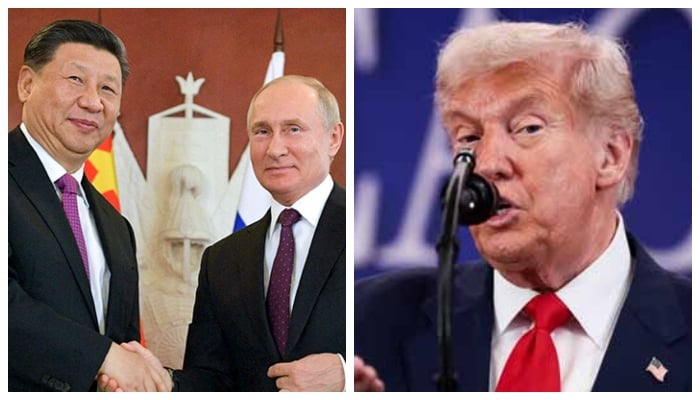
President Trump’s second term has amplified these tensions. While Washington frames its actions as necessary to protect national security, many in the region see them as confirmation that the US metes out punishment while China offers partnership. The central question remains unanswered: what does Washington offer Latin America that can compete with China’s economic gravity?
Russia’s resurgence follows a more traditional path. In Eastern Europe, Nato expansion was perceived in Moscow as a direct challenge to its strategic buffer zone. In realist terms, great powers do not tolerate rival military alliances on their borders. Russia’s invasion of Ukraine, while indefensible under international law, was driven by this logic of spheres of influence. Beyond Europe, Russia has reasserted itself in Africa and the Middle East as an arms supplier, political broker and military actor. Its alignment with China is strategic, a shared rejection of Western dominance.
Together, China and Russia form the backbone of a broader Global South coalition increasingly sceptical of Western norms and institutions. And the Western system is eroding from within. The US faces political polarisation, industrial decline, rising debt and diminishing public support for global military commitments. Europe remains strategically dependent on Washington while struggling with economic stagnation and internal divisions.
Sanctions, once a powerful tool, are now accelerating the creation of alternative financial systems, reducing their long-term effectiveness. Institutions once presented as neutral are widely seen as instruments of Western power, applied selectively and inconsistently.
Nato itself faces an identity crisis. Threats against allied sovereignty, scepticism towards collective defence and calls for unilateral control over strategic territories have shaken alliance cohesion and prompted European discussions of strategic autonomy.
What is emerging is not a reformed global order, but a fragmented one. The world has moved from bipolar stability to unipolar dominance to multipolar competition and is now entering a phase of open systemic fragmentation. Ukraine, Gaza, Sudan, the Red Sea, Taiwan and Latin America are symptoms of a system that no longer commands universal consent. As great powers consolidate their spheres of influence, coercion is replacing consensus. Weak states, especially those rich in energy, rare earths and strategic minerals, are becoming the primary victims of this transition.
The post–World War II order was designed to manage rivalry. Today, rivalry is dismantling the order itself. Calling Canada the 51st state of the US, indicating the use of force to capture Greenland, imposing tariffs, not distinguishing between friend and foe and treating everyone with the same stick, withdrawing from 66 international organisations, constantly criticising Nato allies and pressuring them to increase their defence budgets – these acts by President Trump have severely damaged the US’s role in global leadership and the trust of its allies.
On the other hand, they have provided opportunities for China to make more inroads into the global market. The criticism by President Trump and his advisers of the current global system may be right, but the way they are trying to fix it is totally wrong. Just as Gorbachev’s criticism of the Soviet system was correct, as mentioned in the perestroika and glasnost doctrines, he had no clear idea of how to fix it.
The writer is a journalist. He can be reached at: [email protected]