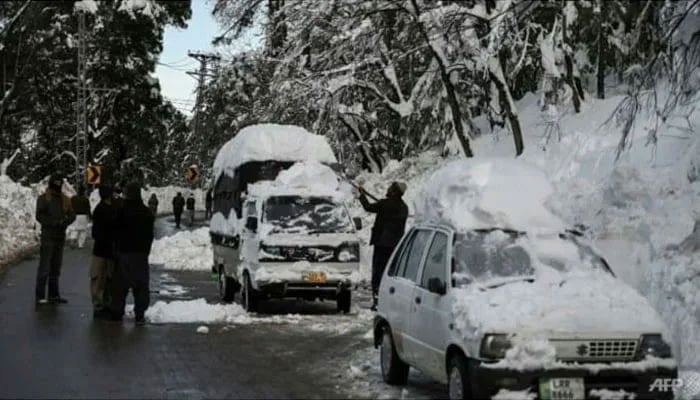
ISLAMABAD: After a long time, Murree witnessed an extraordinary spell of snowfall two days ago -- one of the heaviest in recent years. Being a resident of Islamabad with deep roots in Murree, I decided to travel early in the morning to my hometown, just hours after the night-long snowfall.
While the administration had imposed strict restrictions at the 17-Mile Toll Plaza, preventing vehicles from moving further, a decision primarily taken for public safety, it created concerns for the locals.
Residents of Murree, whose families, homes and livelihoods are in the area, found themselves treated the same way as tourists. The locals, unlike visitors, cannot simply be turned back. Their lives are tied to the region. While safety considerations are understandable, future policies must distinguish between tourists and residents.
Despite these restrictions, I managed to reach Murree early morning via Lower Topa and Jhika Gali. What immediately stood out was that the roads had already been cleared. Whether during the night or early morning, snow-clearing operations had been carried out efficiently. The main routes were completely open, and at no point did I face any difficulty while travelling.
This was a welcome change from past experiences when even moderate snowfall would paralyse the entire town. Although, at certain internal points vehicles were temporarily stopped by local officials possibly to avoid congestion, such blockages appeared unnecessary, especially when entry into Murree itself was already strictly controlled from outside.
Throughout the day, intermittent snowfall continued. When I began my return journey to Islamabad later in the evening, the main artery and expressway remained largely clear. Traffic congestion did occur due to one-way movement of vehicles allowed to enter Murree, but blockages were managed and gradually cleared.
However, while returning from Bhurban-Kashmir Bazar route, conditions were different. At Gharial -- a steep uphill section -- snowfall had not yet been cleared. Around 15 to 20 vehicles were stranded, unable to climb the slope. What I witnessed there left a deep impression. Before any snow-clearing machinery arrived, Pakistan Army personnel -- soldiers in uniform, along with officers -- stepped in. I personally saw a Major and a Lieutenant among them. Without asking anyone their identity, background or political affiliation, they began pushing vehicles one by one.
Passengers, including men, remained seated inside their cars. The soldiers themselves pushed until vehicles crossed the difficult patch. Heavier vehicles that could not be moved manually were towed using military vehicles.
After my vehicle crossed the stranded stretch, a soldier approached and offered tea and a brief rest. It was not a gesture meant specifically for me; the same offer was being extended to other motorists as well. There were no questions. No discrimination.
No delay.
At a time when political differences often lead to sweeping judgments about institutions, this scene was a reminder that beyond politics, this is the same
army that serves ordinary citizens in moments of difficulty, quietly and without cameras.
Overall, the role of the civil administration in managing snowfall, ensuring road clearance and preventing loss of life was noticeably better than in the past. From a tourist-management perspective, the arrangements were largely effective. However, another serious issue emerged soon after.
Large parts of Murree’s residential and rural areas remained without electricity. The locals, particularly in villages, faced prolonged outages while temperatures continued to fall. I raised this issue on social media and drew the attention of the prime minister and chief minister of Punjab.
Following this, I received a call from the Prime Minister’s Office, and Punjab Chief Minister Maryam Nawaz personally responded on X, directing Iesco to restore electricity in the affected areas on an urgent basis.
In previous years, a recurring complaint from Murree residents has been that administrative priority during snowfall remains focused almost entirely on tourists, while local communities especially those living in villages, are overlooked. This time, the response was comparatively better.
Yet a clear lesson remains. If main roads and tourist routes can be reopened on a priority basis, the same urgency must apply to village roads, electricity supply and basic services for the locals. Development and relief cannot be selective.
Snowfall may attract tourists, but Murree is not merely a resort, it is home to thousands of families who deserve equal attention, dignity and planning.
The recent snowfall demonstrated improved coordination, dedication on the ground, and commendable service by both civil administration and the armed forces. What is now needed is a consistent policy that treats locals not as an afterthought, but as the first priority.