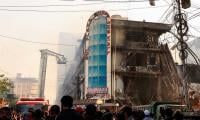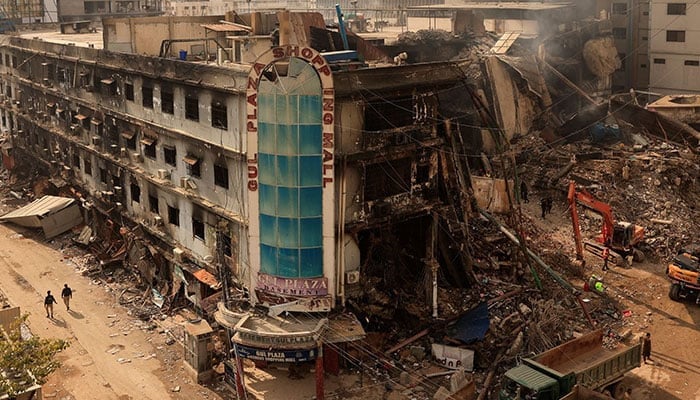
As I watched the news of the Gul Plaza fire unfold, a familiar ache returned. Scores dead. More missing. Families waiting outside a smouldering building, calling phones that will never ring again.
The blaze burned for 36 hours while 1.4 million gallons of water were poured onto a structure that had no business housing 1,200 shops in the first place. This is not just a tragedy. This is Karachi’s recurring nightmare; one we have chosen to live with.
I was born in Steel Town, the township of Pakistan Steel Mills. In the 1980s and 1990s, Steel Town was what we called ‘mini Islamabad’ – a planned community with greenery lining every street, sports grounds where children played cricket until sunset, its own water and electricity produced by the mills. Families from across Pakistan lived together, maintaining their neighbourhood with the pride of ownership.
When I visit Steel Town now, I see a disaster zone. The mills shut down, and with them died the community spirit that kept the town alive. No one owns Steel Town anymore, and it shows in every broken footpath and dried-up lawn.
Karachi is becoming Steel Town on a massive scale. This city of 20 million was once the City of Lights, where dreams materialised, where migrants from every corner of Pakistan built generational wealth. It was our American Dream. Today, it is a city that its own people have forgotten to own. We throw kachra in our streets and blame the municipality. We spit paan on our walls and curse the government. We build without permits, block fire exits, store flammable goods in basements, and then weep when flames consume what our negligence has created.
The problem with Karachi is not that the government does nothing. The problem is that we, the people, have abandoned our city. From China-cutting to encroachments, from political vendettas to everyday hooliganism, Karachiites have turned against their own metropolis. We have destroyed the social fabric that once made this city governable. And now we demand that a mayor fix in five years what we have broken over five decades.
Mayor Murtaza Wahab is a Karachiite who feels for this city as any of us do. His party governs both the city and the province. Yet things are not moving towards a better, more sustainable Karachi. Why? Because no government, no matter how well-intentioned, can save a city that its citizens refuse to protect. Participatory governance requires participation. It requires us to own our city before we can demand others fix it.
Here is what owning Karachi could look like. The government, starting with the mayor and the Sindh government, must create a Karachi portal that actually works – accessible, comprehensive, transparent. A portal that lists every building declared dangerous to occupy. Every fire safety violation. Every complaint about public safety. Every encroachment removed and each one still standing. Strategic communication that invites citizens to be partners, not just complainants.
But transparency is only half the equation. Karachi hosts Pakistan’s top business community, its greatest celebrities from drama to film to news media, its finest sports talent. These are not just residents; they are stakeholders with platforms and influence. When Tabish Hashmi hosted Mayor Wahab on ‘Hasna Mana Hai’, he offered his full support and time for Karachi – whenever and wherever required. There are others who want to bring this city back to its glory. They are ready to contribute voluntarily. What is missing is a platform that channels their energy into action.
After Gul Plaza, we will do what we always do. The chief minister will announce compensation. An inquiry committee will be formed. Reports will be written. And then we will wait for the next fire, the next building collapse, the next preventable tragedy. The Sindh Forensic DNA Laboratory will become familiar with more grieving families. More children will lose parents. More parents will lose children.
Or we could choose differently. We could decide that Karachi belongs to us and that we belong to Karachi. We could stop waiting for someone else to save our city and start saving it ourselves. The government must lead, yes – with portals, with enforcement, with transparency. But leadership without followership is just noise. Civil society, the media, citizens, political actors, the state itself: all of us must own this city together.
Steel Town taught me what happens when a community stops caring. When ownership dies, so does everything we have built. Karachi is too massive, too important, too loved to suffer the same fate. But love is not enough. We need action. We need accountability. We need to stop being the people who ignore our city and start being the people who fight for it.
The City of Lights can shine again. But only if we stop waiting for someone to flip the switch and start doing it ourselves.
The writer is the CEO of Campaignistan and founder of the Islamabad Science Festival. He tweets/posts @farhadjarralpk and can be reached at: [email protected]