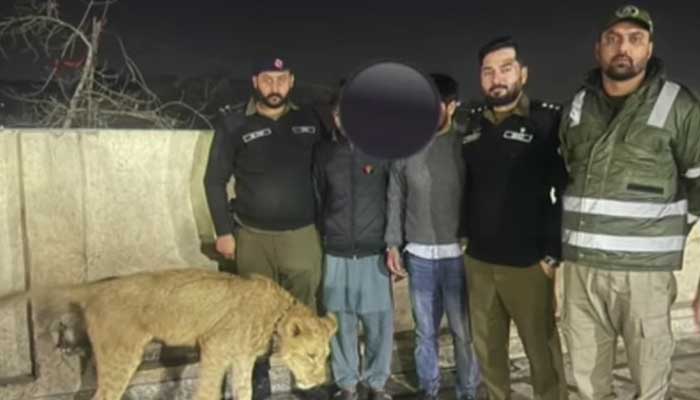
The latest incident of a lion attack in Lahore once again highlights the consequences of lax enforcement and the brazen entitlement of a few. That a wild animal was kept as a pet is itself a mockery of the law. According to reports, an eight-year-old girl was injured after a pet lioness attacked her in Lahore’s Bhekewal Pind area, leading to the arrest of the owners. The authorities have also recovered the lion. Apparently, the owners did not have a licence either. But the incident should not end here. Many content creators on social networking and video-sharing platforms use pet lions as props. All this happens right under the watchful eyes of the authorities, yet no action is taken to rescue the animals from this monstrosity. It is worth mentioning that several years ago, a tiger was paraded across Punjab in a political rally. When political leaders themselves show such leniency, there is little left to expect from ordinary people.
Keeping exotic wildlife, especially a fierce predator like a lion, is a direct threat to public safety and a gross act of cruelty towards animals forced into unnatural captivity. The law in this regard is flawed. There should be no licences for wildlife ownership. Across the world, we have seen examples where people have rescued lion cubs and later released them back into the wild after proper care and training. For a beast like a lion, the jungle is the only suitable place. Why don’t our authorities run awareness campaigns explaining exactly why keeping a lion as a pet is a bad idea? For the sake of someone’s vanity, we are now left with an eight-year-old girl who bears not only physical wounds but also emotional scars. No apology or legal proceeding can undo that harm.
Every few months, we come across incidents where irresponsible ownership leads to horrific accidents. Last year, a pet lion escaped and injured three people in Lahore, prompting a large-scale crackdown by the Punjab Wildlife Department that led to the recovery of 13 lions. The current incident raises an uncomfortable question: how many such animals are still hidden behind high walls? Such offences are, unfortunately, quite common here. True to their nature, the authorities are more interested in reacting to crises than preventing them. After the last incident, there should ideally have been no unlicensed wild animals inside any home. The fact that there were shows a failure of enforcement. Action must be taken against owners, traders, and veterinarians if they are found keeping, selling, or facilitating the possession of wild animals. It is time for the authorities to state loudly and clearly that wild animals are not for our amusement or for elevating our social status. They do not belong in small homes or farmhouses.