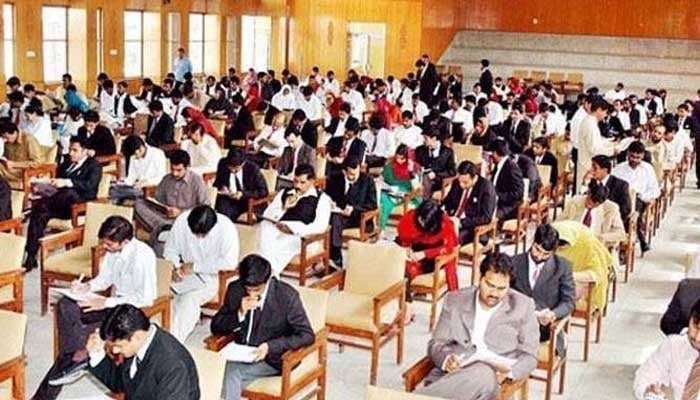
ISLAMABAD: A review of academic qualifications of civil servants inducted through the Central Superior Services (CSS) examination between 2021 and 2024 has revealed a persistent mismatch between officers’ educational backgrounds and professional requirements of the service groups they are assigned to.
The data — compiled from bureaucrats qualification records — covers officers inducted into the Inland Revenue Service (IRS), Pakistan Audit & Accounts Service (PAAS) and Information Group, and highlights structural weaknesses in Pakistan’s generalist recruitment model.
According to the data, which was discussed and reviewed by the Civil Service Reforms Committee, the vast majority of officers posted to these technically specialised groups do not possess academic qualifications directly relevant to the core functions of their respective services.
The Inland Revenue Service, responsible for tax collection, enforcement and interpretation of complex fiscal laws, shows a pronounced qualification gap. The data for CSS batches 2021 to 2024 indicates that most officers inducted into the IRS come from general academic disciplines, including political science, international relations, history, sociology and general sciences, rather than finance, accounting, taxation or economics.
Experts note that IRS officers now deal with issues such as digital audits, international taxation, transfer pricing and forensic documentation -- areas that typically require formal academic training.
“The problem is not competence of individuals,” said a committee source, adding, “It is systemic. You cannot expect optimal outcomes when officers have never studied the subject they are administering.”
A similar pattern emerges in the Pakistan Audit & Accounts Service, which is constitutionally mandated to audit public expenditure and maintain government accounts. The qualification table shows that officers inducted during 2021-2024 largely do not hold degrees in accounting, auditing, commerce or finance — disciplines central to the service’s professional mandate.
Governance specialists warn that this mismatch weakens institutional capacity, particularly at a time when public sector auditing requires familiarity with international accounting standards, performance auditing and digital financial systems.
The data also highlights notable inconsistencies in the Information Group, responsible for government communication, media management, public messaging and digital outreach.
According to the records, hardly any of officer inducted into the Information Group during these years possesses qualifications in journalism, mass communication, media studies or related fields. Instead, many officers come from unrelated academic backgrounds.
At a time when governments operate in a 24-hour news cycle and information warfare has become a strategic concern, experts argue that communication roles can no longer be treated as generalist assignments.
The data shows that instead of their relevant qualifications, the officers in these specialised groups have masters or graduation degrees in disciplines like Pharmacy, History, English, Anthropology, Micro Biology, Bio Technology, Petroleum and Gas, Agriculture, Plant Bio, Zoology, Engineering degrees, MBBS, Chemistry, Automotive, etc. It is argued that the issue reflected in the data is structural rather than personal.
The CSS examination continues to function as a uniform competitive gateway, with service allocation based largely on merit ranking and preference rather than subject relevance.
While post-induction training attempts to bridge the gap, experts argue that short-term training cannot replace years of formal academic grounding, particularly in highly technical domains. The findings have revived debate over long-pending civil service reforms, particularly proposals recommending service-specific academic eligibility criteria, specialised recruitment streams for technical groups and greater alignment between education and functional responsibility.