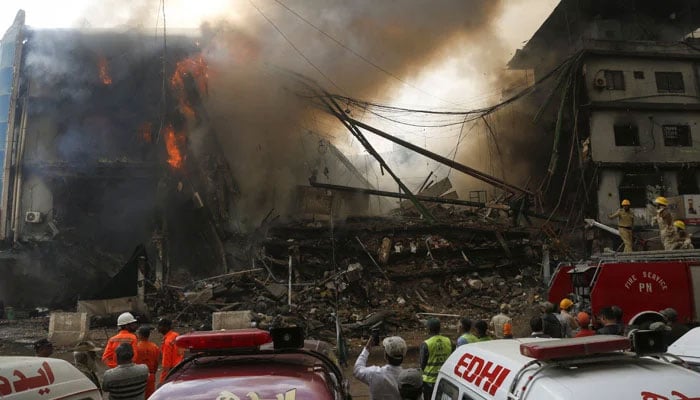
The fire that tore through Karachi’s Gul Plaza over the weekend cannot and should not be seen as yet another accident to be added to the city’s long list of urban calamities. This national tragedy is a collective failure and an indictment of a system that has learned nothing from its own bloodstained past. At least 26 people are confirmed dead, many more remain missing, several bodies are unidentifiable and entire families are still searching for loved ones who went shopping and never returned. Shops built over decades have been reduced to ash in hours and what remains standing is a grim monument to neglect. The fire burned for more than 24 hours. Water ran out within the first few hours. Narrow roads, blocked by construction and crowds, prevented bowsers from reaching the site. Rescue teams arrived late, worked without adequate ventilation and faced a building with almost no functional emergency exits. A fire station sits minutes away, yet the blaze raged unchecked through the night. The mayor arrived nearly a day later. By then, the mall was a furnace and a tomb.
Officials now speak of compensation, committees and forensic reports. These gestures, however necessary, cannot obscure the central truth: this was not an unavoidable disaster. Gul Plaza housed more than 1,200 shops in a structure that, by admission, had only partial approval, illegal extensions and no proper emergency exits. Only two of 16 gates were open. The basement, where people were shopping, had a single exit. Ventilation was so poor that thick smoke trapped those inside within minutes. Fire safety systems, if they existed, failed completely. This was a death trap masquerading as a marketplace. Nor does responsibility end with building owners and traders. The government’s role is central and damning. How did a building of this scale operate for years without basic fire safety compliance? How were illegal floors added, basements commercialised and exits sealed without the knowledge or complicity of regulators? Why does Karachi, a city of over 20 million, still lack a modern firefighting force, reliable water supply, traffic management for emergencies and enforceable building codes?
The thing is: we have been here before. The echoes of Baldia Town are impossible to ignore. In 2012, nearly 260 workers died behind locked doors in a factory that had passed inspections and lacked functional exits. Editorials were written, inquiries promised, commissions formed. Yet more than a decade later, people are once again trapped behind smoke-filled corridors in an illegal building, waiting for a rescue that comes too late. What makes this tragedy even more unbearable is its ordinariness. This was not an industrial complex hidden in an alley. It was a busy shopping centre in the heart of the city, on one of Karachi’s main arteries, visited daily by families, workers and traders. If such a place can become a mass grave overnight, then no mall, market or office in this city is safe. The government must be held to account not only for the slow and chaotic response but for the system that makes these catastrophes inevitable. There must be criminal proceedings against those who built, approved and operated this building in violation of the law. There must be a citywide audit of commercial structures, with immediate closures of unsafe buildings. Fire and rescue services must be modernised. Emergency exits, alarms and ventilation cannot remain optional. Above all, we must stop treating such disasters as acts of fate. If this tragedy fades into the familiar cycle of mourning, promises and forgetting, then the next fire is already waiting.