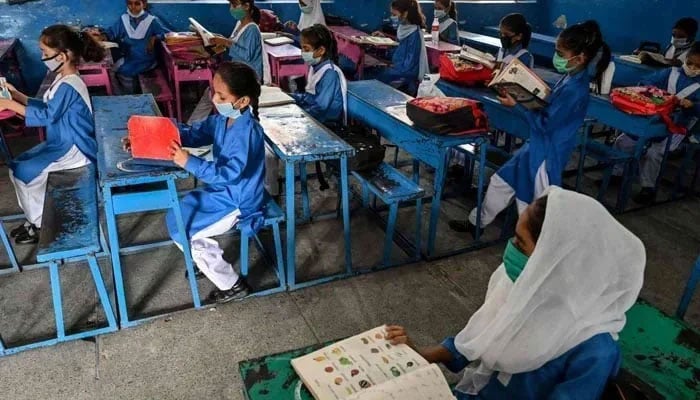
ISLAMABAD: Literacy in Pakistan is overwhelmingly dictated by household income, with gender and geography further widening the educational divide, a new analysis released by Gallup Pakistan on January 14 reveals.
The study, based on the Household Integrated Economic Survey (HIES) from September 2024 to June 2025, shows that moving from the poorest to the richest income quintile results in a nearly 38 percentage point increase in literacy.
This trend remains consistent across all demographics, including men, women, and both urban and rural populations.
According to the data, literacy levels for the poorest quintile remain low across all groups, with urban males at 56 percent, rural males at 49 percent, urban females at 42 percent, and rural females at only 28 percent.
In contrast, literacy rates for the richest quintile show a sharp increase, reaching 93 percent for urban males and 84 percent for rural males.
While women in the richest quintile also see gains- 83 percent for urban and 65 percent for rural- the data highlights that income often outweighs other factors.
Notably, a poor urban female remains worse off than a rich rural male, indicating that geography cannot compensate for the impacts of poverty.
The report emphasises that rural women face a double disadvantage, recording the lowest literacy levels at every single income tier.
However, researchers pointed to a steep income gradient for rural females- whose literacy jumps from 28 percent in the poorest group to 65 percent in the wealthiest- as evidence that policy interventions and systems can substantially move the needle on educational outcomes.
This analysis was conducted by Gallup & Gilani Pakistan, the Pakistani affiliate of Gallup International, and draws on data for the population aged 10 years and above.
The Gilani Research Foundation, which supported the work, is headed by Dr Ijaz Shafi Gilani, who pioneered the field of opinion polling in Pakistan in 1980.