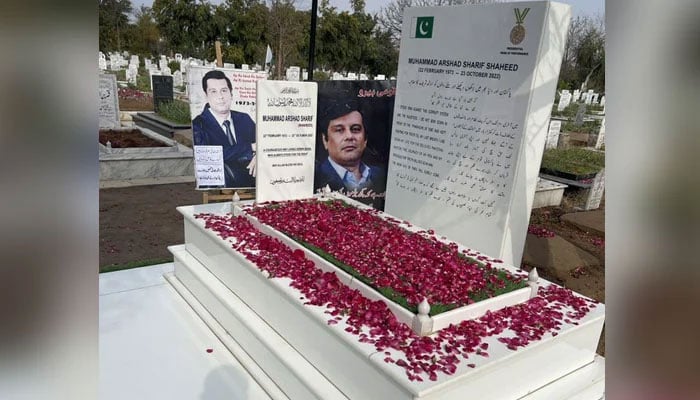
ISLAMABAD: The Federal Constitutional Court (FCC) on Wednesday directed the parties to submit within five days, written submission in murder case of journalist Arshad Sharif and adjourned further hearing.
A two-member bench headed by Justice Aamir Farooq heard a suo motu case regarding independent and transparent investigations into the tragic murder of senior journalist Arshad Sharif.
During the hearing, Justice Aamir Farooq remarked that after receiving the written submissions, the court will issue an appropriate order. He said the fact is that the investigation process in this case has been quite slow; however, the court does not want to place blame on anyone regarding who is responsible for the delay.
On the court’s inquiry, Additional Attorney General Aamir Rehman informed the court that initially the Kenyan government had refused to cooperate in the investigation; however, in September last year, a Mutual Legal Assistance (MLA) agreement was concluded between the governments of Pakistan and Kenya.
As soon as the Kenyan government shows readiness for further investigation, a Pakistani investigation team will be sent to the crime scene, the law officer added.
Justice Aamir Farooq asked what further progress is possible in the case after the agreement between the two countries. In response, the Additional Attorney General submitted that two accused have been nominated in the challan and black warrants have been issued for the accused present in Kenya while Interpol has also been contacted for their arrest.
He further informed the court that the prime minister himself has contacted the President of Kenya by telephone, and the government is making full efforts to complete the investigation as soon as possible.
The learned judge remarked that the murder of Imran Farooq had also taken place in England, and in that case, the police of Pakistan and the United Kingdom jointly conducted the investigation. In response, the Additional Attorney General contended that the nature of the Imran Farooq murder case and the Arshad Sharif murder case is different. Meanwhile, the court adjourned further hearing.
Separately, the FCC has adjourned for today (Thursday) hearing in cases related to the Super Tax.
A three-member bench of the Federal Constitutional Court headed by Chief Justice Aminuddin Khan and comprising Justice Syed Hassan Azhar Rizvi and Justice Arshad Hussain on Tuesday heard the appeals of Federal Board of Revenue (FBR) against the judgments of the Sindh, Lahore and Islamabad High Courts regarding levy of Super Tax through Section 4B inserted in the Income Tax Ordinance, 2001. Barrister Farogh Naseem, counsel for various companies presented detailed arguments and raised points regarding the super tax and respect for judicial decisions.
The counsel argued that the Federal Board of Revenue (FBR) has some margin to refuse to comply with the decisions of the superior judiciary; however, the court must consider both the FBR and the taxpayers.
He submitted that the FBR wants to ensure that taxpayers are left with no money, while taxpayers fear that they may ultimately become so exhausted that they leave the country altogether.
Farogh Naseem further submitted that that this court must also review the 26th and 27th constitutional amendments and decide whether the judiciary needs evolution or revolution.
He further said that FBR’s counsel is currently contradicting the arguments of her senior and may even say that she is not bound by the decisions of the Supreme Court and High Courts.
He submitted that the tax has already been imposed; some people will have reserve funds and some will not. Naseem contended that around the world, it is announced in advance before imposing a tax, but here a tax is imposed six months later, at a time when the money has already been collected.
Meanwhile, the court adjourned the hearing for today (Thursday) wherein Farogh Naseem will continue his arguments.