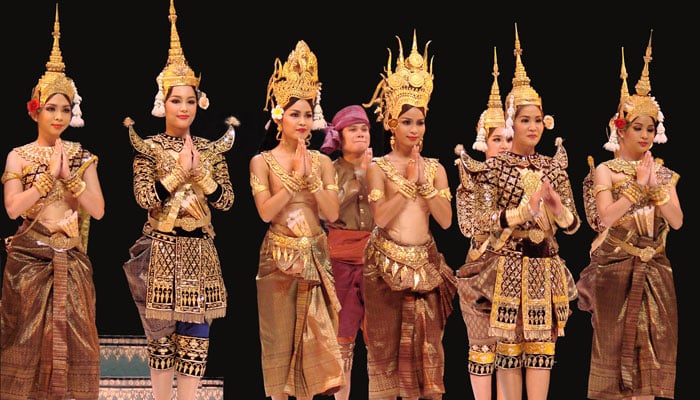
Last week I returned from a week-long vacation to Cambodia, covering four cities: the capital Phnom Penh, Kampot (famous for its salt fields, locally grown peppers and durian fruit), Kep (famous for the fresh blue crab sold at its Crab market), and Siem Reap (the country’s cultural capital and gateway to the Angkor Wat temple complex).
According to World Bank figures, Cambodia’s nominal per capita GDP in 2024 was $2,627, moderately higher than Pakistan’s $1,485. It has a population of around 18 million, just at the lower range of Karachi’s officially estimated population of 18-20 million. Its economy relies primarily on tourism, textiles and agriculture. Poverty is visible, but not as glaringly as it is here at home. To anyone from Pakistan, the roads and transportation infrastructure may seem basic, but they are sufficient for its relatively small population. Fun fact: All prices everywhere, the touristy and the non-touristy places, are listed in US dollars, and all places accept both it and local currency as a matter of routine.
Now that it has been a week since I returned and I am approaching the end of the post-vacation period, the vacation one needs after a vacation to settle back into routine, and I have had time to reflect on my experiences, I can sum them up in two lessons.
The farther you travel, the more things stay the same. Sometimes, it may seem like we are the only ones, the only country, where it is hard to stay afloat, where the deck seems perpetually stacked against us and whatever little progress we make in our lives is not because of the government but in spite of it.
During one of our long inter-city drives, Samdy, our driver and owner of eight rental cars, shared his hopes and aspirations for his daughter. Cambodia boasts a literacy rate of over 80 per cent, a primary enrollment rate of 97 per cent, which drops off to around 55 per cent by middle school, but Samdy lamented the low quality of education in under-invested public schools, which are free but have high student-teacher ratios, often 50 students to a classroom.
His wish is for his child to study to become an accountant and find a job abroad and to give her a fair shot at a better life. It was like listening to many parents in Pakistan. He and his wife work to afford the $ 1,000-per-month tuition for international education at a mid-level private school. When I remarked that it seemed quite expensive, he replied that his friend and business partner, with similar ambitions for his child, sends his child to an even better international school, staffed with foreign teachers, that charges $3,000 per month.
Critics of the government, including journalists, activists and opposition leaders, frequently use the expression “eating the country” to describe the corruption of the ruling elite, comprising family members and friends of the prime minister, who is the son of the previous prime minister. As for ordinary people, one of the books I read before the trip quotes Gen William Westmoreland, commander of US forces in Vietnam in 1974, as saying, “The Oriental doesn’t put the same high price on life as does a Westerner. Life is plentiful, life is cheap in the Orient” (Joel Brinkley, ‘Cambodia’s Curse’). The vibe of this situation should be very familiar to Pakistanis.
The second lesson I took away is captured by the quote “All revolutions devour their own children”. The problem is that it is attributed to Ernst Rohm, a member of the Nazi Party. And so, instead, I am going to go with a Cambodian proverb I learned: “Patience will get you home, rushing will leave you on the street”, meaning that it is better to do things slowly and carefully than hurriedly and end up losing everything.
A key event in Cambodia’s recent history was the genocide inflicted by the Khmer Rouge, a radical communist movement, not by outsiders but by indigenous Khmer people, that ruled the country from 1975 to 1979. The stated goal at that time was to bring about a classless society and usher in an agrarian revolution. Roughly 25 per cent of the country’s population was murdered in the purge, forced displacements, prosecution, executions and forced labour camps that followed. The Khmer Rouge targeted residents of urban centres, particularly those perceived as intellectuals – teachers, doctors, engineers and anyone who looked educated. That is how it began, but eventually, everyone and anyone ended up being at risk of being murdered.
The capital, Phnom Penh, has two key sites dedicated to the remembrance of this history. The Choeung Ek Genocide Center, also known as the Killing Fields, is a mass grave on the outskirts of the city, one of many across the country, and is the site of the remains of around 10,000 victims, including women and children. The on-site exhibit describes in graphic detail the horrors that were perpetrated there, some too distressing to be reproduced in a newspaper. The other is the Tuol Sleng Genocide Museum, originally a school which was converted into a detention centre and execution site. The exhibits at both the Genocide Centre and the Genocide Museum are chilling reminders of the violence people are capable of inflicting on their own tribe in the name of revolution.
Middle-aged and older Cambodians lived through the events and have handed down the trauma they lived through to younger generations, making it a part of the collective national psyche. Several people I spoke to expressed frustration with widespread corruption in government and disappointment with its inability to significantly improve the lives of ordinary citizens. Nevertheless, they are willing to tolerate it as long as it means continued peace that sustains economic activity (much of it now driven by Chinese investments under the Belt and Road Initiative) and allows people to work and build their lives.
People I spoke with appeared very clear on the economic dividends of long-term peace in the country. Of course, no one condones corruption in government, but people who have lived through instability know to ask what the plan is for the day after the revolution.
It made me realise that we are far too cavalier with calls for overnight revolutions in our political discourse, be they of the French, Iranian, Chinese or even Cambodian kind. Revolutions tend to be bloody and once they ‘eliminate’ their initial slate of targets, they often tend to turn on their own people. So, the next time I hear someone pining for a literal revolution, I will have to tell them to take a closer look at the history of how those usually tend to go for ordinary people. If someone is promising reform through revolution, run the other way.
The writer (she/her) has a PhD in Education.